Opening a coffee shop is one of the most pursued small business dreams — and the market behind it keeps growing. According to Grand View Research, the U.S. specialty coffee market was estimated at $47.8 billion in 2024 and is projected to grow at a compound annual growth rate of 9.5% through 2030. Consumer appetite for quality, origin-focused coffee has held steady, which creates real opportunity for independent shop owners.
Knowing how to start a coffee shop, however, and building one that lasts are two different challenges. In most neighborhoods today, you're not introducing people to the idea of a local café — you're asking them to choose yours over two or three they already visit. The shops that last tend to have a clear concept, tight operations, and a genuine understanding of the community they serve.
This guide covers nine essential steps, from your first round of market research to grand opening day and the months that follow. Whether you're weighing your first lease or planning your concept, you'll find honest, practical guidance on what it takes to open a coffee shop that runs well and grows over time.
Here's what we'll cover:
- Conduct market research and find your niche
- Develop your concept, brand, and design
- Create a comprehensive business plan
- Calculate startup costs and secure funding
- Find the right location
- Obtain licenses, permits, and insurance
- Source equipment, technology, and suppliers
- Hire and train your coffee shop team
- Launch with marketing and a thoughtful grand opening
Step 1: Conduct Market Research and Find Your Niche
If you're serious about how to start a coffee shop, start with solid market research — it’s the foundation for every decision that follows. Understand your customer, your competition, and your differentiation before you spend a dollar on build-out. This dramatically improves your odds of success from day one.
Understand Your Target Market
Who are you opening for?
- Professionals who need a fast, reliable morning coffee before a commute?
- Students and remote workers who linger for hours with a laptop?
- Neighborhood regulars who want a familiar, comfortable place to land on weekends?
You’ll probably serve more than one type of customer, but anchoring around a primary audience helps determine hours, seating, and price point.
Think through your customers' behaviors across different parts of the day. Morning rushes reward speed and consistency. Afternoons tend to bring the laptop crowd looking for a place to settle in. This knowledge helps you staff and stock accordingly.
Here are two approaches to gathering this information.
- Run short surveys or informal interviews. Use neighborhood Facebook groups, local subreddits, or in-person conversations.
- Spend time observing foot traffic near your potential location. Study different times of day and different days of the week.
Income levels and price sensitivity play a big role in this stage too. A $7 oat milk latte lands differently in a high-income urban neighborhood than in a working-class suburb. Your research should help you calibrate what your target customer will spend regularly, not just occasionally.
Analyze Your Local Competition
Once you understand your customer, run a quiet "CIA-style" competitor analysis by visiting every coffee shop nearby at different times of day. Order drinks, notice the pace of service, and observe who's in the room. While you're there, take note of:
- Menu offerings, pricing, and how staff treat customers, especially regulars
- Ambiance, seating, noise level, and WiFi quality
- How busy each shop is during the morning rush versus midday versus afternoons
Take your research online. Read Google and Yelp reviews for every competitor you visit. Negative reviews are especially useful — they reveal exactly where existing shops are falling short and where a gap exists for someone willing to do it better.
Find the unmet needs. Maybe the neighborhood has no quality espresso option near a transit hub. Maybe every existing shop closes by 4 p.m. Those gaps are where your concept can take root.
Identify Your Unique Selling Proposition
Your unique selling proposition (USP) is what gives someone a clear reason to choose your shop over the one they already visit.
Some strong USP foundations for coffee shops:
- A direct relationship with a specific coffee roaster, or roasting your own beans on-site
- A design and atmosphere that fills a visible gap in the neighborhood
- A commitment to sustainability or ethical sourcing that resonates with your audience
- A menu built around a genuine flavor identity, not just standard café fare with seasonal add-ons
Common formats worth considering include the third-wave specialty café, grab-and-go commuter stand, drive-thru kiosk, and coffee and co-working hybrid. Each has different space requirements, staffing needs, and revenue potential, so choose the format that fits both your market gap and your operational strengths.
Test concepts before fully committing. A pop-up at a local market, a small catering run for a community event, or a few rounds of candid feedback from people in your target demographic can tell you a great deal about what resonates with the public.
Step 2: Develop Your Concept, Brand, and Design
Defining your concept, brand, and design early gives every decision that follows a clear frame of reference — from the equipment you buy to the way your staff greets someone at the counter. Defining this before you sign a lease reduces costly pivots and gives your team a clear foundation.
Choose Your Coffee Shop Style and Brand
Start by choosing your format, because it sets the parameters for almost everything else. The most common models for independent coffee shops are:
- Traditional sit-down coffeehouse — anchored around atmosphere and dwell time
- Grab-and-go / commuter-focused — built for speed, with a streamlined menu and minimal seating
- Specialty / third-wave concept — centered on sourcing, craft, and coffee education, often with a premium price point
- Hybrid concept — coffee paired with co-working, a bakery, a wine program, or another complementary offering that extends revenue across dayparts
- Drive-thru or mobile cart — lower overhead and high throughput, heavily dependent on location and traffic patterns
Next, define your brand personality. Upscale or approachable? Modern and minimal or warm and lived-in? A neighborhood anchor has a different energy than a destination shop, and your branding should reflect that distinction clearly. The right answer depends on your market.
Now on to visual identity flows. Your logo, color palette, and typography show up on signage, cups, menu boards, and social media. Customers form an impression within seconds of walking in or landing on your Instagram page, so consistency across every touchpoint carries real weight.
Finally, your brand values. If sustainability is central to your identity, that commitment should show up in your sourcing, your packaging, your waste practices, and your partnerships with local makers. Customers notice when values only live on a sign instead of showing up in daily operations.
Design Your Layout and Atmosphere
A well-designed coffee shop layout serves two goals:
- A smooth customer experience
- An efficient operational flow behind the counter
A functional layout typically allocates roughly 40–50% of floor space to seating and 30–40% to service and prep. The remaining 10–20% covers storage, office space, and bathrooms. Most independent coffee shops fall somewhere between 600 and 2,000 square feet depending on concept and market, so space planning is essential.
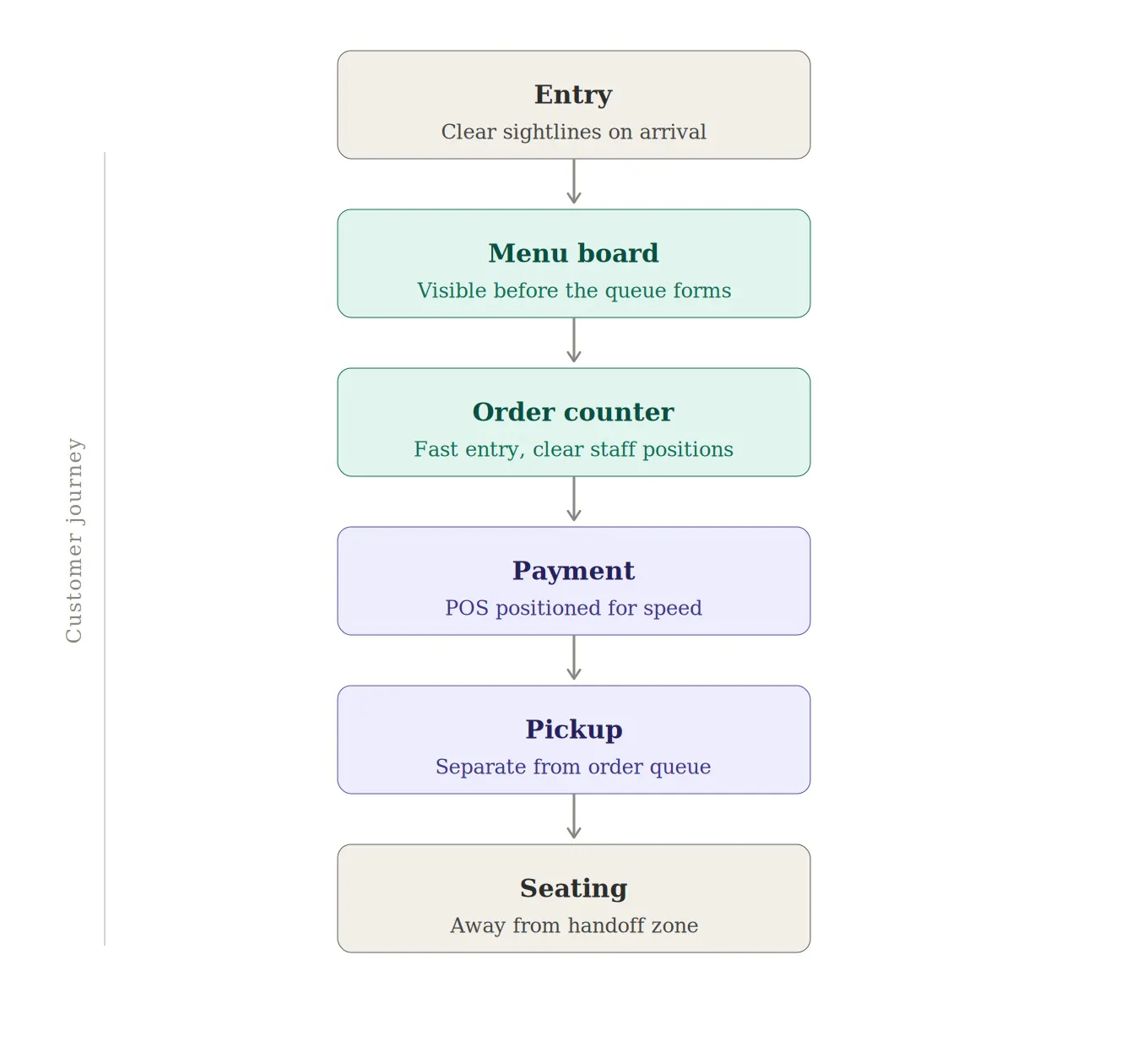
Behind the counter, think in terms of a working triangle between espresso machine, grinder, and POS. At the same time, design customer flow so entry, menu board, order counter, payment, pickup, and seating follow a logical sequence that keeps the line moving and prevents congestion near the handoff area.
Brand personality comes to life through your cafe’s atmosphere. Lighting should be brighter and more functional near the counter, warmer and softer in the seating area.
The seating mix should reflect your customer profile: two-tops and four-tops for flexibility, a communal table if your concept supports lingering, bar stools along a window if space allows. Materials and finishes should reinforce your brand story.
Technology is part of the atmosphere too. Reliable WiFi and sufficient outlets are non-negotiable if your concept welcomes remote workers. Your POS system should be positioned for fast, natural order flow — placing it away from the natural service path creates friction during busy periods. Digital menu boards give you flexibility to update pricing and seasonal offerings without reprinting, and they make a strong first impression on new customers.
Finally, build accessibility in from the start rather than retrofitting it later. ADA-compliant entrances, counters at accessible heights, and compliant restrooms are legal requirements in most jurisdictions.
Step 3: Create a Comprehensive Business Plan
A business plan helps you think through your coffee shop on paper before you build it in the real world — and for anyone figuring out how to start a coffee shop, it's one of the most important steps in the process. It clarifies your strategy, surfaces risks early, and gives you concrete benchmarks to measure progress against once you open. Most lenders expect to see one before they approve financing.
Why You Need a Business Plan
Many first-time owners treat the business plan as a formality. Instead, treat it as a working document that forces you to answer hard questions about your concept, costs, and target customers before those questions become expensive surprises. It also gives you a roadmap to return to when day-to-day operations pull your focus away from the bigger picture.
Key Components of a Coffee Shop Business Plan
A complete business plan for a coffee shop typically includes the following sections:
- Executive Summary — a concise overview of your concept, goals, and financial highlights. Write this section last.
- Company Description — your concept, legal structure, ownership, and location
- Market Analysis — your target customers, local competition, and the gap your shop fills
- Organization and Management — ownership structure, key roles, and an org chart if applicable
- Products and Services — your menu, pricing strategy, and sourcing approach
- Marketing and Sales Strategy — how you'll build awareness, drive traffic, and retain customers
- Financial Projections — startup costs, monthly operating expenses, revenue forecasts, cash flow, and break-even analysis
- Funding Request — the amount you need, how you'll use it, and your repayment plan, if applicable
- Appendix — supporting documents such as lease agreements, sample menus, permits, and supplier contracts
Each section builds on the one before it, from market analysis through pricing, projections, and funding needs.
Financial Projections and Break-Even Analysis
You need clear, honest numbers help to avoid running out of cash in the first year.
Start with a simple revenue estimate: multiply your expected average ticket size by the number of customers you expect per day, then multiply that by your number of operating days per month. Be conservative, especially in the early months.
Average ticket × daily customers × operating days = monthly revenue estimate
Your monthly costs will typically include:
- Rent
- Payroll
- Cost of goods sold
- Utilities
- Technology subscriptions
- Insurance
- Marketing
- Maintenance
The key at this stage is to map every category so your break-even calculation reflects reality rather than a best-case scenario.
It takes an estimated 12–24 month timeline to reach break-even, depending on size, location, rent load, and how quickly you build a regular customer base. Because of that timeline, working capital becomes one of the most important line items in your plan.
Once you open, Otter Analytics helps you compare projections against real performance. You can track sales by hour, day, product, and channel, then adjust staffing and menu decisions with real data.
Step 4: Calculate Costs and Secure Funding
Before you sign anything, know what opening a coffee shop will cost and how you'll fund it. Costs vary by market and concept, but the categories are consistent — this is where many first-time owners underestimate how much runway they need.
Startup Cost Breakdown (2026)
Cost category | Estimated range |
Lease deposit and initial rent | $5,000–$20,000 |
Renovation and build-out | $20,000–$150,000+ |
Equipment | $30,000–$80,000 |
POS and technology | $2,000–$5,000 |
Licenses and permits | $500–$5,000 |
Initial inventory | $3,000–$8,000 |
Signage and branding | $2,000–$10,000 |
Pre-opening marketing | $2,000–$5,000 |
Insurance (first year) | $2,000–$5,000 |
Working capital reserve | $15,000–$40,000 |
Most coffee shops cost between $60,000 and $300,000+ to open. Professional and legal fees are separate line items and usually cost $2,000–$5,000.
Typical Monthly Operating Costs
Cost category | Estimated range |
Rent | $2,000–$10,000+ |
Labor/payroll | $8,000–$25,000 |
Cost of goods sold (COGS) | $4,000–$12,000 |
Utilities | $500–$1,500 |
Technology subscriptions | $150–$400 |
Insurance | $250–$600 |
Marketing | $300–$1,000 |
Maintenance and supplies | $700–$2,000 |
Labor and COGS each typically land around 25–35% of revenue in a healthy operation. Total monthly expenses often land between $15,000 and $50,000+, depending on size and rent.
Funding Options
How are you going to pay for it?
- Personal savings — the most common starting point
- SBA loans — the 7(a) program offers up to $5M for eligible small businesses in the U.S.
- Traditional bank loans and equipment financing
- Friends, family, or silent partners
- Crowdfunding or microloans
- Grants — particularly for minority-, women-, or veteran-owned businesses
When approaching lenders, bring a clear business plan, realistic projections, a detailed cost breakdown, and evidence of market research.
Step 5: Find the Right Location
Location can make or break a coffee shop. A great concept in the wrong spot will struggle; a solid concept in the right one builds a customer base fast.
Location Types
Different locations serve different business models:
- Business districts — strong weekday morning and lunch traffic, quieter on weekends
- Residential neighborhoods — regulars, weekend focus, early evening potential
- College campuses — high volume, strong seasonality
- Shopping centers — built-in foot traffic, parking, longer lease commitments
- Stand-alone sites — more visibility, potential for drive-thru
- Shared spaces — inside bookstores, co-working spaces, hotels, or markets
What to Look For
Before committing to a space, evaluate:
- Demographics — does the area match your target customer profile?
- Foot traffic — consistent daily volume is essential for street-level concepts
- Competition — avoid oversaturated blocks, but look for areas where your niche can stand out
- Accessibility — parking, public transit, bike access, ADA compliance
- Size — most coffee shops fall between 600 and 2,000 sq ft
- Zoning — confirm food-service use is permitted before going further
- Build-out condition — how much work does the space need, and who pays for it?
Negotiating Your Lease
Lease terms deserve as much attention as the space itself. Key things to understand:
- NNN vs. gross leases — triple net leases pass property taxes, insurance, and maintenance costs to the tenant; gross leases bundle these into one monthly figure
- CAM charges — common area maintenance fees in shopping centers can add significantly to your base rent
- Tenant improvement allowance (TI) — negotiate for the landlord to contribute to build-out costs
- Free or reduced rent during build-out — standard to request, not always granted
- Lease length — five to ten year terms with renewal options are common for brick-and-mortar shops
Review any lease with an attorney before signing. The fine print on maintenance responsibilities, permitted use, and escalation clauses can cost you more than the headline rent number.
Step 6: Obtain Licenses, Permits, and Insurance
Opening without the right paperwork isn't an option. Requirements vary by city and state, but the categories below apply in most markets. Start this process 2–4 months before your target opening date.
Business Licenses and Permits
Federal and state:
- Employer Identification Number (EIN)
- Business license and legal structure registration
- Seller's permit or sales tax permit
- Food service or retail food license
Local (city/county):
- Business operating license
- Health department permit
- Building permit (if renovating)
- Fire department inspection and permit
- Sign permit
- Outdoor seating permit, if applicable
- Music license (ASCAP, BMI, or local equivalent) if you play music
Total licensing costs typically run $500–$5,000+. Budget time as well as money — some permits take weeks to process.
Health and Safety Certifications
Before you open, your staff will need food handler certificates and at least one person on your team should hold a food manager certification such as ServSafe. Your local health department will conduct an initial inspection before you're cleared to operate, and fire safety sign-off and occupancy limits will also need to be confirmed.
Insurance
General liability, property insurance, and workers' compensation are the baseline. Beyond that, most shops also carry business interruption coverage and product liability. If you're running deliveries with a company vehicle, add commercial auto. Plan for $3,000–$10,000+ annually depending on size, location, and coverage levels.
Step 7: Source Equipment, Technology, and Suppliers
The right equipment keeps your shop running during a morning rush. The wrong equipment — or the wrong layout for it — creates bottlenecks that cost you in speed, consistency, and staff frustration.
Essential Coffee Shop Equipment
On the coffee side, you'll need the following:
- A commercial espresso machine
- Espresso and bulk grinders
- Drip brewers
- A cold brewed coffee setup
If your concept includes food, add:
- Refrigeration
- Display cases
- Prep tables
- A blender
Furniture and fixtures include tables, chairs, stools, shelving.
When sourcing equipment, you have three options: new, used, or leased. New equipment ensures warranties and reliability but costs more upfront. Used equipment reduces initial spend but may come with higher maintenance risk. Leasing preserves cash flow and keeps equipment current, though it adds a recurring cost.
Most new owners use a mix depending on the item — invest in a quality espresso machine while sourcing furniture secondhand.
Invest in the Right POS and Technology
A reliable POS system is one of the most important operational decisions you'll make. During a morning rush, a slow or clunky system creates line backups, order errors, and frustrated staff.
What to look for:
- Fast, intuitive order entry built for high-volume quick-service
- Integrated reporting so you can track sales by item, hour, and channel
- Staff management tools including roles, permissions, and performance tracking
- Offline mode support for when internet connectivity is unreliable
- Seamless integration with online ordering and delivery platforms
Otter POS is built for coffee shops and fast-casual concepts. The Starter Plan runs $19/month and the Main Plan $59/month — both include analytics, menu management, live monitoring, and 24/7 support. The hardware is compact and counter-friendly, which makes it a practical fit for smaller coffee bars where space behind the counter is limited.
Beyond the POS, Otter Order Manager centralizes delivery and takeout orders from multiple platforms into a single screen, eliminating the tablet chaos that slows down service in busy shops. For shops that want to offer tableside or QR ordering, Otter Digital Dine-In handles that too.
Other technology to budget for: guest WiFi, a loyalty platform, and a basic email or SMS tool for staying in touch with regulars.
Step 8: Hire and Train Your Coffee Shop Team
Staff define the customer experience more than any other single factor. A well-trained, motivated team can elevate a modest space. An undertrained one can sink a beautiful one.
Determining Your Staffing Needs
Small shops typically run on 3–5 employees; medium shops need 6–10. Your core roles are baristas, shift leads, and a manager or owner-operator. Schedule around your traffic patterns — most coffee shops are morning-heavy, with lighter afternoon and evening staffing needs.
Labor typically runs 25–35% of revenue in a healthy operation. Build your schedule around that target, not around how many people feel comfortable to have in the room.
Recruiting and Hiring
Look for candidates on job boards, local community groups, social media, and through culinary or hospitality schools. Referrals from people you trust are often the most reliable source.
Prioritize hospitality mindset and reliability over existing espresso skills — the latter can be taught, the former is much harder to train. Look for people who handle fast-paced environments well and show genuine interest in coffee and in the community your shop serves.
Training Your Staff
Week 1: Culture and values, menu overview, basic food safety, POS training, customer service fundamentals, and opening and closing procedures. Otter POS has an intuitive interface that shortens the learning curve for new hires on the register.
Week 2: Espresso fundamentals, milk steaming, calibration, brew methods, consistency, and speed.
Week 3: Shadowing shifts moving to independent order handling, managing difficult situations, building confidence under pressure.
Ongoing: Coffee tastings, seasonal menu training, and cross-training across roles.
Building a Positive Workplace Culture
Competitive pay varies by market, but most shops land in the $12–$18/hour range plus tips. Tip pooling, free coffee, flexible scheduling, and genuine recognition can go a long way in retaining good staff. High turnover is expensive — in time, in training, and in the consistency of your customer experience.
Otter's staff management tools support scheduling, role permissions, and performance tracking, giving managers visibility into how the team is performing without micromanaging every shift.
Step 9: Launch with Marketing and a Grand Opening
A great product needs customers. A solid marketing strategy before and during your opening to build the audience needed to carry your shop through the early months.
Build Your Social Media Presence
Start with Instagram and Facebook — where local food and coffee culture lives. Post consistently, use location tags, and document the build-out process. People enjoy following a shop's journey from empty space to opening day, and it builds an audience before you serve a single cup.
Your Google Business Profile deserves equal attention. Complete every field, upload high-quality photos, keep your hours current, and respond to every review. Local search visibility drives real foot traffic, and most customers will check Google before visiting somewhere new.
Unfortunately, most restaurants receive a negative review from time to time — what separates strong operators is how quickly they catch and respond to them. Oftentimes, your response can turn a gripe into a loyal customer for life. Otter Ratings and Reviews monitors your reviews across platforms in one place, so nothing slips through.
Collect email and phone contacts from day one. A simple sign-up form — at the counter, on your website, or linked in your social bio — gives you a direct line to your most interested potential customers for soft opening invites, promotions, and seasonal updates.
Pre-Opening Marketing Timeline
2–3 months out: Create your brand accounts, share build-out progress, introduce your concept and the team behind it, and start building your email list.
1 month out: Announce your opening date, preview the menu, and introduce any roaster partnerships or key suppliers.
2 weeks out: Increase posting frequency, invite local food creators and neighborhood influencers for early tastings, and tease grand opening offers.
Soft Launch and Grand Opening
Run a soft launch one to two weeks before your official opening — limited hours, a tighter menu, friends and family nights. Use it to stress-test operations, identify gaps in your workflow, and give your team confidence before full volume hits.
For the grand opening itself, keep it simple and generous. Offer free samples or pastries and an opening discount. Hire a local musician or collaborate with a neighboring business. A charity tie-in can also build goodwill with the community early on.
Build Customer Loyalty
Regulars are the foundation of a sustainable coffee shop. Daily specials, seasonal drinks, and community events — latte art competitions, for example — give people reasons to return and to bring their friends.
Otter Loyalty and Otter's marketing tools help you run loyalty programs, send targeted offers to regulars, and track how promotions affect sales.
Frequently Asked Questions
How much does it cost to start a coffee shop?
Most coffee shops cost between $60,000 and $300,000+ to open, depending on location, concept, and build-out condition. Major cost categories include lease deposits, renovation, equipment, inventory, permits, and working capital reserve. Expect to need more runway than your initial estimate — early months are rarely as busy as projected.
Can a coffee shop be profitable?
Yes, but margins are thin and highly sensitive to labor and food costs. Controlling COGS and payroll — each ideally around 25–35% of revenue — is where profitability is won or lost. Tools like Otter Analytics help you track performance by hour, product, and channel so you can adjust quickly rather than discovering problems at month end.
What type of coffee shop is most profitable?
High-throughput grab-and-go and drive-thru concepts tend to generate strong returns because they keep labor and rent costs low relative to volume. Sit-down shops can be equally profitable with the right rent-to-revenue ratio and strong daypart utilization across morning, midday, and afternoon.
Do I need a business plan for a coffee shop?
Yes. Beyond the operational clarity it provides, most lenders won't approve financing without one. Treat it as a working document you return to regularly, not something you write once and file away.
What licenses do I need to start a coffee shop?
Requirements vary by location, but most shops need a business license, EIN, seller's permit, food service license, health department permit, and fire safety sign-off at minimum. Start the process 2–4 months before your target opening date and check with your city and county for local requirements.
How long does it take to open a coffee shop?
Plan for 6–12 months from concept to opening, sometimes longer. Lease negotiation, permitting, build-out, and equipment lead times all take more time than first-time owners expect.
What POS system is best for coffee shops?
Look for a system built for speed, with intuitive order entry, integrated reporting, and solid support. Otter POS is designed for fast-paced café environments — compact hardware, offline mode, real-time analytics, and plans starting at $19/month.
How do I find the best location for my coffee shop?
Focus on foot traffic, demographics, and rent relative to your projected revenue. A high-rent location only works if volume supports it. Review lease terms carefully — CAM charges, escalation clauses, and maintenance responsibilities can significantly affect your real monthly cost.
How do coffee shops handle delivery orders?
Most shops work with one or more third-party delivery platforms. The operational challenge is managing multiple tablets and order streams during busy periods. Otter Order Manager consolidates orders from every platform into a single screen, reducing errors and keeping service moving.
Streamline your coffee shop from day one. Book a demo to see how Otter's all-in-one platform helps coffee shops manage orders, build loyalty, and grow profitably.
Book a demo to see how Otter's all-in-one platform helps coffee shops manage orders, build loyalty, and grow profitably.