
Table of contents
Toast and Square are two of the most common names restaurant operators compare before choosing a POS, and for good reason: they solve different problems well. Toast is built specifically for full-service restaurants with complex back-of-house needs; Square is built for speed and simplicity across a much broader range of businesses, restaurants included. Below is a full breakdown on pricing, real costs, features, and hardware, plus where a third option like Otter fits in.
Key insights
- Square's free plan has no monthly software fee, making it the lower-cost option for smaller or newer operations; Toast's lower in-person processing rate can offset its higher software cost once volume climbs
- Toast is generally the better fit for full-service, casual, and fine dining restaurants that depend on table management and kitchen display integration; Square tends to win for cafes, food trucks, and counter-service concepts
- Toast's hardware is proprietary and purpose-built for harsh kitchen conditions; Square's iPad-based hardware is cheaper and more flexible but less suited to back-of-house wear over time
- For delivery-heavy or multi-channel operators choosing between the two isn't quite right, Otter is worth a look as a third alternative built specifically around consolidating orders across platforms
Toast vs Square: quick comparison
Metric | Toast | Square for Restaurants |
|---|---|---|
Monthly software | $0 (Starter Kit), $69 (Point of Sale), custom for larger operations | $0 (Free), $49 (Plus), $149 (Premium) |
In-person processing | Typically quoted around 2.49% + 15c on paid plans, confirm with Toast's sales team | 2.6% + 15c (Free), 2.5% + 15c (Plus), 2.4% + 15c (Premium) |
Online / card-not-present | Not published, confirm with Toast's sales team | 3.3% + 30c (Free), 2.9% + 30c (Plus and Premium) |
Hardware costs | Mid-hundreds to $1,000+; $0 upfront on pay-as-you-go | Free magstripe reader up to mid-hundreds (iPad-based) |
Setup | Setup fee required; 2-4 week rollout, training included | No setup fee; self-directed, up and running quickly |
Contract terms | 2-3 year contracts; early termination fees apply | Month-to-month, no termination fees |
Toast vs Square pricing and fees
Toast pricing
Toast's software starts at $0 on the Starter Kit, though most full-service operators end up on packages that run closer to $165-$300 or more per month once hardware, add-ons, and support tiers are factored in. Processing fees are not published on Toast's own pricing page; the 2.49% + 15c in-person rate above is a commonly reported figure across independent Toast-pricing breakdowns, not a number Toast states outright, so confirm the exact rate with Toast's sales team before budgeting against it.
Square pricing
Square's Free plan costs nothing beyond processing fees. Plus runs $49/month per location, and Premium runs $149/month per location. Unlike Toast, Square publishes its processing rates directly: 2.6%/2.5%/2.4% + 15c in-person across Free/Plus/Premium, and 3.3%/2.9%/2.9% + 30c for online and card-not-present transactions.
The practical difference: Square is the more transparent, predictable option to budget against since every number is published. Toast's total cost is harder to pin down until you're actually talking to their sales team, since neither the processing rate nor most add-on pricing is public.
True cost breakdown: Toast vs Square
All figures below are illustrative estimates built on typical reported rates, not confirmed line-item quotes from either provider. Actual costs will vary based on hardware configuration, add-ons, negotiated processing rates, and installation fees.
Small cafe (single terminal)
500 transactions/month, $15 average ticket, $7,500/month in sales. At this volume, Square's free plan is hard to argue with: no monthly software fee, self-directed setup, and minimal hardware investment.
Toast: roughly $330/month in processing and software fees. Square: roughly $270/month in processing, no software fee. Edge: Square.
Mid-sized full-service restaurant (3 terminals)
2,000 transactions/month, $40 average ticket, $80,000/month in sales. This is where it gets close: Toast's lower in-person processing rate starts to generate meaningful savings against Square's Free or Plus rates at this volume.
Toast: roughly $2,360/month in processing and software fees. Square: roughly $2,330-$2,380/month. Edge: too close to call on price alone.
High-volume QSR (4+ terminals + kiosk)
5,000 transactions/month, $25 average ticket, $125,000/month in sales. At high transaction volumes, Toast's lower processing rate compounds into real savings.
Toast: roughly $4,030/month in processing and software fees. Square: roughly $3,950/month. Edge: Toast.
2-year total cost of ownership
Scenario | Toast | Square |
|---|---|---|
Small cafe | $7,920 | $6,480 |
Mid-sized full-service | $56,640 | $55,920 |
High-volume QSR | $96,720 | $94,800 |
Toast vs Square: feature comparison
Feature | Toast | Square | Edge |
|---|---|---|---|
Order management & kitchen integration | Detailed modifiers, multi-station routing, coursing coordination with KDS | KDS as a $20/month add-on | Toast, better for complex workflows |
Table management & tableside | Custom floor plans, seat-level ordering, course management, split checks | Basic table management on Plus/Premium | Toast, more suited to full-service |
Online ordering & delivery | Commission-free, paid add-on | Included on most plans, no extra cost | Square, included at no extra cost |
Inventory & menu management | Recipe costing, vendor management, real-time stock tracking | Basic tracking, manual updates often needed | Toast, deeper for margin decisions |
Reporting & analytics | Real-time, customizable dashboards | Basic on Free; more advanced on Plus/Premium | Toast, more detail |
Employee management | Time clock, tip pooling, scheduling, payroll integration | Time tracking, team management | Toast, more comprehensive |
Customer engagement | Loyalty, marketing, gift cards (paid add-on) | Loyalty, marketing, gift cards (included) | Square, gift cards at no extra cost |
Customer support | 24/7 phone, web messaging across all plans | Limited on Free; phone only on Plus/Premium | Toast, 24/7 across every plan |
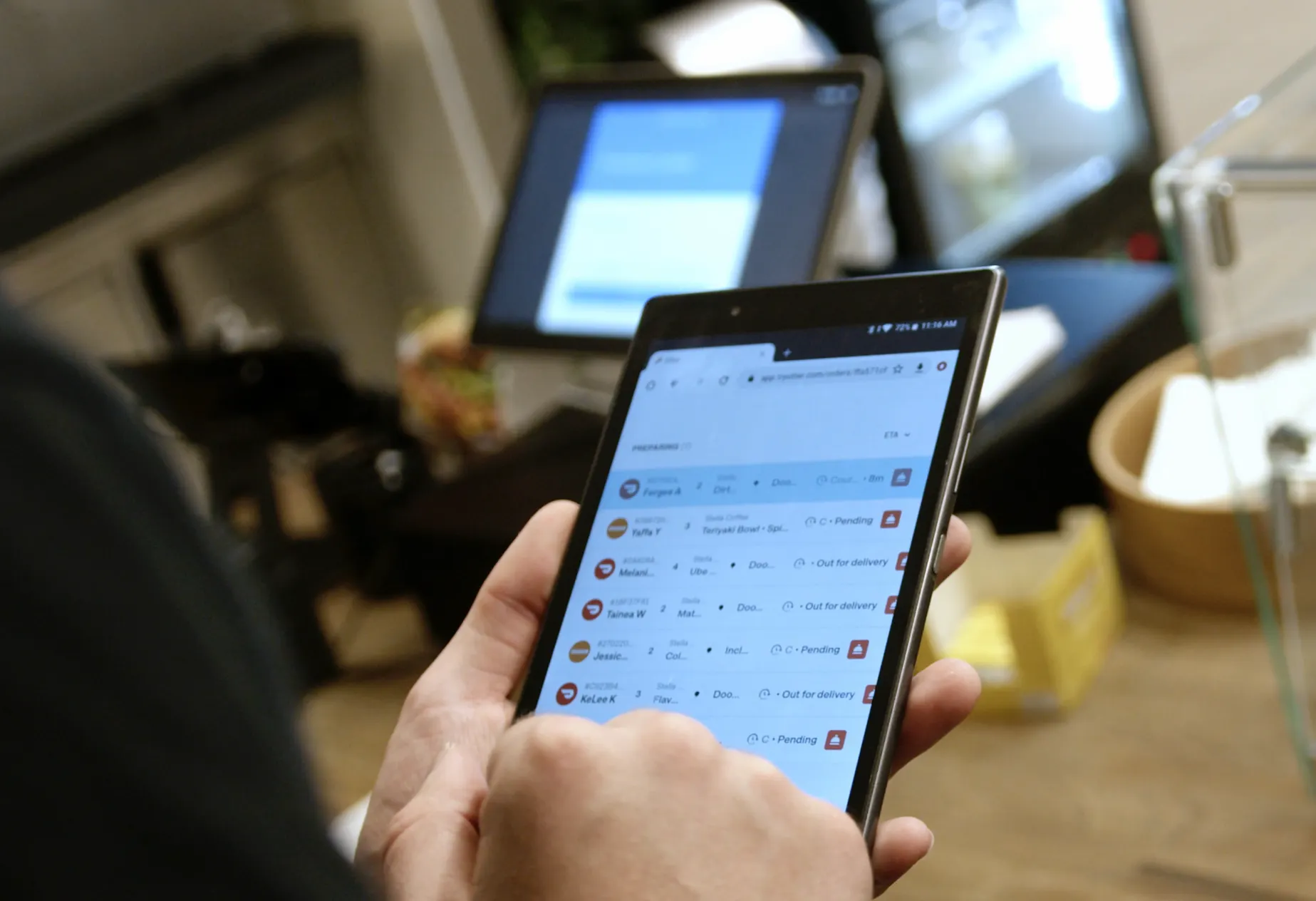
Where a third option fits: for operators managing orders across multiple delivery channels, neither Toast's nor Square's native tools are built around that specifically. Otter's Order Manager consolidates incoming orders from delivery channels into a single workflow, and menu updates sync across POS, kiosk, and delivery platforms, cutting down the manual effort of keeping everything aligned.
Toast vs Square: hardware comparison
Toast hardware
Toast's hardware is proprietary and purpose-built for restaurant environments. Its POS terminals and handheld devices are designed to withstand spills, grease, and heat, conditions that consumer-grade hardware often struggles with. Edge: Toast, purpose-built for harsh kitchen environments.
Square hardware
Square's hardware is iPad-based and considerably more accessible on price, ranging from a free magstripe reader up through all-in-one Register terminals in the mid-hundreds of dollars. Edge: Square, more affordable and flexible for front-of-house.
Durability and kitchen-readiness
Toast's terminals are designed for back-of-house conditions, heat, moisture, and the pace of a busy kitchen service. Square's hardware performs well in front-of-house settings like cafes, counters, and food trucks, but is generally less suited to harsh kitchen environments over time. Edge: Toast, for demanding kitchen environments.
Which should you choose: Toast vs Square
Choose Toast if you: are a full-service, casual, or fine dining restaurant that depends on table management, coursing, and a more structured front-of-house workflow.
Choose Square if you: run a cafe, bakery, food truck, or counter-service concept where simplicity and low overhead come first.
Coffee shops and cafes: Square is the practical choice for most coffee shops and cafes. The free plan handles basic ordering and payments cleanly.
Quick-service and fast-casual: for simple, lower-volume quick-service operations, Square keeps costs low and setup straightforward.
Full-service and casual dining: Toast is generally better suited here. Where table management, seat-level ordering, and kitchen display integration are central to daily operations, Toast's tools are more comprehensive than what Square's current plans offer.
Food trucks and mobile operations: Square's portable hardware, accessible price points, and month-to-month terms make it well-suited to food trucks and mobile operations.
Multi-location restaurants: for larger multi-location groups, Toast's centralized reporting and cross-location management tools are worth the added investment.
Consider Otter as a third alternative if you...
manage orders across multiple delivery platforms at once, or run a business that's heavily delivery-driven. Otter is worth considering for QSRs, fast-casual concepts, ghost kitchens, and multi-location operators who want delivery-focused consolidation without either Toast's enterprise-level cost or Square's more general-purpose feature set. Its Order Manager consolidates incoming orders from delivery channels into a single workflow, menu updates sync across your POS, Kiosk, and delivery platforms, and analytics and live monitoring are included rather than sold as add-ons. Pricing runs through published bundles rather than a quote-only process, hardware included; see Otter's current pricing for exact rates.
Matt Smith, General Manager of Big Daddy Bagels, described what managing delivery orders looked like before consolidating onto one system:
“At first it was a nightmare, trying to do DoorDash, Grubhub, UberEats... the tablets were all ringing at once. Now that it's all streamlined, it really doesn't matter where an order comes from.”
Price both before you commit to either
Toast and Square solve different problems well, and the right pick usually comes down to how structured your front-of-house and kitchen workflow actually is, not just the sticker price. If delivery volume and order consolidation are the bigger headache, it's worth pricing a third option built specifically around that before signing a multi-year contract with either one.
Frequently asked questions about Toast vs Square
Is Toast the same as Square?
No. Both are cloud-based point of sale systems that handle payment processing, but they're built for different types of operations. Toast is designed exclusively for restaurants, with proprietary hardware and a deep feature set aimed at full-service dining. Square serves a much broader range of businesses, retail, services, and food, and its restaurant product is more accessible but less specialized than Toast.
Which is cheaper, Toast or Square?
It depends on your volume and how you define cheaper. Square's free plan has no monthly software fee, making it the lower-cost option for smaller or newer operations. At higher transaction volumes, Toast's lower in-person processing rate can offset its monthly software cost. The true cost comparison depends on your hardware, which add-ons you use, and how much you process each month, confirm exact processing rates with each provider directly.
Is Toast better than Square for restaurants?
For full-service restaurants that need table management, coursing, and advanced kitchen integration, Toast is generally the better fit. For cafes, food trucks, and counter-service concepts that need something simple and affordable, Square often works better. Neither system is universally superior, the right choice depends on your restaurant type, volume, and budget.
How much does Toast cost compared to Square?
Toast's software starts at $0 on the Starter Kit and $69/month on the Point of Sale plan, with custom pricing for larger operations; processing fees aren't published, confirm the exact rate with Toast's sales team. Square starts at $0 on the free plan, $49/month for Plus, and $149/month for Premium, with published processing rates on every tier. Both platforms charge extra for add-ons, and hardware costs vary significantly, Toast's proprietary kits run from the mid-hundreds to over $1,000, while Square's iPad-based hardware starts at $0 for a basic card reader.
What is the disadvantage of Toast?
Toast's biggest drawbacks are its multi-year contracts, proprietary hardware lock-in, and the way costs compound once you add features beyond the base plan. For smaller or newer restaurants, the total cost and commitment level can be difficult to justify before the operation is fully established.
Which is better for a small restaurant, Toast or Square?
Square is generally the better starting point for small restaurants. The free plan, low hardware costs, and month-to-month terms give smaller operators room to grow without locking into a system that may be more than they need. Toast is worth considering once an operation scales to the point where its advanced features justify the investment.
Who is Toast's biggest competitor?
Toast competes most directly with other restaurant-specific POS systems. Square for Restaurants is its most common comparison, particularly for smaller operations. Other frequently mentioned competitors include Lightspeed, Clover, and TouchBistro, each with their own strengths depending on restaurant type and size. See Otter's Toast POS competitors guide for a fuller rundown.
Does Toast have better features than Square?
For restaurant-specific functionality, table management, kitchen display integration, coursing, and advanced labor tools, Toast is more comprehensive. Square covers the essentials well and is easier to set up, but it lacks some of the depth that full-service restaurants rely on. For simpler operations, Square's feature set is often more than sufficient.
Can I switch from Square to Toast, or the other way around?
Switching is possible but requires planning. Moving from Square to Toast means investing in new proprietary hardware and signing a multi-year contract, so it's worth doing a full cost analysis before committing. Going from Toast to Square is generally more straightforward on the software side, though you'll need to factor in any early termination fees in your Toast contract and the cost of replacing hardware.
What POS system is better than both Toast and Square?
That depends on what your restaurant needs. For delivery-heavy or multi-channel operations, Otter is purpose-built in ways that Toast and Square are not: consolidating orders across platforms, syncing menus in real time, and including analytics and live monitoring rather than selling them as add-ons. Other alternatives worth researching include Lightspeed, TouchBistro, and Clover, depending on your operation type and priorities.

See Otter in action