Table of contents
Every order, payment, and customer interaction creates data — and with data comes responsibility.
Today's restaurant chains rely on dozens of third-party vendors to operate: a restaurant POS system, delivery platforms, loyalty programs, review management tools, and analytics dashboards. Each vendor handles sensitive customer information, from credit card details to order histories, plus critical business information like employee records and supplier contracts.
While this interconnected ecosystem has enabled chains to scale efficiently, it also begs a crucial question: how do you ensure every vendor in your technology stack can be trusted with your most confidential data?
This is where SOC II compliance comes in. Think of SOC II as the gold standard of evaluation, helping you determine how seriously your technology partners take security and data protection. It's the benchmark that separates trustworthy vendors from potential liabilities.
For restaurant chains, SOC II compliance isn't necessarily something you need to be certified in yourself — it’s the vendors you rely on that must prove they can protect your data and operate reliably. In an industry where customer trust directly impacts your bottom line, choosing SOC II-compliant vendors is essential.
What SOC II compliance actually means
SOC II compliance might sound like technical jargon, but it's actually quite straightforward. Think of it like an inspection of your technology partners — it's an independent audit that verifies a company follows strict standards for protecting and handling data.
You might hear about different types of SOC reports. To quickly clarify the difference, SOC 1 focuses on financial reporting and internal controls, while SOC 2 examines how service providers handle data security and data privacy. There's also SOC 3, which provides a general public summary of SOC 2 findings. For restaurant chains evaluating technology vendors, SOC 2 compliance is what matters most.
SOC II stands for System and Organization Controls 2, developed by the American Institute of Certified Public Accountants (AICPA), and it's based on five Trust Services Criteria:
Security: Your vendor protects sensitive data from unauthorized access. For restaurants, this covers customer data like payment card information, plus proprietary financial information and supplier contracts.
Availability: Stipulates the vendor's systems stay online and operational when you need them. This means their technology platforms remain accessible and functional during your business hours.
Processing Integrity: A guarantee that systems work accurately and completely. Orders get processed correctly, payments go through properly, and loyalty points are calculated with clarity.
Confidentiality: Protecting sensitive information beyond basic security — customer preferences, operational data, and strategic business information can also give you a competitive edge.
Privacy: Ensures personal data is collected, used, and disposed of properly. With regulations like GDPR, HIPAA (for healthcare-related data), and PCI DSS (for payment processing), it's often required by law.
Here's how this works in practice: when a customer places an online order, a SOC 2 compliant vendor must securely process the payment (security), keep the ordering system online (availability), charge the right amount and send the order to the correct location (processing integrity), protect special dietary notes (confidentiality), and handle customer information according to data protection laws (privacy).
The key advantage of SOC 2 compliance is that it's not a one-time check. Service organizations must undergo regular SOC audits — typically SOC 2 Type 2 audits that examine controls over a period of time — to maintain their compliance, which means they're continuously held accountable for these standards.
Why restaurant chains must demand compliance from vendors

As a restaurant chain, you handle massive amounts of sensitive data daily — but you're not the only one touching that information. Every technology vendor you work with becomes one of two things: a potential security risk or trusted partner. Because you don’t need to pursue a SOC II certification for your own business, the real opportunity — and risk — comes from the vendors you choose to work with.
The data flowing through your vendor network
Consider what's actually moving through your technology ecosystem every day. Your POS system processes every transaction and payment card data. Your delivery platform stores customer addresses and preferences. Your loyalty program tracks detailed purchase behaviors and personal data. Your supply chain tools contain vendor contracts and financial information. Employee management systems hold sensitive information subject to various data protection requirements.
Each vendor relationship represents a potential entry point for cyberattacks and service disruptions, and a critical link in your regulatory compliance chain. When you work with business partners who lack proper cybersecurity measures, you're essentially creating dangerous vulnerabilities across your entire operation.
What happens when vendors cut corners on security
The consequences of choosing the wrong vendor extend far beyond their company. According to IBM's 2024 Cost of a Data Breach Report [1], the average cost of a data breach reached $4.88 million in 2024. For restaurant chains, vendor security failures can trigger expensive legal battles, result in regulatory fines, and cause immediate revenue loss.
But the financial damage goes deeper. Research shows that about a third of data breach costs come from reputation damage and lost business [2]. When customers hear about data breaches or service failures, they associate those problems with your brand, not your technology partner.
Service outages create their own costly problems, especially during peak dinner hours. These cyber threats affect individual transactions and have the power to cripple your organization's ability to serve customers entirely.
Why SOC II compliance matters for vendor selection
SOC 2 compliance serves as a trust signal when evaluating potential partners. It tells you that a service organization has invested in proper security controls, undergone independent SOC 2 audits by certified CPAs, and committed to maintaining these information security standards over time.
Instead of hoping they take cybersecurity seriously, you have documented evidence through their SOC 2 report that they do. In an industry with tight margins, this kind of assurance isn't just helpful — it's essential for protecting your bottom line and reducing security risk.
Key benefits of working with SOC II-compliant vendors
SOC II-compliant vendors deliver concrete business advantages that directly impact your bottom line. Here's what you actually get when you choose partners who take compliance seriously:
1. Data security that protects your brand reputation. SOC 2 compliant vendors implement robust security controls to protect sensitive data and customer information. For restaurant chains, this means your loyalty program information stays secure even when storing detailed purchase histories, dietary preferences, and personal stats across thousands of customers. When a customer saves their payment card details for quick reordering or stores their delivery address in your app, you can be confident that sensitive information is protected by proven cybersecurity measures. And as the future of POS brings even more customer data into the transaction, that protection will only grow in importance.
2. Operational continuity you can count on during peak hours. SOC compliance requirements ensure vendors maintain reliable systems with proper uptime monitoring and disaster recovery procedures. This translates directly to revenue protection. When your POS system needs to process hundreds of transactions during lunch rush, or your delivery platform handles a surge of weekend orders, SOC 2 compliant service providers have demonstrated they can keep systems running when you need them most — and keep the clean transaction records that make restaurant bookkeeping far less painful.
3. Regulatory readiness without becoming a compliance expert. Data privacy regulations like GDPR and CCPA continue expanding, and SOC 2 compliant vendors help you stay ahead of these requirements without mastering every legal detail yourself. When a service provider properly handles data retention, customer consent, and information deletion requests, you're protected from potential fines and legal exposure. This data protection becomes especially valuable for chains operating in multiple states or countries where privacy laws vary.
4. Customer trust that drives long-term loyalty. When customers see that you work with security-conscious business partners, it reinforces their confidence in your brand. SOC 2 compliance demonstrates professionalism and accountability in how you handle their personal data. This trust factor becomes increasingly important as customers become more aware of data privacy issues and more selective about which brands they're willing to share sensitive information with.
5. Simplified vendor management as you scale. Working with SOC 2 compliant vendors streamlines your own risk management processes. Instead of conducting extensive security reviews for every technology partner, SOC compliance provides a standardized framework for evaluation. This saves time during vendor selection and gives you confidence that your partners meet consistent information security standards, making it easier to scale your technology stack as you grow.
Common risks when vendors are not SOC II compliant

We know operators already have tight margins — adding unnecessary risk from a vendor only increases pressure on your business. When vendors skip proper security measures, the consequences land squarely on your restaurant's reputation and bottom line.
Picture this: It's 7 PM on Friday night...
Your busiest revenue hour of the week is in full swing. Orders are flowing, your kitchen is hitting perfect timing, and then your POS system crashes. Not just a quick glitch — a complete system failure that lasts 45 minutes.
This isn't a hypothetical scenario. If you’re processing 50 orders per hour during peak dinner service with an average ticket of $35 — a 45-minute POS crash means 37 lost orders, representing over $1,295 in immediate lost revenue.
But the real damage extends beyond that single evening. Frustrated customers leave without ordering. Others who waited through the chaos may never return. Your delivery partners mark you as unreliable. Social media overflows with complaints about the "disorganized" restaurant that couldn't take orders.
Real Life Case Study: When vendor security failures make headlines with your name
Data breaches don't stay contained within vendor companies. The average cost of a data breach hit $4.88 million in 2024 [2], but for restaurant chains, the damage often goes beyond financial penalties.
Consider this recent case study: ethical hackers recently exposed severe vulnerabilities in a leading fast food chain’s digital systems. They discovered hard-coded passwords and weak security controls that gave unauthorized access to employee accounts and internal controls. Most concerning for restaurant operators, the hackers accessed raw audio recordings from drive-through systems that contained customer data processed by AI systems.
The security researchers described the company's cybersecurity as "catastrophic" and found vulnerabilities that allowed them to access admin functions across multiple platforms. Thankfully for the fast food giant, this report was conducted by ethical hackers who responsibly disclosed the issues. Still, it demonstrates what malicious cyber threats could accomplish when restaurant technology systems lack proper security controls.
The legal and financial fallout
Data privacy regulations continue expanding, and using non-compliant vendors can expose you to significant penalties. When service organizations mishandle customer data or fail to meet regulatory requirements, your business bears responsibility for those failures.
The fines alone can be substantial, but the legal costs and time spent dealing with regulatory issues create additional burdens. Meanwhile, your marketing team works overtime to rebuild trust that shouldn't have been lost in the first place.
The domino effect on your operations
Security failures and service outages don't happen in isolation. When one vendor system fails, it often triggers problems across your entire technology stack. Orders get backed up, payment card processing can't function, customer data becomes inaccessible, and staff resort to manual workarounds that slow everything down.
For restaurant chains operating on thin margins, these operational disruptions can turn profitable days into expensive disasters. The organization's ability to serve customers depends entirely on reliable, secure technology partners.
How to evaluate a vendor's SOC II compliance
Evaluating vendor compliance doesn't have to be complicated, but it does require asking the right questions and knowing what to look for. When discussing SOC II compliance with potential vendors, here's how to interpret their responses:
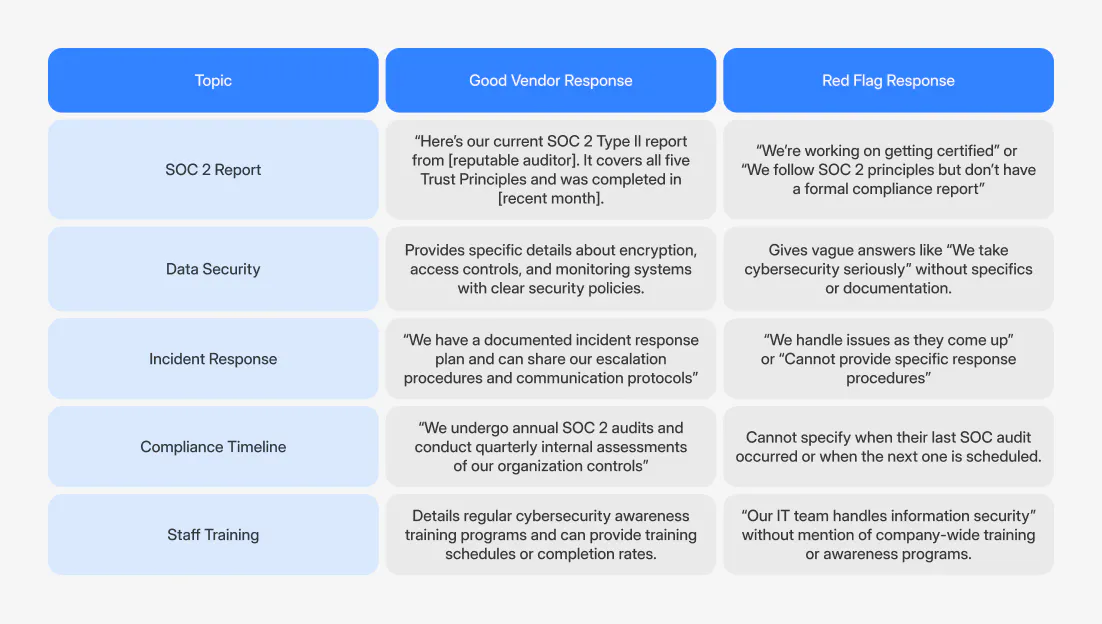
Essential questions to ask every vendor
When vetting technology partners, make sure to cover these key areas:
Documentation: Request to see their current SOC 2 Type II report and verify it's less than 12 months old. The compliance report should cover all five Trust Services Criteria and be conducted by a reputable third-party auditing firm with certified CPAs. Look for evidence that they also maintain other relevant certifications like ISO 27001 for information security management.
Policies: Ask for their data handling and retention policies, incident response procedures, and backup/disaster recovery plans. Legitimate service providers will have these documented and readily available as part of their compliance checklist.
Ongoing compliance: Confirm they reassess SOC compliance annually through Type 2 audits, perform regular vulnerability scans, and maintain formal change management procedures to address security risks.
Making SOC II part of your vendor evaluation process
Integrate SOC compliance requirements into your RFP process from the beginning. Include SOC 2 compliance as a mandatory requirement, not just a nice-to-have feature. This approach saves time by filtering out service providers who haven't invested in proper security controls before you get deep into negotiations.
When vendors can't provide SOC 2 documentation, ask them to outline their timeline for achieving compliance. While you might work with a cloud service provider who's actively pursuing certification, avoid those who haven't even started the process or don't understand why information security matters.
Remember that SOC 2 compliance isn't just about checking a box — it's about finding business partners who share your commitment to protecting customer data and maintaining reliable service. Whether you're evaluating SaaS platforms, cloud services, or traditional software vendors, SOC compliance should be a fundamental requirement in your vendor selection process.
Otter's role in secure restaurant technology
Choosing the right partner matters. When you're evaluating technology vendors for your restaurant chain, work with businesses that understand that security and reliability are fundamental protection requirements.
Otter helps restaurant chains manage their entire technology ecosystem while prioritizing the cybersecurity and compliance principles that SOC 2 represents. Our platform integrates multiple critical functions that chains depend on daily, all built with data protection and operational reliability at the core — and as newer channels like voice ordering for restaurants enter the stack, that foundation matters even more. This comprehensive approach helps automate many security processes while maintaining the information security standards that restaurant chains require.
POS management that processes thousands of transactions securely
Otter's POS solutions handle the transaction volume that large chains generate — often thousands of payments daily across multiple locations — while maintaining the security controls that protect both customer data and your proprietary financial information. The system processes payment card transactions and tracks sales data with encryption and access controls that meet the cybersecurity standards SOC 2 requires. For chains operating dozens or hundreds of locations, this means consistent information security standards across every point of sale. That consistency extends to self-service, too — our guide on how to use a kiosk machine covers the front-of-house side.
Ratings and reviews management that protects customer data
Customer feedback and online reputation management involve handling sensitive data and business-critical information about your brand perception. Otter's ratings and reviews management protects customer data while helping you monitor feedback, respond to reviews, and keep tracking guest sentiment over time across platforms. The system ensures that customer information shared in reviews is handled according to data privacy requirements — the kind of sensitive information handling that SOC 2's privacy and confidentiality Trust Principles address — while giving you the tools to maintain your brand reputation.
Order management that maintains availability when you need it most
Order management systems are the backbone of modern restaurant operations, especially for chains handling delivery and pickup orders across many platforms. Otter's order management solution maintains the availability and processing integrity that prevent the costly outages described earlier in this article. When your dinner rush depends on seamless order processing, reliable systems directly protect your revenue from the kind of cyber threats and disruptions that can cost hundreds of dollars per hour or more.
Analytics that secure your most sensitive business intelligence
Data analytics platforms handle some of your most sensitive information — sales trends, customer behaviors, operational insights, and competitive intelligence. Otter's analytics solution provides chains with comprehensive performance data while maintaining the confidentiality controls that protect your strategic financial information. The platform aggregates information from multiple sources while ensuring that confidential stats remain secure and access is properly controlled.
Partnership approach that prioritizes your operational success
Beyond individual products, Otter represents the kind of vendor partnership that restaurant chains need in today's environment. We've built our entire platform with the understanding that you can't afford vendors who cut corners on security or reliability. Our approach aligns with the same principles that SOC II compliance addresses — protecting your data, maintaining system availability, ensuring accurate processing, and handling customer information responsibly.

Book a demo to see how Otter’s all-in-one platform can help your restaurant thrive.