Table of contents
- Intro
- Chasing the Algorithm: How Delivery Apps Actually Work
- The Customer Discovery Funnel
- Understanding Delivery Marketing for Third Party Platforms
- Marketing Strategies for Restaurants on Third-Party Food Delivery Platforms
- Otter’s Three Levers You Can Control
- Challenges & Common Mistakes in Delivery Platform Marketing
- Delivery Marketing Measurement & Attribution
- Case Studies: Proving Incremental Net Payout
- Automation & AI: Your Competitive Advantage
- Sources
Intro
Third-party delivery platforms have fundamentally changed how restaurants acquire and serve customers. For multi-unit operators and franchisees in particular, these platforms represent both tremendous opportunity flanked by significant complexity. 60% of consumers now order food delivery at least once per week and most Americans average 4.6 orders per month. Visibility on Uber Eats, DoorDash, and similar platforms isn't optional: it's essential for growth.
With 65% of limited-service restaurants (and 41% of full-service restaurants) on delivery apps competing for user attention, it’s easy to get lost in the sea of competitors. Getting found, chosen, and re-ordered requires more than just being present on these platforms. It demands strategic marketing that understands how platform algorithms work, how customers make decisions, and how to optimize across multiple levers simultaneously.
Studies show that restaurants ranked (shown) in the top three positions receive up to 50% more orders compared to those ranked lower.
The stakes are high. Restaurants shown initially to a user receive up to 50% more orders compared to those ranked lower. Similar to Google search, where ~70% of clicks go to the first three links, delivery apps follow the same pattern: if you don't rank highly, your chances of being seen and chosen are severely limited.
This guide provides a comprehensive framework for delivery platform marketing, from algorithm mechanics to measurement strategies. Whether you're managing five locations or five hundred, you'll learn how to drive sustainable growth while protecting your margins.
¹ 2025 DoorDash Delivery Trends Report.” DoorDash for Merchants, DoorDash, 23 July 2025, https://merchants.doordash.com/en-us/resources/restaurant-online-ordering-trends
² National Restaurant Association. Off-Premises Restaurant Trends 2025. National Restaurant Association, 15 Apr. 2025, https://restaurant.org/research-and-media/research/research-reports/off-premises-restaurant-trends-2025/
³ 2025 DoorDash Delivery Trends Report.” DoorDash for Merchants, DoorDash, 23 July 2025, https://merchants.doordash.com/en-us/resources/restaurant-online-ordering-trends
⁴ DoorDash, 2025 DoorDash Delivery Trends Report.
⁵ Kingsnorth, Simon. Digital Marketing Strategy: An Integrated Approach to Online Marketing. 1st ed., Kogan, 2019. https://eprints.upjb.ac.id/173/1/Digital%20Marketing%20Strategy%20An%20Integrated%20Approach%20to%20Online%20Marketing%20by%20Simon%20Kingsnorth%20%28z-lib.org%29.pdf
Chasing the Algorithm: How Delivery Apps Actually Work
Understanding the Platform Business Model
It’s essential to understand how the Delivery Platform business model works in order to complement the aims of the platforms- by working towards the same objectives, you’re set up for greater visibility overall. Delivery platforms operate as marketplaces connecting hungry customers with restaurants. Their success depends on maximizing the number of orders, customer satisfaction, and engagement with their platform. To achieve this, they use sophisticated algorithms that determine which restaurants appear in search results, how they're ranked, and which promotions customers see.
Algorithms are getting smarter every day. They're learning from each order, each click– and even each delayed order. This continuous learning creates a dynamic environment where yesterday's winning strategy may not work tomorrow.
Understanding this dynamic is critical: you're not just competing with other restaurants– you're competing for algorithmic favor.
Algorithm Mechanics & Ranking Factors
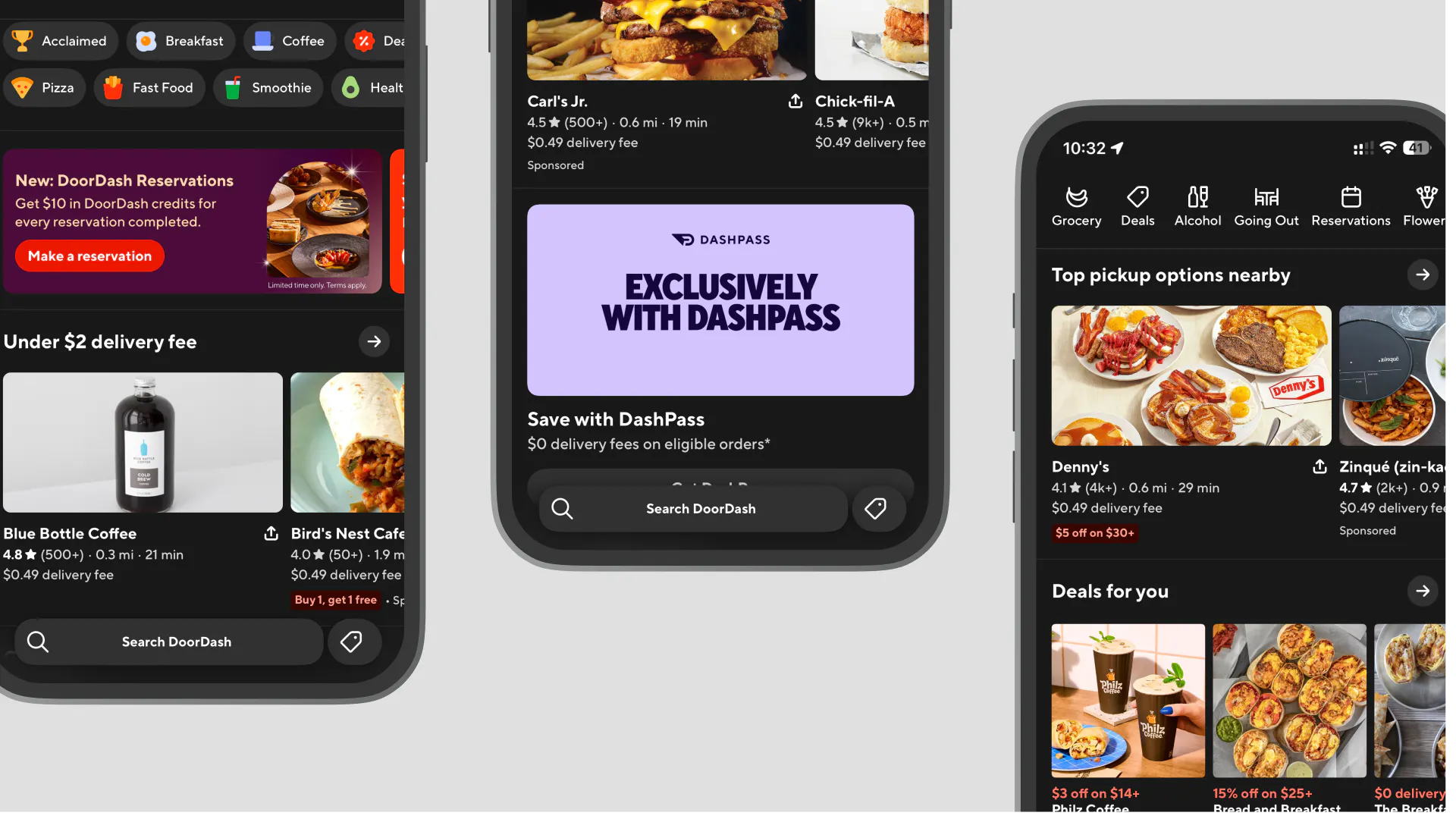
Delivery platform algorithms optimize for a single goal: completed orders that create happy customers. When a user opens the app, the algorithm evaluates hundreds of restaurants in real-time across dozens of factors to determine the optimal ranking.
The key to understanding delivery app ranking is personalization. Similar to traditional search engines, delivery apps show personalized food ordering options to each user based on their usage of the app. This means there's no one-size-fits-all ranking: what users see depends on their individual behavior, preferences, and context.
Personalization Factors Include:
- Past Order History: If a user frequently orders vegetarian dishes, the algorithm prioritizes vegetarian restaurants in their results. Similarly, users who order late-night snacks see restaurants operating during those hours.
- User Location: Distance from the user is one of the most significant factors. Closer restaurants naturally rank higher, all else being equal.
- Behavioral Signals: Platforms track which restaurants users click on but don't order from, which dishes are added to cart but not purchased, and which promotional offers drive conversions. This data refines future recommendations.
- Temporal Patterns: Users who consistently order breakfast see breakfast-focused restaurants ranked higher during morning hours. Lunch and dinner rankings adjust based on user habits.
Primary Ranking Factors You Can Control:
While personalization factors are largely outside your control, several critical ranking factors respond directly to your actions:
- Ratings and Reviews: Your star rating and review count are among the most powerful ranking signals. Higher ratings signal quality to both the algorithm and potential customers. A 4.8-star rating with 500 reviews typically outranks a 4.9-star restaurant with 50 reviews due to statistical confidence.
- Order Accuracy and Error Rate: Low order error rates signal operational reliability. Restaurants with high accuracy rates (no reported missing items, wrong orders, quality issues) rank higher, because the algorithm trusts them to deliver good experiences.
- Preparation and Delivery Time: Consistently meeting or beating your estimated prep times improves algorithmic trust. Restaurants promising 25-minute delivery rank differently than those estimating 45 minutes– speed matters to hungry customers.
- Overall Popularity: Order volume signals demand. More orders create a virtuous cycle: popularity drives visibility, which drives more orders, which in turn reinforces popularity.
- Engagement Signals: Click-through rate, conversion rate, and repeat order rate tell the algorithm which restaurants customers actually want. Higher engagement creates sustained increase in on-app visibility.
- Marketing Activity: Active promotions, advertising spend, and promotional performance demonstrate your commitment to driving orders. Platforms reward restaurants that invest in growth.
It's useful to think of ranking factors in two categories:
- Can't Control: Distance from user, what the user ordered previously, user preferences, cuisine type preferences
- Can Control: Ratings and reviews, popularity (order volume), order accuracy, missed orders, preparation time, marketing activity
The Paid vs. Unpaid (Organic) Marketing Reality: Is it worth investing in paid optimization?
Here's a critical truth that many operators miss: organic ranking optimization alone is no longer sufficient for high visibility.
In recent years, delivery platforms have introduced paid advertising features that allow restaurants to buy premium placement. These paid placements appear at the top of search results, in homepage carousels, and in category-specific sections, where customers are most likely to click.
The impact is significant. Without paid promotions or discounts, your visibility will always be lower than competitors using these tactics. The number of restaurants running visibility ads has increased significantly over the past year. This means that even restaurants with excellent organic signals (great ratings, fast delivery, high popularity) find themselves outranked by competitors willing to pay for visibility.
This doesn't mean organic optimization is pointless—far from it. Strong organic signals improve the effectiveness of your paid campaigns. A sponsored listing for a 4.8-star restaurant converts far better than a sponsored listing for a 4.2-star restaurant. The most successful operators combine both strategies.
Optimization Tips
- Maintain 4.8+ ratings and under 30-minute prep times for badges.
- Run time-limited discounts (e.g., 20% off) to spike velocity.
- Use platform analytics for peak-hour ads, layering with social proof for sustained features.
Why Active Marketing Matters
Simply being listed on a platform is not enough. This passive approach ignores a fundamental reality: platforms themselves must make choices about which restaurants to show, and they make those choices based on data.
Restaurants that actively manage their delivery marketing send strong signals that they're serious about the channel. They respond to reviews, run strategic promotions, invest in ads, and optimize their operations. The algorithm notices and rewards this behavior with better placement. There is also a financial incentive for third party delivery platforms to provide algorithmic favor to restaurants running promotions– usually they get an additional cut of some of the promotions run on their platform.
The alternative (hoping customers will find you without marketing effort) means competing with hundreds of restaurants that ARE actively marketing. In that environment, invisibility is the default outcome.
If the majority of orders go to the top ranked listings, and paid placements occupy those positions, organic-only restaurants are fighting for scraps amongst each other. The restaurants that rank highest combine operational excellence (organic signals) with strategic marketing investment (paid visibility).
Most importantly, restaurants that win use comprehensive tools to help manage many of these processes, using AI-driven, smart data to automate, adjust and optimize– including reputation management, ratings analysis and marketing.
The Customer Discovery Funnel
How Customers Make Delivery Decisions
Understanding how customers consider, choose, and purchase on third party delivery platforms is essential to creating the match between their needs and your products. Luckily, it’s not as difficult as it may seem. Customer behavior on delivery platforms follows a predictable pattern that in-the-know operators can influence at each stage.
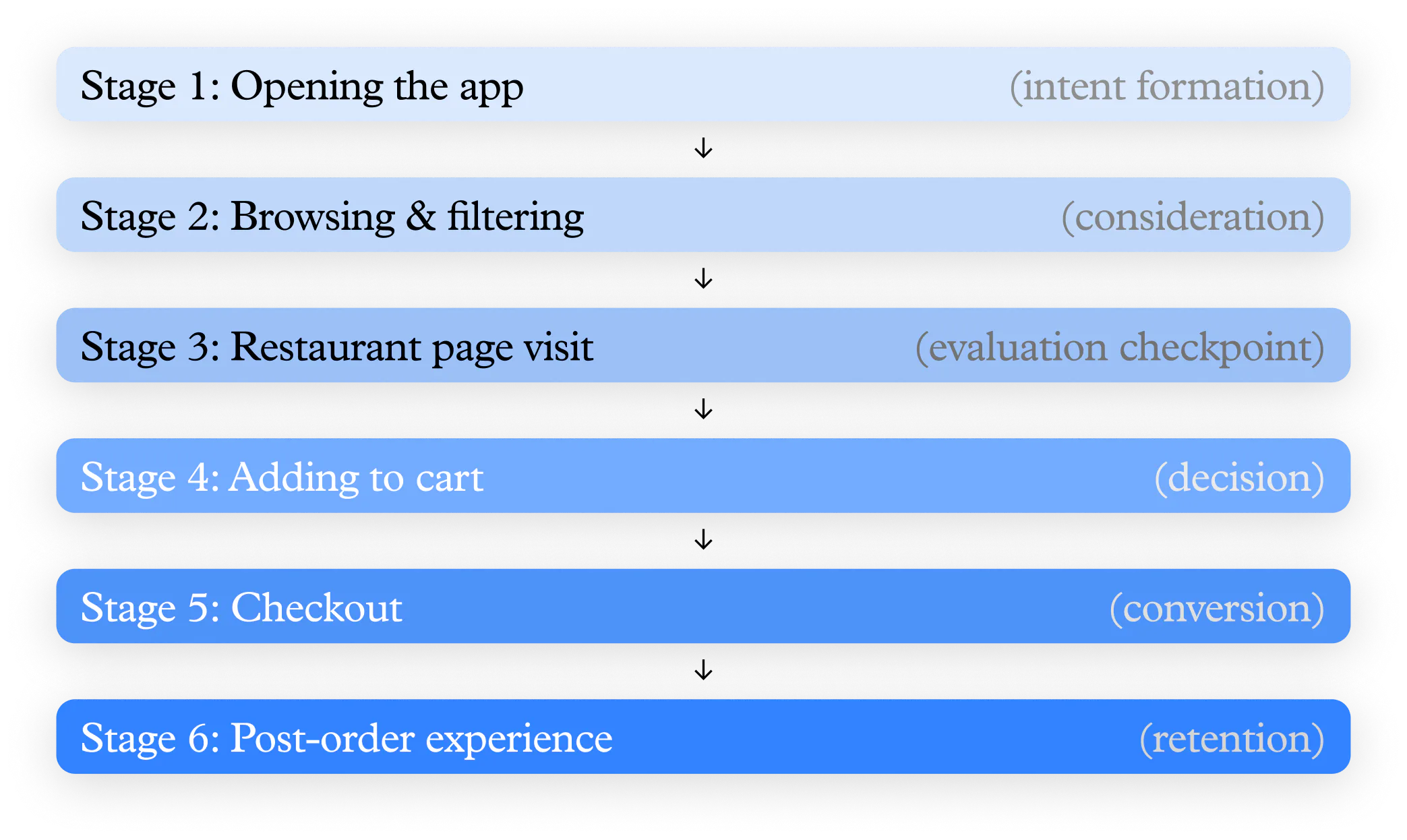
Stage 1: Opening the App (Intent Formation)
Most delivery orders aren’t impulse buys. Customers usually know what they want and order with a specific goal in mind. Customers open a delivery app with varying levels of intent, and hunger, but all have a desire to order – and to do so efficiently. Some know exactly what they want. Others have a general idea, but are browsing for inspiration.
Most fall somewhere in between: hungry with a general craving, but open to persuasion. At this stage, the platform's homepage carousel, personalized recommendations based on previous ordering patterns, and category browsing features influence what they are shown when they enter the app or search. Restaurants featured prominently here capture attention before customers even begin searching.
Getting featured on the home page of delivery apps like DoorDash, Uber Eats, and Grubhub can dramatically increase orders compared to those ranked lower. There are two primary ways to be features on the home page: organic (or unsponsored) recognition based on performance metrics and paid advertising placements.
Stage 2: Browsing & Filtering (Consideration)
Customers on third-party food delivery platforms prioritize convenience, speed, and promotions when choosing orders. A study ranks these influences: convenience tops customer motivations, followed by anticipated delivery time and discounts.
What does "Convenience" mean for customers?
- Proximity
- Clear Menu
- Reliability
- Trust Signals & Reviews
- One-Tap Ordering: (Pre-loaded favorites, quick checkout)
Algorithms boost visibility for high-rated restaurants with strong past orders, encouraging repeat choices based on location, preferences, and popularity.
Most customers don't search for specific restaurants. They browse categories (pizza, Mexican, healthy), apply filters (delivery time, ratings, price), and scroll through results. This is where ranking matters most.
Customers usually do not scroll past the first page of results shown. If you're not in that initial view, you're essentially invisible. Strategic marketing moves you up this ranking.
Factors That Influence Customer Selection.
Preference (Ranked)
- Ordering efficiency & reliability
- Menu clarity & ease of decision-making
- Alignment with customer identity/lifestyle
- Trust signals & perceived risk reduction
- Habit and prior experience
- Promotions & discounts
- Upsells and impulse triggers
Gunden et. Al 2020
Stage 3: Restaurant Page Visit (Evaluation Checkpoint)
Once a customer clicks on your listing, they scan your menu, check your ratings, read recent reviews, and look for promotions. Customers are motivated by efficiency. They browse delivery apps looking for the fastest, easiest, and best option. Customers also cognitively optimize while browsing. This means high-quality photos, accurate simple descriptions, compelling offers, and strong social proof drive conversion at this stage.
Here, customers engage in deliberate evaluation, supported by mindfulness and attention to detail. They are comparing options, not browsing emotionally. Clarity and detail wins here.
Stage 4: Adding to Cart (Decision)
The customer has decided to order from you, but they're finalizing their selection. Upsell opportunities, item descriptions, and customization options influence basket size. A well-designed, clear menu maximizes order value without overwhelming customers. Performance expectancy declines when friction or uncertainty increases. Cognitive overload reduces completion– this could mean too many modifiers (i.e. separate utensil and napkin inclusion selection, among other modifier categories).
Sidebar: The Subscription Hook
Tip: Users who opt into to a platform's subscription service demonstrate more loyalty towards restaurants, order more frequently, and are more likely to give higher reviews and ratings. Promotions exclusively targeted towards this set help to capture this target
Stage 5: Checkout (Conversion)
Delivery fees, service fees, estimated delivery time, and any applied promotions factor into the final decision. Some customers abandon at this stage if the total seems too high or delivery too slow. Promotions can be the deciding factor that pushes them to complete the order. Sudden fee-like add-ons disguised as modifiers can break the process and cause cart abandonment.
Stage 6: Post-Order Experience (Retention)
After delivery, the customer rates their experience and decides whether to order again. This is where operational excellence: food quality, accuracy, packaging, and timeliness, determines whether you've gained a repeat customer or lost them forever. Habit formation through reliability is key. Habit is built by boring excellence, not variety.
Research shows that repeat orders on delivery platforms are driven by brand equity. For restaurants, brand equity is built through perceived value, emotional connection, and shared values, all of which customers do attribute to individual restaurants, even when ordering through third party platforms
In other words: customers are loyal to restaurants that feel worth it, familiar, and aligned with them. More on that later.
Research on online food delivery behavior shows that customers order through a deliberate, efficiency-driven mindset, meaning restaurants perform best when menus prioritize clarity, confidence, and execution reliability over impulse-driven design. (Gunden, 2020)
The Visibility-Conversion Loop
Success on delivery platforms requires excelling at two distinct challenges: getting found (visibility) and getting chosen (conversion). These work together in a reinforcing loop.
Better visibility drives more orders. More orders generate more reviews and engagement data. Better reviews and engagement improve your ranking. Higher ranking drives more visibility. Strategic marketing accelerates and supports this flywheel.
¹ Gunden, N., Morosan, C., & DeFranco, A. (2020). Consumers’ intentions to use online food delivery systems in the USA. International Journal of Contemporary Hospitality Management, 32(3), 1325–1345. https://doi.org/10.1108/IJCHM-06-2019-0595
² Gunden, N., Morosan, C., & DeFranco, A. (2020). Consumers’ intentions to use online food delivery systems in the USA. International Journal of Contemporary Hospitality Management, 32(3), 1325–1345. https://doi.org/10.1108/IJCHM-06-2019-0595
³ Jadhav, Sarvesh, Ray Titus, Tina Babu, and R. Chinnaiyan. “Evaluation of Consumer Behavior Regarding Food Delivery Applications.” arXiv, 15 Jan. 2024, https://arxiv.org/pdf/2401.14409.pdf
Understanding Delivery Marketing for Third Party Platforms
What Is Delivery Platform Marketing?
Delivery marketing encompasses all activities designed to increase your visibility, conversion rate, and repeat orders on third-party platforms. Unlike traditional restaurant marketing (which drives awareness and foot traffic) or digital marketing (which drives website orders), delivery platform marketing operates within the rules and algorithms of platform marketplaces– which can be complex and change rapidly.
The objective is two-fold:
- Short-term: Drive immediate order volume through promotions, ads, and visibility tactics that put your restaurant in front of hungry customers right now.
- Long-term: Build a sustainable competitive advantage through reputation management, experience, customer retention, and optimizing for how delivery apps rank your compounds over time.
Delivery Marketing vs. Other Marketing Channels
Delivery marketing isn’t like traditional marketing. Restaurants don’t own the customer, the data, or the rules; they operate inside platforms. Algorithms drive performance, which means the same promotion can deliver very different results across apps like Uber Eats and DoorDash. Add 20–30% commission fees, and margins stay under constant pressure, forcing every marketing dollar to work harder.
Brand control is limited, as restaurants appear in standardized listings alongside competitors, so differentiation relies more on ratings, reviews, promotions, and menu presentation than on rich brand storytelling. At the same time, delivery platforms enable real-time optimization: operators can test, adjust, and see results within hours, while app-driven personalization adds complexity, since visibility and ranking vary by user based on individual behavior and preferences.
Not Just Discounting: The Visibility Imperative
Many operators equate delivery marketing with discounting. This is a costly mistake. While promotions play a role, sustainable delivery success comes from holistic (organic/unpaid and paid) visibility optimization.
The Visibility Customer Journey
Ranking → Discovery → Sales Pathway
- Ranking determines whether customers see you at all
- Discovery determines whether they click on your listing
- Sales determines whether they actually order
Most restaurants focus exclusively on sales (via discounts) while ignoring ranking and discovery. This creates a vicious cycle where poor visibility forces aggressive discounting to generate any orders at all, which destroys margins and prevents investment in the activities that would improve organic visibility.
Smart operators flip this model. They invest in ranking factors (reputation, operational excellence, strategic promotions) that improve organic visibility. This generates more orders at better margins, which funds continued optimization.
However, in today's competitive landscape, you can’t afford to ignore paid strategies. The reality is that delivery apps have made it possible, and increasingly necessary, to pay for higher rankings through ads and promotions. Being able to pay for visibility is now the most impactful way of gaining significant and consistent improvement in delivery app rankings.
Without paid promotions or discounts, you are constantly being outranked by those who are using these tactics. If you are not running them, your visibility will always be lower than competitors who are.
The Two Pillars: Organic + Paid
Conquering food delivery algorithms requires combining organic search optimization with high-performing ads and discounts. Master both aspects, and your chances of ranking high and increasing orders are extremely high.
Organic Optimization builds your foundation through careful menu descriptions and categorization, operational excellence, reputation management, and consistent performance. This creates the base level of trust from delivery app algorithms and customer confidence.
Paid strategy amplifies your visibility through sponsored listings and in-app ads that place you in front of customers who might not otherwise find you. This accelerates growth and captures market share in competitive environments.
Sponsored listings have become the dominant visibility strategy for restaurants willing to invest in paid placement. These ad formats work like search engine marketing, letting you bid for premium spots in app search results with hyper-targeted delivery—platforms use user data (location, time of day, order history, search behavior) to serve ads to the most relevant customers.
According to Uber Eats research, sponsored listings can increase orders by up to 15%.¹
The most successful operators don't choose between these approaches—they integrate both into a cohesive strategy where organic signals improve paid campaign performance and paid campaigns generate the volume that strengthens organic signals.
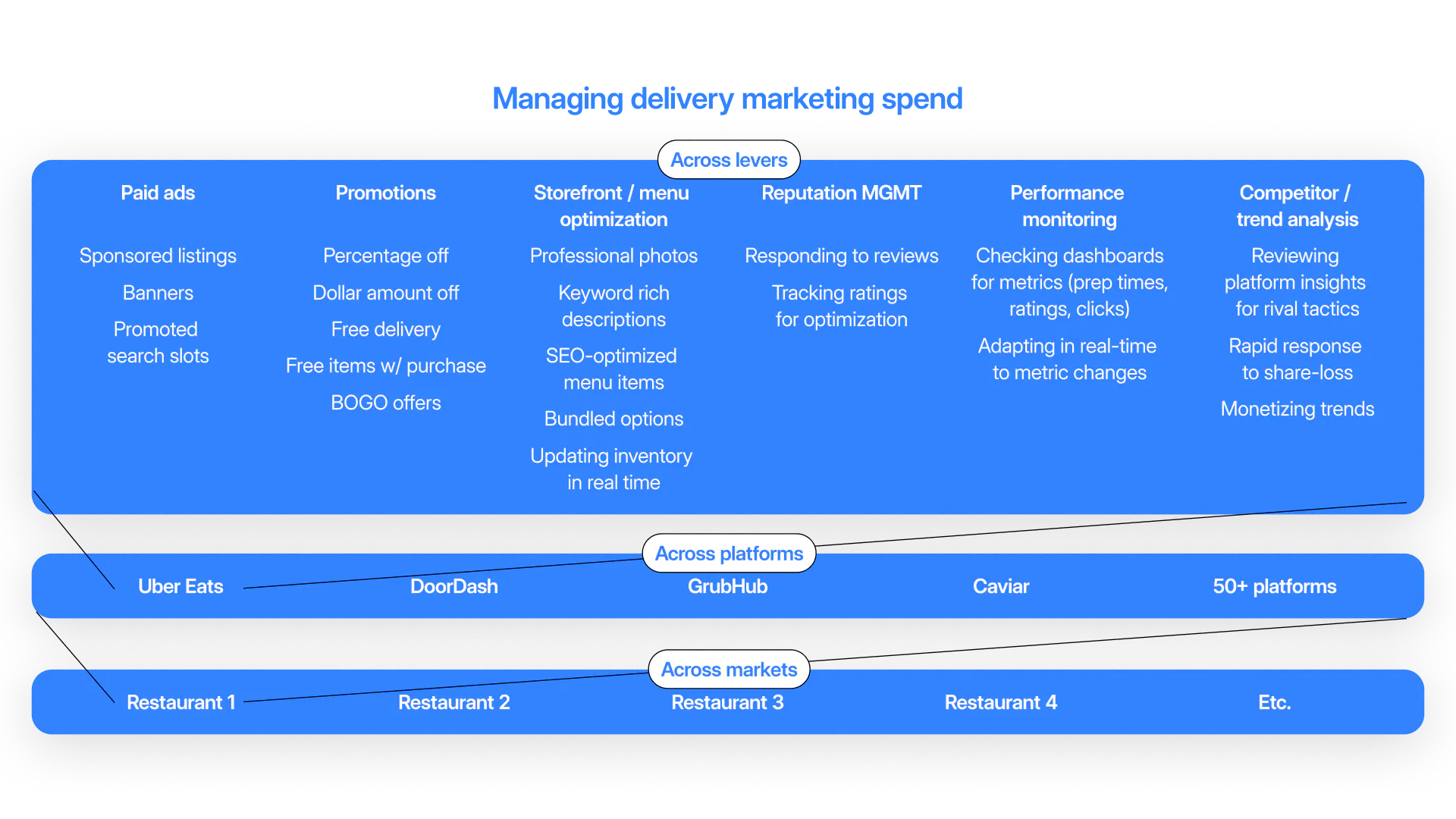
What Delivery Platform Marketing Activities Look Like
"Doing" delivery platform marketing means actively managing your restaurant's presence through platform dashboards and tools on a daily/weekly basis. It's hands-on work blending operations, content creation, and data analysis:
- Menu & Storefront Optimization: Uploading professional photos, writing keyword-rich descriptions, categorizing items for search matching, bundling for higher order values, and updating inventory real-time.
- Paid Advertising: Setting budgets for sponsored listings, banners, and promoted search slots, and tracking cost-per-order.
- Promotions & Deals: Launching offers via app tools to appear in carousels and boost algorithm signals.
- Reputation Management: Responding to reviews, and tracking ratings to optimize
- Performance Monitoring: Checking dashboards for metrics (prep times, ratings, clicks), iterate
- Competitor & Trend Analysis: Reviewing platform insights for rivals' tactics
These activities create a feedback loop: better visibility drives orders, which strengthens rankings, funding more optimization.
¹ Uber Eats. “Offers Updates (May 2025).” Uber Eats for Merchants, 2025, https://merchants.ubereats.com/us/en/resources/articles/product-highlights/offers-updates-may-2025/.
Sidebar: Customers choose delivery restaurants in a deliberate, efficiency-driven, and risk-averse manner
Marketing Strategies for Restaurants on Third-Party Food Delivery Platforms
Restaurants that perform well on third-party delivery platforms don’t do so by mimicking retail e-commerce or social media marketing tactics. Instead, both academic research and large-scale platform data show that customers choose delivery restaurants in a deliberate, efficiency-driven, and risk-averse manner. Success comes from making ordering feel easy, reliable, and aligned with the customer’s lifestyle, then amplifying that foundation with targeted marketing levers.
This section outlines how restaurants can translate those insights into effective marketing strategies on platforms they already use.
Recap: How Customers Choose Restaurants on Delivery Platforms
Customer selection on delivery platforms follows a consistent hierarchy of priorities. The most influential factors are ordering efficiency and reliability, followed by menu clarity and ease of decision-making. Identity fit—whether the restaurant “feels like it’s for someone like me” also plays a major role. Trust signals such as ratings, reviews, and order accuracy reduce perceived risk and heavily influence final choice. Habit and past experience shape repeat behavior, while promotions and upsells play a supporting, not leading, role.
Research confirms that customers are not browsing casually or emotionally– nor impulsively. They enter the app with a clear task and a desire to order efficiently and with confidence.
Key Insight: Customers are not choosing the most exciting option. They are choosing the option that feels most likely to work.
Organic (Unpaid) Optimization: The Foundation of Delivery Marketing
Before promotions, ads, or paid placements can perform, restaurants must optimize the fundamentals that drive conversion.
1. Simplicity Over Persuasion
Delivery menus should prioritize information clarity rather than persuasion. Customers respond best to menus that present only essential information: that means clear photos, accurate descriptions, and transparent pricing. Excessive upsells, too many modifiers, and promotional clutter slow customers down and reduce their intent to purchase.
Sidebar: Menu Design
The most successful delivery menus are often simpler than in-store menus, not more promotional.
- Present clear, essential information only (photo, ingredients, price)
- Avoid clutter, excessive upsells, or a complex presentation of choices
2. Decision Ease and Cognitive Flow
Customers browse and decide quickly. Clear item names, logical categories, and a limited set of intentional choices help them move from browsing to checkout without hesitation. If a menu requires interpretation, it’s often skipped. The goal isn’t to sell harder; it’s to reduce friction. Avoid overloading menus with limited-time or experimental items that need explanation.
3. Identity Alignment
Customers don’t just choose food—they choose brands that feel right for them. As they browse, they’re asking, “Is this for someone like me?” Everything from menu language and pricing to photos and item mix should signal the lifestyle you’re serving. That lifestyle might be healthy, family-friendly, indulgent, or purely efficient. This often calls for delivery menus that differ meaningfully from dine-in. When that alignment is strong, it becomes one of the most powerful drivers of intent, second only to actual results. This factor strongly affects shortlisting during browsing and final choice during evaluation.
4. Trust and Risk Reduction
Delivery customers do not like taking risks. They rely on ratings, reviews, order accuracy, realistic photos, and evidence that food will travel well. Restaurants that consistently deliver what is promised (on time and without errors) build trust that directly improves conversion and repeat behavior. Restaurants should help customers feel confident that their choice will “hold up” through delivery. In repeated studies, trust and clarity matter more than novelty and enticement. Customers are choosing the least risky option, not the most exciting.
5. Habit Through Reliability
Habit strongly influences repeat orders, but it is earned through consistency. Order accuracy, predictable prep times, standardized packaging, and reliable portions are the true drivers of long-term delivery growth. Novelty does not build habit: reliability does.
¹ Gunden, N., Morosan, C., & DeFranco, A. (2020). Consumers’ intentions to use online food delivery systems in the USA. International Journal of Contemporary Hospitality Management, 32(3), 1325–1345. https://doi.org/10.1108/IJCHM-06-2019-0595
Otter’s Three Levers You Can Control
Based on extensive analysis of delivery marketing performance, Otter has identified three levers which consistently drive results. Each lever plays a role at a different point in the journey, and their impact compounds when used together.
Once organic fundamentals are in place, restaurants can scale results by orchestrating three controllable levers: Promotions, Reputation, and Advertising. The strongest operators do not rely on one lever alone; they coordinate all three based on their specific situation.
3 Levers of Marketing Performance:
- Promotions
- Reputation
- Advertising
This is Otter's three-pronged approach to third-party delivery marketing, designed to boost visibility and maximize competitiveness without overspending on discounts, develop loyalty and increase customer retention in a hyper-targeted manner, and get to the top of users' search results.
Lever 1: Promotions
Promotions influence both visibility and conversion. Platforms’s algorithms favor restaurants running active promotions, and customers use offers as a final decision-making cue when choosing between similar options. Well-designed promotions also increase order volume, which improves organic ranking over time.
Otter data shows that optimized promotional strategies have driven meaningful results, including double-digit increases in net revenue per store and sustained growth through improved feed ranking. However, promotions work best when used strategically: to acquire new customers or reactivate lapsed ones, rather than as permanent discounts for habitual buyers.
Key Highlight: Promotions should close decisions (to order), not create dependency (on them).
Specific, time-bound offers (e.g., free delivery plus a dollar-off threshold) outperform generic discounts and allow operators to manage demand and margins more effectively.
Sidebar: Promotions Hack
Offering promotions tailored to different customer segments like new, lapsed, and subscription users boosts visibility and favor from delivery app algorithms.
Lever 2: Reputation
Reputation is one of the most powerful drivers of both algorithmic ranking and customer trust. Star rating, review volume, review recency, and response rate all influence whether customers choose a restaurant.
Otter data indicates that responding to reviews and offering coupons can increase return orders by up to five times, and that reputation management drives measurable sales lift and strong ROI when paired with targeted recovery offers. Despite this, the majority of delivery platform reviews still go unanswered, representing a significant missed opportunity. Otter uses AI to automate and personalize responses.
Sidebar: The Review Flywheel
Reviews → Responses → Loyalty → Repeat Orders → Higher Rankings
Reputation management is inseparable from operations. Order accuracy, prep time consistency, and customer service directly affect ratings, which in turn affect visibility and conversion.
Lever 3: Advertising
Platform advertising guarantees visibility through sponsored listings, carousels, and category placements. Ads are most effective when layered on top of strong operations and solid reputation. They amplify what already works; they do not fix operational or menu issues.
Ads perform best when restaurants have strong ratings, competitive pricing, and clear goals, such as launching a new location, driving a specific daypart, or defending market share. Careful targeting, budget discipline, and ongoing performance monitoring are essential to avoid overspending. Platforms like Otter offer dynamic advertising and paid placement services using data-driven factors to ensure optimal spend with maximum results.
How the Levers Work Together
Sophisticated operators orchestrate promotions, reputation, and ads based on context. New locations often start with aggressive promotions to drive trial, followed by intensive reputation management to build reviews, and then layer in ads once conversion strength is proven. Mature locations with stagnant growth typically audit which lever is weakest and focus there before rebalancing spend.
Practical Shortcuts and High-Impact Tweaks
Small optimizations can produce outsized returns. Using delivery-realistic photos, simplifying item descriptions, tightening prep-time estimates, refining cuisine tags, and removing poor-performing SKUs all improve both conversion and ranking. These “quiet” optimizations often outperform louder marketing tactics.
Final Takeaway
Customers do not choose restaurants on delivery platforms the way they browse social media or shop retail. They choose the restaurant that feels reliable, low-risk, and easy.
The most effective delivery marketing strategies are built on clarity, reliability, and trust, then amplified through promotions, reputation, and advertising working together
Challenges & Common Mistakes in Delivery Platform Marketing
Understanding delivery marketing strategies is essential, but execution at scale introduces significant challenges. Even operators who grasp the fundamentals of promotions, reputation, and advertising often struggle to implement them profitably across multiple locations and platforms.
This section examines the obstacles restaurants face when managing delivery marketing, the costly mistakes that commonly follow, and why manual execution becomes unsustainable as scale and complexity grow.
The Complexity of Managing Delivery Marketing at Scale
Each delivery platform operates with its own algorithms, ranking systems, promotional tools, and performance incentives. A promotional strategy that boosts visibility on DoorDash may have minimal impact - or even negative effects - on Uber Eats. This fragmentation creates operational complexity that intensifies with each additional location and platform.
In competitive categories, using the same strategies will fail quickly. Visibility is fluid, demand shifts throughout the day, and ranking positions change based on real-time factors: ratings updates, prep time performance, competitor promotions, and adjustments delivery apps make in their own algorithms. Effective delivery marketing must be dynamic, localized, and continuously monitored.
Manual management across multiple platforms requires constant intervention: logging into separate dashboards, adjusting promotions in real time, monitoring spend against performance, responding to reviews across channels, and reconciling payouts. This approach is difficult to scale, prone to human error, and often influenced by platform representatives whose advice may prioritize platform revenue over restaurant profitability.
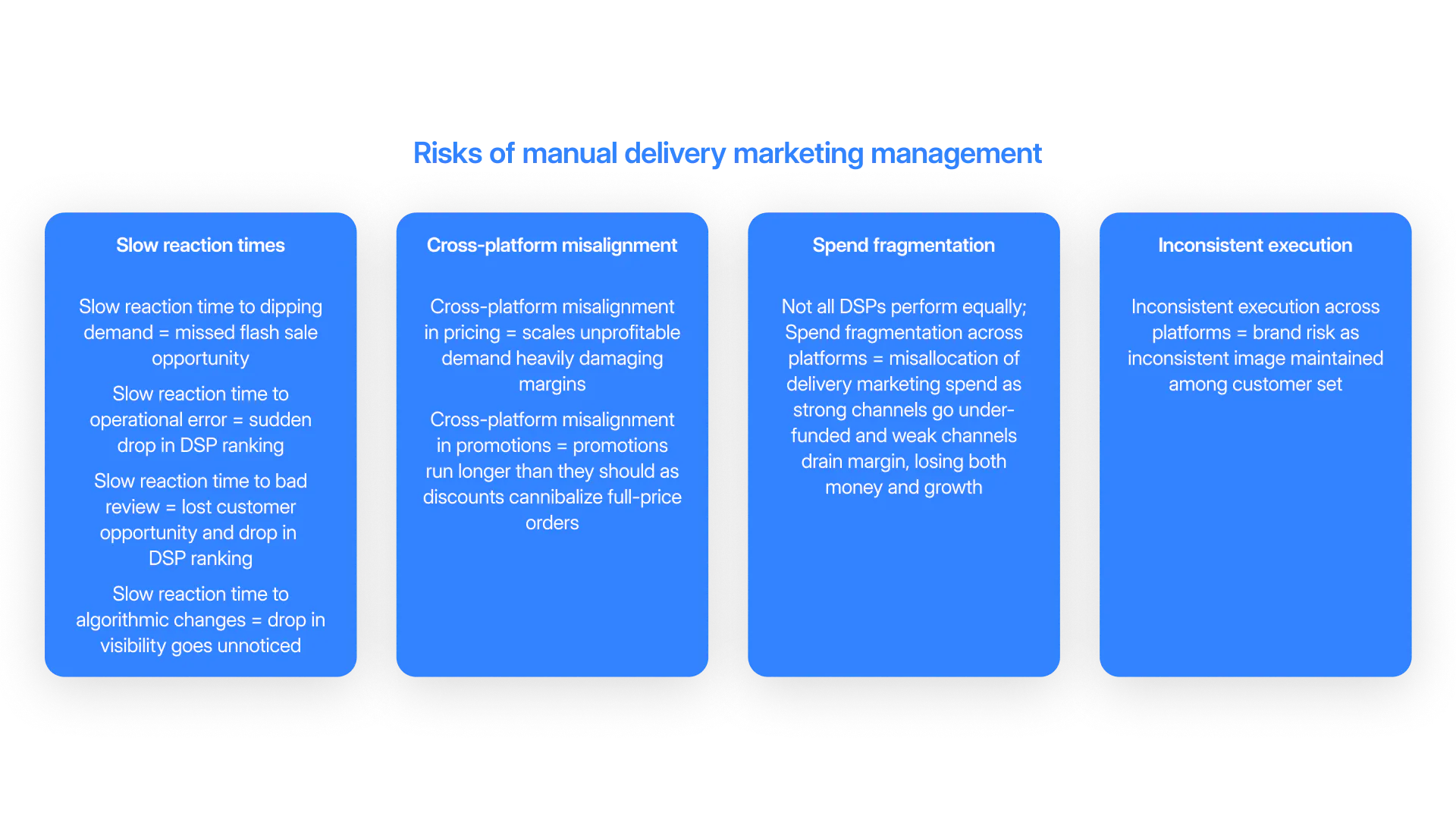
Without unified systems, restaurants face:
- Cross-platform misalignment in pricing, promotions, and messaging
- Slow reaction times to demand shifts or competitive threats
- Spend fragmentation among delivery platforms
- Inconsistent execution across locations
The Hidden Risks of Running Discounts or Promotions Without Measuring Net Payout
Discounting is one of the most widely used - and most dangerously misunderstood - delivery marketing levers.
Over 65% of online food outlets offer some form of promotion. Yet many restaurants run discounts without accurately measuring whether those promotions generate positive returns. This is particularly hazardous on delivery platforms, where commissions can reach 20–30% of gross sales.
A promotion that appears successful at the top-line sales level may actually destroy margin once platform fees, discount costs, and refunds are deducted. The critical metric is net payout- revenue after all commissions, promotions, and deductions - yet most operators lack visibility into this number in real time.
Sidebar: Without clear net payout measurement, restaurants risk:
Losing money on promotion-driven orders
Mistaking volume growth for profitability
Scaling unprofitable campaigns across locations
Subsidizing customers who would have ordered at full price anyway
Because each platform reports performance differently, calculating true net payout manually is time-intensive and error-prone. Many operators are effectively flying blind - optimizing for order volume without accurately revising margins.
7 Common Marketing Mistakes on Delivery Platforms
1. Applying Blanket Discounts Across Items or Order Values
Applying universal discounts on all menu items, or order value, without conditions like minimum spend or specific purchases, is one of the most common and costly mistakes. Blanket discounts create waste by subsidizing customers who would have ordered at full price, while failing to generate meaningful incremental demand.
Effective delivery marketing requires precision: the right offer, on the right platform, at the right time, for the right customer segment. Without this targeting, promotions cannibalize full-price orders instead of driving true growth.
2. Ignoring Reviews and Ratings
Platform algorithms heavily weight ratings and responsiveness to reviews. Failing to respond to reviews - especially negative ones - lowers rating scores and pushes listings down in search results.
Research shows that customers typically attribute delivery failures to the restaurant rather than the platform, even when issues stem from third-party logistics. Silence signals indifference, damages trust, and reduces re-order intent while simultaneously harming organic visibility.
Sidebar: Responding to reviews and couponing can increase return orders by up to five times, yet the majority of delivery reviews still go unanswered. (Otter Data)
3. Paid Ad Overspend
Paid visibility has become increasingly necessary, but many restaurants overspend on ads without measuring whether campaigns actually add incremental total revenue or simply shift existing demand to lower-margin promotional items.
If total revenue does not rise meaningfully relative to ad spend, the campaign is likely cannibalizing full-margin sales rather than generating new demand. Without incrementality tracking, operators cannot distinguish between growth and displacement.
“Manually calculating how much you’re actually making on delivery platforms is complicated when you’re running paid ads, promotions, and discounts—on top of commission charges and delivery fees that all impact your bottom line. Multiply that across multiple locations, and the complexity increases exponentially.”
— Edzel Tabing, Otter Restaurant Specialist
4. The Copy-Paste Promotion Trap Across Locations
Multi-location operators often replicate promotions across all stores for operational simplicity. This approach ignores a fundamental reality: every location operates in a distinct market with different demand patterns.
Customer preferences, order timing, menu mix, price sensitivity, and competitive intensity vary dramatically by neighborhood. The same promotion can:
- Drive profitable incremental growth in one location
- Waste promotional budget in another
- Reduce profitability in a third location where demand was already strong
As restaurant franchises scale, the cost of misalignment compounds. Static, uniform campaigns fail to account for local market dynamics and minimize the overall profitability of the delivery channel.
5. Margin Cannibalization and Marketing Spend Fragmentation
Not all delivery sales represent true incremental revenue. Research suggests that only 30–50% of delivery platform revenue is genuinely incremental, meaning a significant portion would have occurred through dine-in or direct ordering channels regardless.
Poorly designed promotions accelerate this cannibalization, training customers to wait for discounts rather than ordering at full price. Meanwhile, marketing spend fragments inefficiently across platforms, with operators lacking unified visibility into which channels, dayparts, and promotions actually drive profitable growth.
6. The Customer Relationship Imperative
Although over 50% of delivery users order two to five times per week - making retention critical - many restaurants fail to proactively manage their customer relationships.
Delivery platforms own customer relationships. They restrict restaurant access to customer-level data; email addresses, phone numbers, and direct communication channels remain platform property.These platforms effectively rent their customers to restaurants at a 30% commission premium, with limited restaurant ability to build direct relationships or shift customers to higher-margin channels.
The few relationship levers restaurants can use are:
- Review and ratings management
- Platform-mediated loyalty programs
- Personalized discount targeting
Yet many restaurants fail to establish digital loyalty programs, personalized discounts, or manage reviews and ratings in a timely manner. This is often due to the challenge of manually managing these relationships across multiple platforms and hundreds of locations is operationally overwhelming, even as failure to execute consistently impacts rankings, customer loyalty, and repeat purchase behavior.
7. Operational Blind Spots That Damage Rankings
Small operational failures can trigger sudden ranking drops that are difficult to diagnose manually. Slower prep times, declined orders, incorrect refunds, or inventory mismanagement all send negative signals to platform algorithms.
Manual operators often detect these correlations only after sales have already declined for days or weeks. By the time the issue is identified, recovery requires aggressive promotional spending to regain lost visibility.
Refunds and chargebacks represent another hidden drain. Mismanaged platform refunds leak revenue and create reconciliation challenges that many operators lack the time or tooling to resolve systematically.
Why Manual Management Becomes Unsustainable
The core challenge is not that delivery marketing is conceptually difficult - it's that execution requires continuous, real-time optimization across dozens of variables per location.
Manual management struggles with:
- Reaction time lag: Missing demand dips, competitive threats, or ranking drops until significant revenue has been lost
- Limited bandwidth: Human operators cannot monitor and adjust promotions across multiple platforms, locations, and dayparts simultaneously
- Data fragmentation: Performance data is scattered across platform dashboards with no unified view of net profitability
- Cognitive overload: The volume of decisions required per location exceeds human capacity to process and act on efficiently
For single-location operators, manual management is challenging but possible. For multi-location franchisees and operators managing dozens or hundreds of stores, it becomes mathematically impossible to execute with the precision delivery platforms now demand.
The Path Forward: Unified, Automated Measurement
To operate profitably on delivery platforms at scale, restaurants need:
- Dynamic, localized promotions that adjust to real-time demand by location and platform
- Automated tracking of incremental net payout, not just gross sales
- Unified visibility across platforms, locations, and campaigns
- Real-time optimization that responds to algorithm changes and competitive moves within hours, not days
Tools that automatically track net payout and incrementality enable restaurants to shift from reactive discounting to strategic delivery marketing - protecting already thin margins while scaling what actually works.
Without this level of automation and insight, restaurants face a predictable outcome: growing delivery sales volume, shrinking profitability, and limited ability to course-correct before damage compounds.
The most successful operators recognize that delivery marketing is no longer a channel that can be managed manually at scale. They invest in systems that automate measurement, enable rapid testing, and surface the insights needed to make confident strategic decisions—allowing human operators to focus on strategy, operations, and food quality rather than chasing data across fragmented dashboards.
¹ Huang, Yuru, et al. “Menu Item Prices and Promotions Offered on a Meal Delivery App in the UK and Their Socio-Economic Patterns.” Public Health Nutrition, vol. 28, no. 1, 13 June 2025, e110, Cambridge University Press, https://doi.org/10.1017/S1368980025100529. PMC, https://www.ncbi.nlm.nih.gov/pmc/articles/PMC12305391/
² Lefebvre, Sarah, Marissa Orlowski, and Laura Boman. “It’s All Your Fault! Restaurant vs. Platform Blame Attribution in Food Delivery Service Failures.” British Food Journal, vol. 126, no. 8, July 2024, pp. 3037–3050, Emerald Publishing, https://doi.org/10.1108/BFJ-12-2023-1103.
³ Collison, Jack. “The Impact of Online Food Delivery Services on Restaurant Sales.” Department of Economics, Stanford University, Spring 2020, https://web.stanford.edu/~leinav/teaching/Collison.pdf.
⁴ Gupta, Adyya, et al. “Use of Online Food Delivery Services Among Adults in Five Countries from the International Food Policy Study 2018–2021.” Preventive Medicine Reports, vol. 43, July 2024, article 102766, Elsevier, https://doi.org/10.1016/j.pmedr.2024.102766.
Delivery Marketing Measurement & Attribution
Mastering delivery marketing strategies is only half the equation. The other half - where most operators struggle - is measurement. On third-party platforms, traditional marketing metrics are obscured by platform economics, fragmented reporting, and pay-to-play mechanics that make it difficult to understand what truly drives results.
This section outlines what to measure, where to find it, and how to attribute performance correctly, so that delivery marketing decisions are based on incremental impact, not misleading top-line signals.
Why Traditional Marketing Metrics Break on Delivery Platforms
In most marketing channels, performance is evaluated using familiar indicators: revenue lift, return on ad spend (ROAS), and customer acquisition cost. On delivery platforms, these metrics exist - but they are distorted.
Delivery platforms layer commissions, service fees, delivery charges, refunds, and paid visibility costs directly into transactions. Each platform structures promotions, ads, and reporting differently. The result is a marketing environment where activity is visible, but impact is not.
Critical Reality: A promotion may increase order volume, improve app visibility, and show strong platform-reported ROAS, while still reducing profitability once fees and discounts are applied.
As research on attribution modeling notes, platforms often obscure true incrementality in digital channels like delivery, making it difficult to distinguish correlation from causation. This disconnect is not a failure of marketing strategy - it is a failure of measurement.
Key Distinction: Incrementality asks not whether sales went up — but whether those sales would have happened anyway.
Many operators experience a frustrating pattern: marketing seems to "work," sales go up, dashboards look healthy - but profits simply aren’t where they should be. The root cause is almost always the same: optimizing for the wrong metrics.
The Three KPls that matter
1. Incremental Net Payout
2. New Customer Acquisition
3. Customer Lifetime Value (LTV)
1. Incremental Net Payout
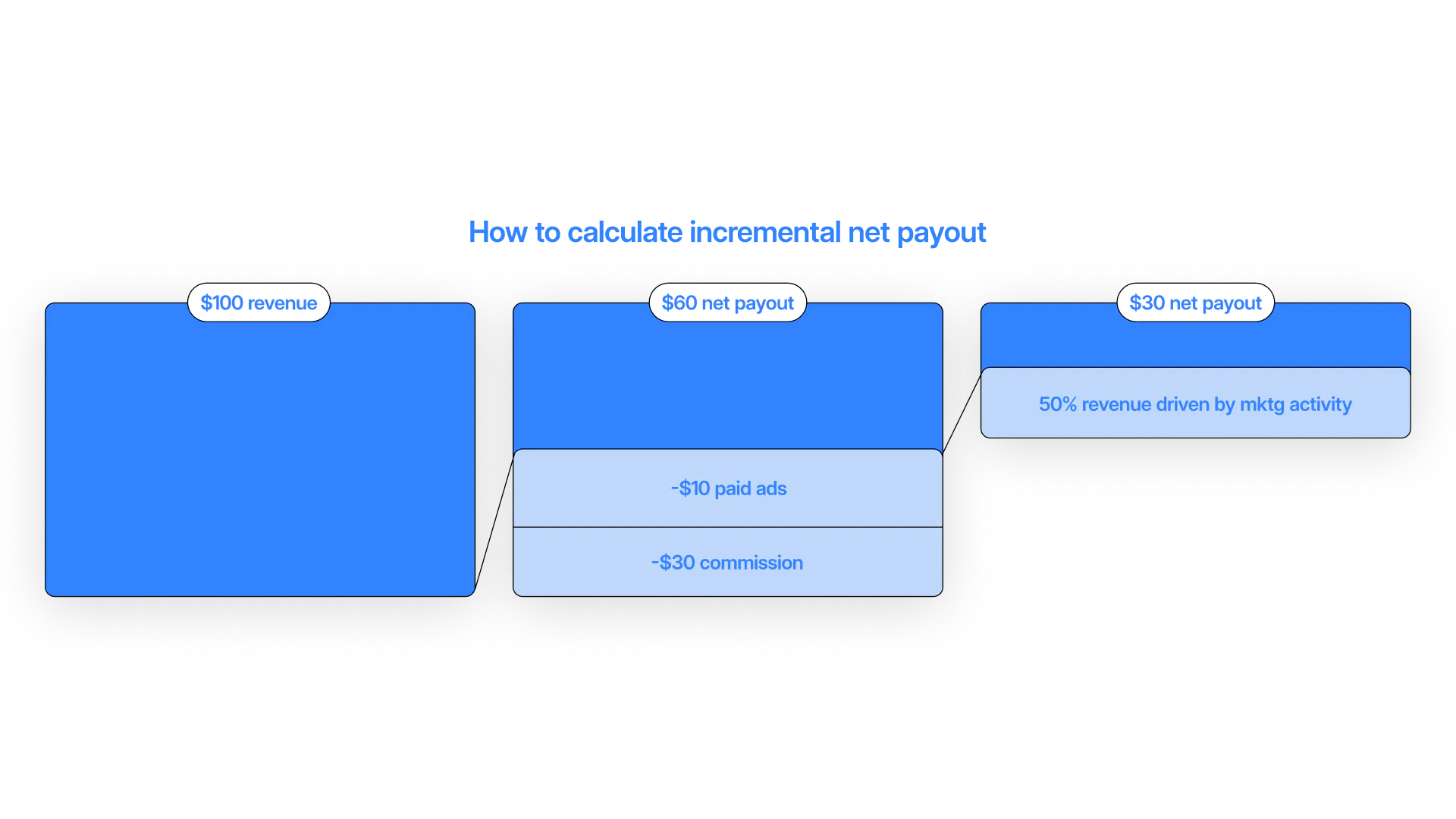
Incremental net payout measures how much more your restaurant actually takes home as a result of marketing activity - after all platform commissions, discounts, refunds, and fees are removed.
This is the most important delivery marketing metric because it reflects true marketing ROI, margin impact, and whether a campaign should be scaled or stopped.
A campaign that increases orders but reduces net payout has failed, regardless of how strong it looks in platform dashboards. Yet this outcome is common because most operators track gross sales rather than post-commission profitability.
Incremental net payout reframes delivery marketing from "driving volume" to "driving profitable growth."
2. New Customer Acquisition
Delivery platforms make it easy to drive orders, while making it much harder to tell who those orders came from.
Customer acquisition measurement focuses on how many new customers a campaign brings in compared against baseline or control stores, rather than discounting customers who already would have ordered.
The most common waste in delivery marketing spend is paying for visibility or discounts that reach existing customers who would have ordered at full price. Without new customer tracking or proper attribution, this waste is invisible.
3. Lifetime Value (LTV)
Lifetime value measures the long-term return on customer acquisition and promotions. Some delivery marketing tactics intentionally trade short-term margin gains for long-term customer retention. Calculating LTV helps to answer whether customers who were acquired through promotions reorder, whether they order at higher frequency, and whether they become profitable over time.
Without LTV measurement, operators risk killing acquisition strategies that pay off later or scaling discounts that never recover their cost. Research shows that 20-30% of the higher acquisition costs can make sense when strong retention turns first-time buyers into repeat customers.
LTV provides the strategic justification for why certain acquisition costs and promotions are worth tolerating even when they erode margins in the short term - when used intentionally.
Where to Find Delivery Marketing Data (and Why It's Fragmented)
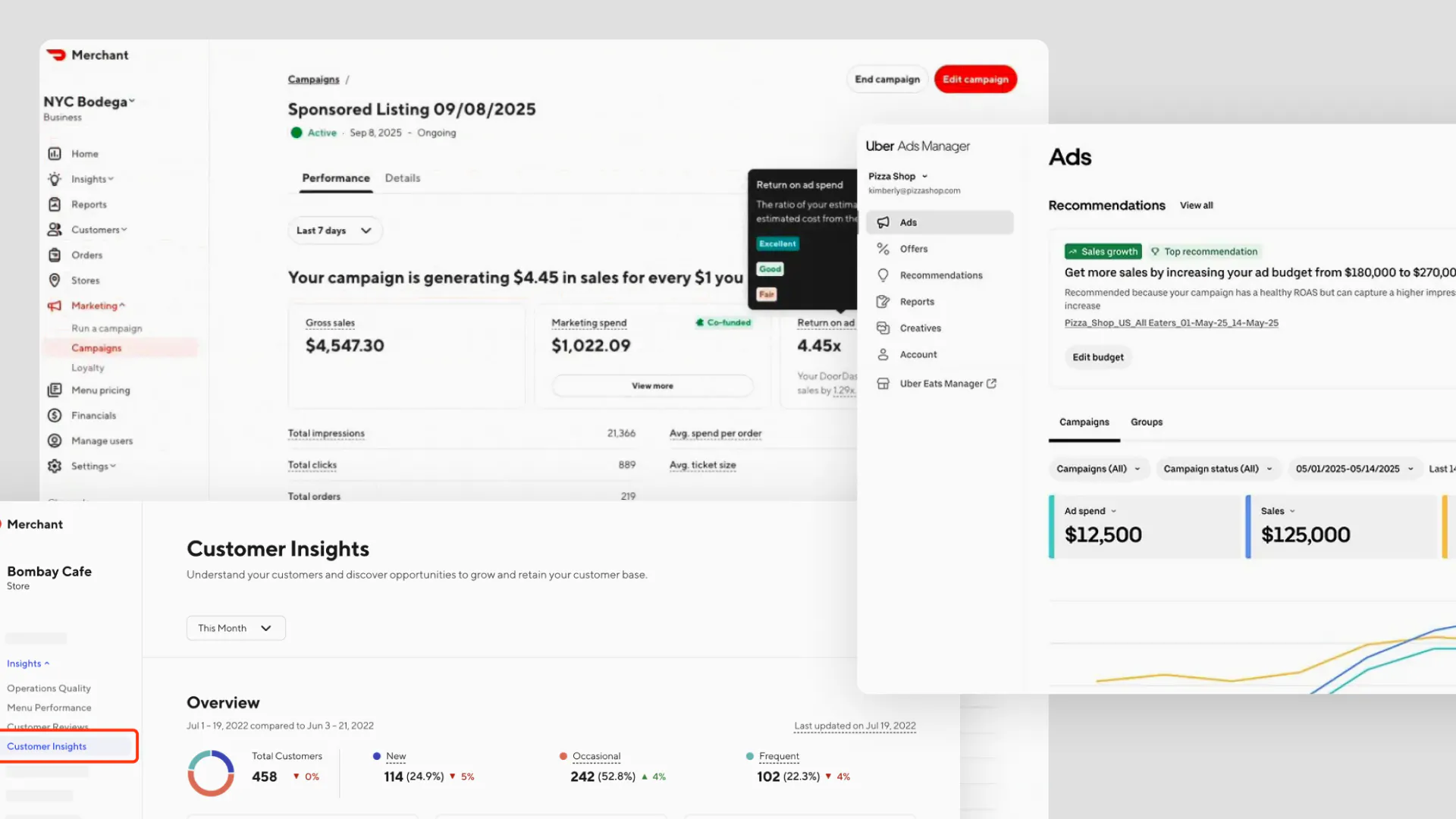
Delivery marketing data lives across multiple disconnected systems: promotion dashboards show discount performance and redemptions, ad dashboards track impressions and attributed orders, store performance views display orders and ratings, financial reports contain payouts and commissions, and review tools monitor reputation metrics.
Each platform presents these metrics in isolation. None provide a unified view of how marketing actions translate into incremental net profitability across locations and time.
Manually stitching this together is possible - but it’s time-intensive, error-prone, and difficult to scale beyond a handful of stores. This fragmentation is why operators often default to the easiest metric to observe: order volume - even though it is rarely the right one.
Best Practices for Measurement & Attribution
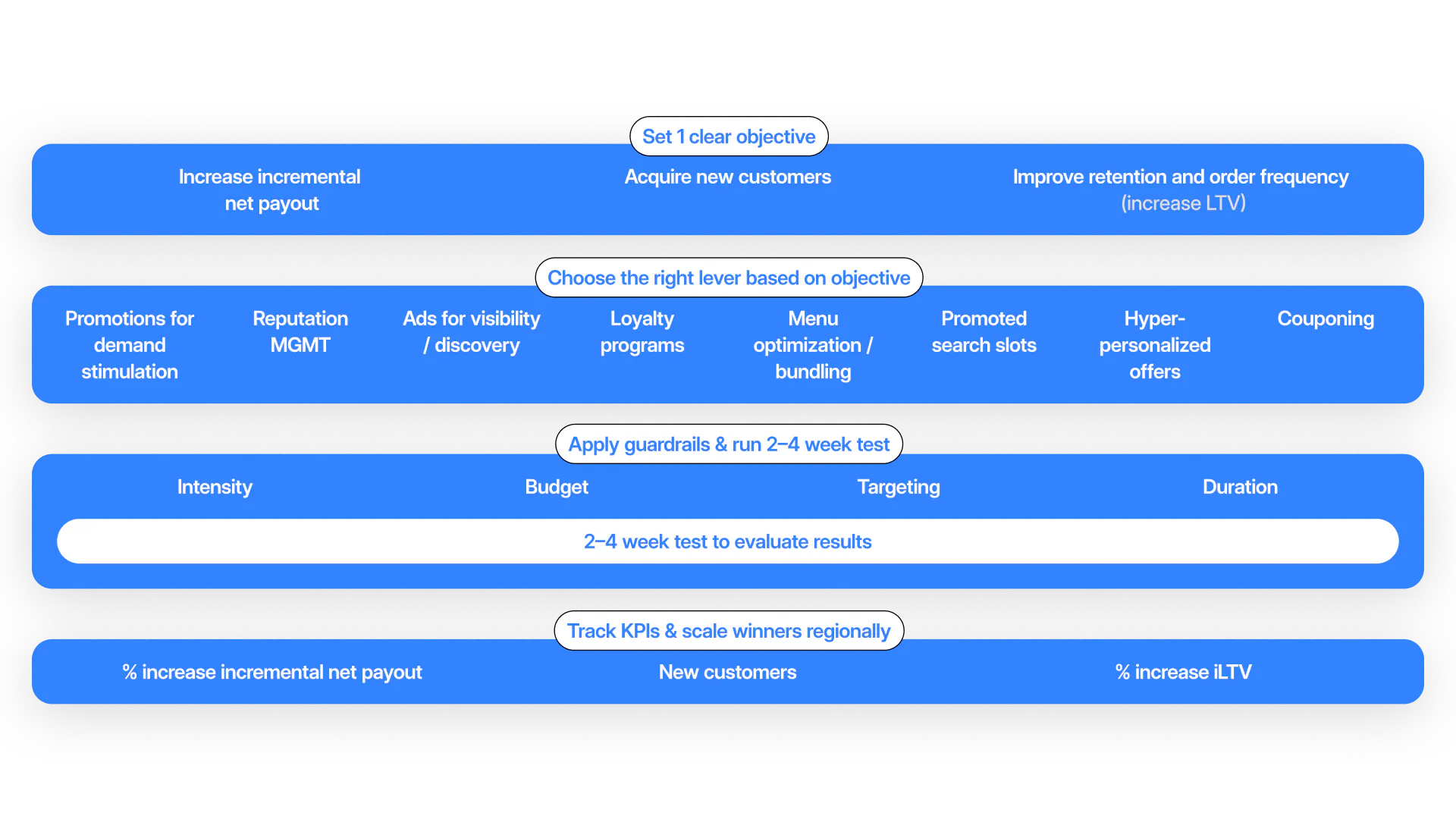
Effective delivery marketing measurement follows a disciplined testing framework that isolates what actually works.
1. Set One Clear Objective
Every campaign should have a single primary goal: increase incremental net payout, acquire new customers, or improve retention and order frequency.
Clear objectives determine which stores to test, which stores act as controls, and which KPIs define success. Campaigns with multiple competing goals produce ambiguous results that cannot be acted upon.
2. Choose the Right Lever Based on Objective
Select the marketing lever based on the identified gap: promotions for demand stimulation, ads for visibility and discovery, and reputation management for conversion and retention.
Avoid pulling multiple levers simultaneously unless attribution can be isolated. The goal is to understand what’s actually working—not just what’s happening at the same time..
3. Apply Guardrails and Run a 2–4 Week Test
Guardrails limit downside risk and improve signal clarity. They define how hard, where, when, and how much to push, ensuring marketing drives profitable growth rather than accidental margin loss.
- Intensity: How aggressive marketing should be, set as a percentage of weekly delivery revenue. Ranges from conservative (defensive visibility) to aggressive (new customer acquisition). Prevents over-discounting during already-strong demand periods.
- Budget: Spend caps as a percentage of revenue or fixed dollar limits, automatically enforced across platforms. Eliminates manual tracking and surprise overruns. Keeps marketing predictable and finance-aligned, even across hundreds of stores.
- Targeting: Where marketing is applied - specific stores, regions, or platforms. Ideal for pilot programs, underperforming locations, or competitive trade areas. Enables clean test versus control comparisons. Without targeting, you cannot tell what's actually working or where to scale.
- Duration: When marketing runs: parts of the day, days of the week, campaign windows. Aligns with operational capacity and avoids discounting during peak demand when orders would have occurred anyway.
Short, controlled tests outperform long "set-and-forget" campaigns. Guardrails prevent the two most common risks: runaway discounting and campaigns that negatively impact profitability.
4. Track KPIs and Scale Winners Regionally
Measure performance against control stores or baseline periods. When a campaign shows positive incremental net payout and customer acquisition, scale to similar stores or markets, but avoid blanket rollouts without validation.
Attribution is local before it is global. What works in one market may not translate to another due to competitive dynamics, customer demographics, or operational capacity differences.
Why Automation Matters for Measurement & Attribution
The challenge is not knowing what to measure - it's executing measurement consistently across platforms, stores, and time.
Manual measurement breaks at scale for the same reasons manual execution does: data fragmentation, reaction time lag, and cognitive overload. By the time performance is manually reconciled across platforms, market conditions have shifted, and opportunities have closed.
Tools like Otter automate the full measurement loop: unified visibility into promotions, ads, payouts, and reviews (audit), guardrails applied across platforms and locations (execution), and incremental net payout, acquisition, and performance tracking (measurement).
This automation allows operators to move from reactive reporting to proactive optimization, making delivery marketing measurable, scalable, and profitable.
Without this level of measurement discipline, restaurants risk growing delivery sales with shrinking margins and a limited ability to course-correct before damage compounds.
¹ Kannan, P. K., Werner Reinartz, and Peter C. Verhoef. “The Path to Purchase and Attribution Modeling: Introduction to Special Section.” International Journal of Research in Marketing, vol. 33, no. 3, 2016, https://doi.org/10.1016/j.ijresmar.2016.07.001.
² Fanderl, Harald. “Focusing on Existing Customers to Unlock Growth.” McKinsey & Company, 16 Aug. 2023, https://www.mckinsey.com/~/media/mckinsey/email/rethink/2023/08/2023-08-16c.html.
Case Studies: Proving Incremental Net Payout
1. National Breakfast Chain + Otter
Objective: Increase delivery visibility and conversion without sacrificing margins.
Approach: Leveraged Otter’s automated services to optimize feed ranking and carousel placement, focused on incremental demand rather than blanket discounts, ran a structured pilot with test versus control stores.
90-Day Results:
- +4.21% net payout growth
- +3.66% revenue growth
Why This Matters: Revenue increased and net payout increased—confirming the lift came from incremental orders, not margin-eroding discounts. This is attribution done right: tying marketing actions to what actually hits the P&L.
Key Takeaway: If revenue is up but net payout is flat or down, marketing isn't working—no matter what the top line says.
2. Large McDonald's Franchisee (New York)
Objective: Drive profitable delivery growth across multiple locations.
Approach: Used Otter’s marketing services for strategic promotional optimization tailored by location, with continuous measurement of incremental net payout. Corporate marketing objectives and campaign schedules were factored in to avoid overlaps.
60-Day Results:
- +15% net revenue per store
- 11,900 new customers acquired
Why This Matters: Double-digit net revenue growth proves the strategy generated profitable demand rather than subsidizing existing orders. The per-store focus demonstrates that localized optimization outperforms blanket campaigns.
3. Reputation Management with Targeted Recovery
Objective: Recapture at-risk customers through review response and personalized offers.
Approach: AI-driven review response combined with targeted coupon delivery to customers who left negative feedback or showed signs of churn.
Results:
- 5x increase in return orders for engaged customers
- 9.2x ROI on coupon spend
Why This Matters: Reputation management is often treated as brand hygiene rather than a revenue driver. This case proves that strategic review response - paired with recovery offers - generates measurable sales lift with strong returns. The 5x repeat rate demonstrates that engagement converts to loyalty when executed systematically.
Automation & AI: Your Competitive Advantage
Delivery marketing has reached a level of complexity where success is no longer determined by knowing what to do - promotions, ads, review management - but by whether those actions can be executed consistently, profitably, and at scale across locations simultaneously.
Manual execution breaks at scale. Without automation, the default outcome is either operational paralysis or profit erosion hidden behind growing order volume.
Automation and AI are not about replacing humans - they work as co-pilots to solve the delivery marketing challenges restaurant operators face. When used correctly, AI systems act as decision support - handling spend analysis, monitoring signals, and optimizing execution, while humans retain control over strategy, brand, and food.
With the Right Tools, You Don't Need a Full Marketing Department
Most delivery marketing failures are not caused by poor strategy. They are caused by insufficient execution capacity.
Managing delivery platforms requires monitoring performance across multiple apps, adjusting promotions by location, platform, and time of day, tracking net payout after commissions and discounts, responding to reviews in real time, detecting ranking drops caused by operational signals, and coordinating national and local campaigns without conflict.
Historically, this level of execution required a large dedicated marketing team (an unrealistic burden for most operators). Automation changes the equation by allowing a small team, or even a single operator, to manage delivery marketing with the precision of a much larger organization.
Key Reality: Automation changes the equation by allowing a small team, or even a single operator, to manage delivery marketing with the precision of a much larger organization.
The goal of AI in delivery marketing is not creativity or brand storytelling. It is capacity expansion: enabling restaurants to execute known best practices using key data and metrics reliably across hundreds of daily decisions that humans cannot reasonably manage manually.
Indispensable Supporting Tools: Let Humans Decide Strategy, Let Tech Do the Math
Delivery platforms are dynamic systems. Rankings shift hourly. Demand fluctuates by the minute. Competitor behavior changes continuously. The real challenge is not deciding what should happen - it's ensuring the right action happens at the right moment.
Unified systems like Otter are designed to sit between strategy and execution. Humans define goals: growth versus profitability, where to invest, what risks are acceptable. The system continuously evaluates performance signals and applies those goals in real time.
Instead of logging into multiple dashboards, reconciling spreadsheets, and reacting after revenue has already declined, operators gain a single, centralized tool that automates monitoring, testing, and adjustment across platforms.
This directly addresses the core failure modes of manual delivery marketing: slow reaction times, inconsistent execution, margin erosion hidden behind top-line growth, and cognitive overload as scale increases.
What AI Can Do Well: Continuous, Localized Optimization
When applied correctly, AI-leveraging platforms like Otter excel at exactly the tasks that break manual delivery marketing.
Per-Store Optimization
Each location operates in a unique micro-market. AI systems analyze store-level performance - order volume, conversion, ranking, payout - and select promotions tailored to that specific location rather than copying national campaigns blindly.
Consider a scenario familiar to multi-location operators: two stores five miles apart in the same city. One sits in a price-sensitive neighborhood with heavy competition. The other serves an affluent area with limited alternatives. A blanket 20% discount wastes budget at the second location while underperforming at the first. AI identifies this asymmetry and adjusts - perhaps 25% off at the competitive location, no promotion at the second one - maximizing net payout across both.
Per-Platform Optimization
Because DoorDash, Uber Eats, and other platforms reward different behaviors, AI evaluates performance independently on each platform. A promotion that works on one app does not automatically propagate to another unless performance justifies it.
Different platforms have different user bases, different peak times, and different competitive landscapes. What drives visibility on Uber Eats during lunch may be completely different from what works on DoorDash during dinner. AI recognizes these patterns and optimizes accordingly.
Per-Day and Per-Daypart Adjustment
AI continuously evaluates demand patterns by time of day and day of week, enabling lunch-only or late-night promotions, off-peak demand stimulation without all-day discounting, and rapid pullback of underperforming campaigns before margin damage compounds.
This timing precision prevents one of the costliest mistakes in delivery marketing: running promotions during periods when demand is already strong. AI identifies when promotions drive incremental orders versus when they simply discount orders that would have happened anyway.
Automated Measurement of Net Payout and ROI
Perhaps most critically, AI systems track performance after commissions, discounts, and refunds, surfacing true net payout. This directly addresses the most dangerous failure mode in delivery marketing: scaling promotions that look successful on gross sales but destroy margin.
Over time, these systems learn which combinations of offer type, timing, and intensity generate incremental demand rather than cannibalizing existing orders. This learning compounds: each week of data improves the accuracy of future optimization decisions.
What AI Cannot Fix
AI is not a solution to foundational restaurant business problems.
It cannot fix poor food quality, slow or inconsistent operations, inaccurate prep times, weak packaging or customer experience, or chronic order errors.
AI should be viewed as an optimization layer on top of a functioning operation, not a substitute for operational discipline. Restaurants must still execute well on fundamentals for automation to be effective. The most successful implementations pair automation with operational excellence - the AI maximizes visibility and conversion while tight operations ensure every new order strengthens rather than weakens the restaurant's position.
Otter Guardrails: Control Without Micromanagement
One of the most common fears operators have about automation is loss of control. Modern systems address this through explicit guardrails.
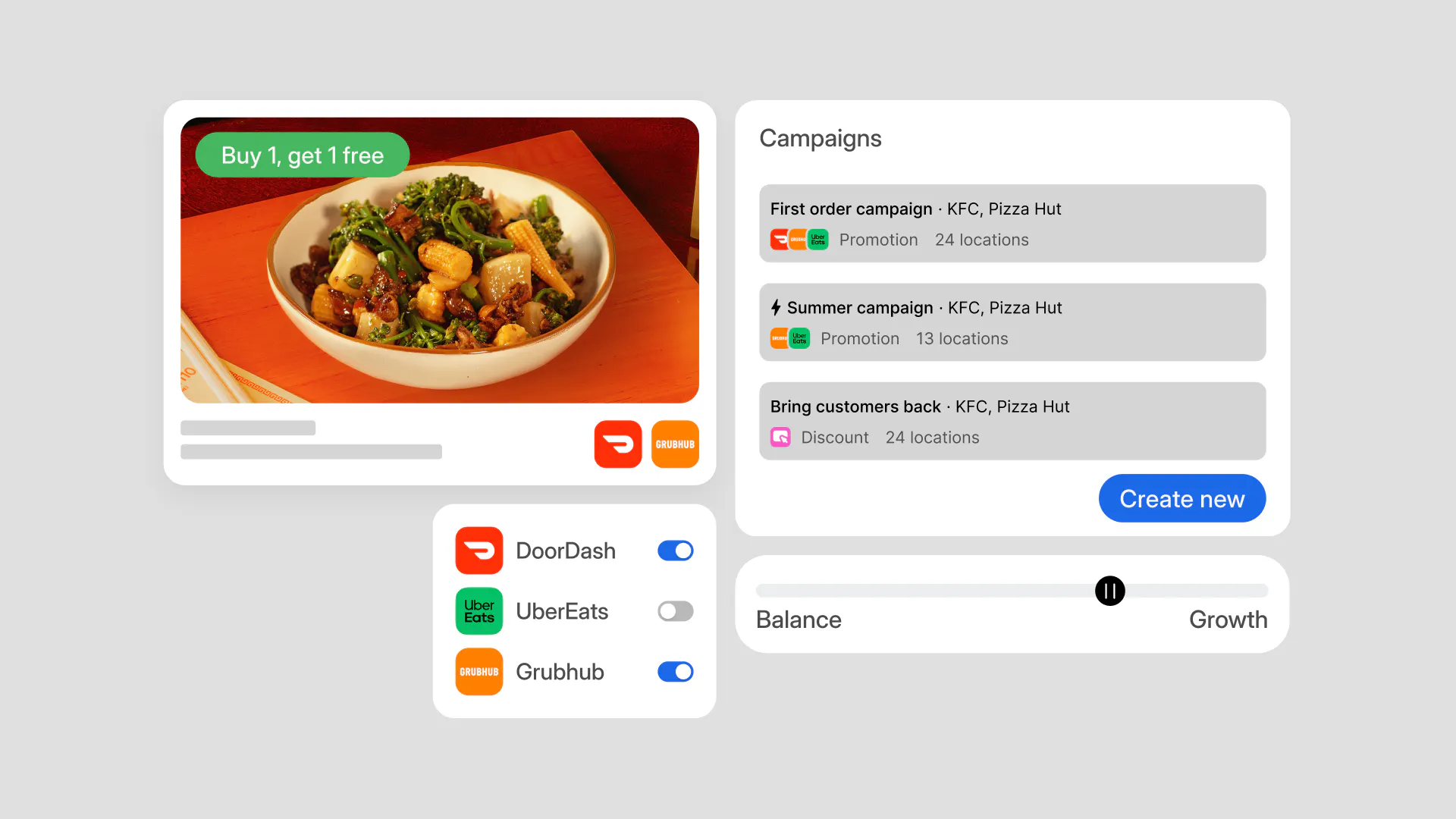
Otter allows operators to define budget (spend caps as a percentage of revenue or fixed dollar limits), duration (clear campaign start and end dates), intensity (how aggressive promotions should be, whether growth-focused or margin-conscious), and targeting (specific stores, regions, platforms, or customer segments).
Within these constraints, the system dynamically selects and adjusts promotions. Outside of them, it does nothing.
In practice, this might look like: "Spend up to 8% of revenue on promotions across all platforms, running Monday through Thursday only, with moderate intensity focused on lunch daypart, targeting stores in competitive markets." The system then executes within those boundaries, testing and optimizing while respecting the strategic constraints. It analyzes previous store performance and tries different promotion types that are still within the set guardrails.
This structure prevents two of the most common automation risks: runaway discounting and set-and-forget campaigns that quietly erode profitability.
Guardrails also enable safe experimentation. An operator can test aggressive promotional strategies in a subset of locations with strict budget caps, evaluate the results, and then scale what works without risking the entire portfolio.
AI as a Co-Pilot: Automation That Amplifies Human Judgment
The most effective operators use AI-powered delivery marketing systems, like Otter, as a co-pilot - not an autopilot.
Humans still decide which markets matter most, how aggressive growth targets should be, what brand standards must be preserved, and when to prioritize margin protection over volume.
AI tools support those decisions by executing consistently across platforms, detecting issues before they escalate, quantifying tradeoffs between growth and profitability, and scaling what works while shutting down what doesn't.
In this model, delivery marketing automation does not replace judgment - it protects it. Strategic decisions are implemented faithfully across thousands of micro-decisions that would otherwise overwhelm even the most experienced teams.
AI-Powered Optimization in Practice
Ad Campaigns
Manual ad management breaks predictably: campaigns launch, performance drifts, and budget wastes for weeks before decline is noticed. AI-powered delivery marketing systems, like Otter, treat campaigns as continuous optimization problems, analyzing store performance, evaluating regional dynamics, and recalibrating automatically based on what's converting.
Customer Re-Targeting and Loyalty
Beyond tracking customer relationships, AI customer loyalty tools can deliver the minimum effective incentive to high-value lapsed customers rather than subsidizing habitual orderers.
Unified Data and Insights
AI-driven tools, like Otter’s, consolidate metrics - promoted sales, ROI, discount performance, store rankings - into unified views that surface what requires attention. Operators see which promotions drive incremental demand versus which cannibalize full-price orders in real time.
Storefront and Menu Optimization
AI continuously tests what customers actually see: which items drive highest margins, which SKUs damage ratings, which photos convert, how browsing patterns suggest reorganization. Research shows optimized descriptions improve conversion by 27%, while strategic item positioning increases order value without discounting.
AI enforces clarity systematically: removing modifier overload, surfacing high-converting items, ensuring photos match expectations.
Lesser-Known Visibility Hacks
Several tactical optimizations deliver disproportionate returns but remain underutilized.
Maintaining 100% uptime prevents ranking drops from brief offline periods - platform algorithms penalize inconsistent availability.
Delivery menu pricing requires strategic calibration; prices significantly higher than in-store equivalents trigger algorithmic penalties that can reduce sales by up to 37%.
Item-specific promotions during peak hours outperform blanket discounts. Promoting high-margin items during lunch or dinner rushes drives sales spikes without training customers to expect constant discounting.
Layering multiple signals, like Happy Hour promotions, with professional photos and dietary tags amplifies visibility through both promotional ranking boosts and improved personalization matching.
Platform analytics enable rapid testing of delivery-exclusive bundles that drive repeat orders without broad discounting. Daily monitoring separates what actually converts from what merely sounds appealing.
The Co-Pilot Model
The relationship between restaurant operator and marketing system should be collaborative. The system surfaces insights that the operator investigates and resolves. The system then optimizes around the improved baseline.
This division of labor plays to the strengths of both human and machine intelligence. Humans excel at strategic thinking, brand stewardship, and context. AI excels at pattern recognition, executing repetitive optimizations without fatigue, and detecting subtle signals invisible in manual analysis.
Systems like Otter operationalize this co-pilot partnership: operators set strategic guardrails - budget, intensity, targeting, duration - while the platform executes within those boundaries, continuously testing and adjusting across locations and platforms. The operator controls strategy; AI handles execution complexity that manual management cannot sustain at scale.
The Path Forward
The challenges outlined in this report are not theoretical. They are structural realities of modern delivery platforms that will only intensify as competition increases.
As delivery marketing complexity grows, the gap between restaurants that rely on manual execution and those that invest in unified automation will continue to widen. The outcome is predictable: manual operators chase volume and lose margin, while automated operators protect profitability while scaling intelligently.
The winners will not be the restaurants with the biggest discounts - but the ones with the best systems.
The question facing operators today is not whether to automate delivery marketing—it's whether to automate intentionally with systems designed for restaurant economics, or to be automated by platform algorithms optimized for platform profitability.
Restaurants that build their own optimization layer maintain strategic control while competing effectively. Those that don't are left managing delivery marketing manually in an environment explicitly designed to overwhelm manual management.
Delivery platforms will continue to increase in complexity. More advertising options, more promotional formats, more data to track, and more decisions required per day. The restaurants that thrive will be those that recognize automation not as a luxury or future consideration, but as an essential capability for competing profitably in the current environment.
The fundamentals still matter: great food, tight operations, excellent customer service. But in 2026 and beyond, operational excellence alone is insufficient. The restaurants that win will combine strong fundamentals with intelligent systems that ensure those fundamentals translate into sustained visibility, profitability, and growth across every platform and every location.
¹ Wansink, Brian, James E. Painter, and Koert van Ittersum. “Descriptive Menu Labels’ Effect on Sales.” Cornell Hotel and Restaurant Administration Quarterly, vol. 42, no. 6, Dec. 2001, pp. 68–72, DOI:10.1016/S0010-8804(01)81011-9.
Sources
https://favoured.co.uk/food-delivery-app-marketing-strategies/
https://famepilot.com/tips-to-increase-visibility-on-uber-eats-doordash/
https://speedsternow.com/blog/how-to-do-restaurant-marketing-right-for-food-delivery-services/
https://din-studio.com/restaurant-tech-how-food-delivery-apps-build-customer-retention/
https://pmc.ncbi.nlm.nih.gov/articles/PMC10091328/
https://help.uber.com/en-AU/merchants-and-restaurants/article/sponsored-listings-faq
https://oyelabs.com/business-models-for-food-delivery-app-like-ubereats/
https://blog.menuviel.com/improve-restaurant-ranking-on-food-delivery-platforms/
https://www.getkard.com/blog/doordash-marketing-strategy--market-dominance-and-merchant-success
Consumers’ intentions to use online food delivery systems in the USA
Gunden, Nefike; Morosan, Cristian; DeFranco, Agnes. International Journal of Contemporary Hospitality Management; Bradford Vol. 32, Iss. 3, (2020): 1325-1345. DOI:10.1108/IJCHM-06-2019-0595