
Table of contents
- Three Questions That Actually Matter Before You Compare Any Platform
- 1. Owner.com: Built for Operators Who Want to Cut Third-Party App Fees
- 2. TouchBistro Marketing: Built for Operators Already Running TouchBistro POS
- 3. Mailchimp and Email-First Platforms: Built for Operators With a List and Time to Manage It
- 4. OpenTable and Reservation-Native Tools: Built to Fill Tables, Not Drive Conversions
- 5. Enterprise Platforms (Salesforce, Malou): Built for Groups, Not Independent Operators
- 6. Otter Marketing: Built for Operators Running Delivery Apps Who Want Measurable ROI
- The Question Every Platform Dodges: Who Actually Owns Your Customer Data?
- Why Marketing Without Ops Data Behind It Underperforms
- How to Match the Platform to Where Your Restaurant Is Right Now
- Your Revenue Mix Determines Which Platform Delivers ROI
- Frequently asked questions about restaurant marketing platforms
You’re paying for a marketing platform, or about to, and every demo sounds identical. Automation, loyalty, analytics, “seamless guest engagement.” None of them lead with the thing that actually matters: this tool was built for a 50-unit chain, not for you.
This guide cuts through that. Below is an honest breakdown of the major restaurant marketing platforms: what each one was actually engineered to do, who it fits, and where it falls short. Scored against three operator-level criteria, not feature checklists.
Key Insights
- Every restaurant marketing platform was engineered for a specific operator type (independent, multi-unit, or enterprise chain), and buying the wrong tier costs you real money in unused features, training time, and pricing built for someone else’s scale.
- Several of the most popular platforms are walled gardens: the vendor holds your guest data, and walking away may mean walking away without your email list. Always test the export function before you sign, not after you’re locked in.
- Marketing tools that sit in a silo from your POS and delivery app data send campaigns based on guesses, not behavior. Every misfired promo to the wrong guest at the wrong time is margin you gave away for no reason.
- For delivery-heavy independent operators, automated delivery app promotions with cross-channel analytics deliver the fastest measurable ROI before a single email workflow is ever built.
Three Questions That Actually Matter Before You Compare Any Platform
Before you book a single demo, run every platform through these three filters. Your full marketing stack, including social media management, email, and loyalty, should connect to where your revenue actually comes from.
1. Who was this built for?
Enterprise platforms built for 50-unit chains come with enterprise pricing, enterprise complexity, and zero empathy for an owner running the floor at 6 p.m. If the vendor doesn’t publish pricing and routes every inquiry to a sales team, that’s your answer.
2. Who owns the guest data when you cancel?
If you grow a loyalty base inside a vendor’s walled garden, you may not own that list when you leave. First-party data, meaning an email list you can export in a standard format, is a real business asset. A list trapped in someone else’s CRM is a subscription liability.
3. Does it connect to your operations, or sit in a silo?
Platforms with no ops integration can’t read your POS or delivery app data, so they send campaigns based on guesses, not behavior. The result: win-back emails land on guests who ordered yesterday, and promo discounts go to your most loyal regulars who didn’t need the incentive.
Each entry below is scored against these three criteria, not the marketed feature list, so you can shortcut the demo process.
1. Owner.com: Built for Operators Who Want to Cut Third-Party App Fees
Core design goal: Replace DoorDash and Uber Eats commissions with a branded, SEO-optimized direct-ordering website that captures first-party data at checkout.
What it does well:
- Google Business Profile integration that drives local SEO visibility and improves your Google Maps ranking
- Direct online ordering solution with email capture built into the checkout flow
- Reduces dependence on third-party commissions (typically 20 to 30% per order) over time
Who it fits best: Independents currently paying meaningful third-party commissions who are ready to invest marketing spend in driving direct traffic. If shifting guests from delivery apps to your own channel is the primary goal, this is the most purpose-built tool for that job.
Honest limitation: This is not a set-and-forget system. The direct site only works if you actively drive traffic to it through social media posts on Instagram or TikTok, email campaigns, and paid digital marketing. If you don't market the site, guests don't find it. Simple as that — a restaurant marketing checklist helps you keep that promotion consistent.
Data ownership checkpoint: Ask specifically whether you can export your complete customer list at any time and what happens to that data on cancellation. Get the answer in writing.
What it doesn’t cover: Delivery app promotion management and cross-channel analytics comparing direct versus third-party performance. If you want to optimize revenue on the apps while building direct, you’ll need a second tool.
2. TouchBistro Marketing: Built for Operators Already Running TouchBistro POS
Core design goal: Loyalty and promotions native to the TouchBistro POS ecosystem, one vendor for hardware, software, and guest engagement.
What it does well:
- POS-triggered automation: post-visit follow-ups, birthday offers, and win-back campaigns based on actual visit data
- Post-dining surveys that feed back into guest profiles
- Reservation data flowing into marketing campaigns for dine-in operators
Who it fits best: Full-service, dine-in-heavy operators already on TouchBistro hardware who want to add a loyalty program without managing a second vendor login.
Lock-in reality: The value drops steeply if you ever switch POS. Your marketing data lives inside TouchBistro’s ecosystem, not in a portable CRM you control. Before you commit, ask the export question.
Delivery-first gap: If more than 40% of your revenue runs through delivery apps, this tool is blind to most of your guest behavior. Limited visibility into third-party app performance means your campaigns are working with an incomplete picture of who your repeat customers actually are.
Bottom line: Excellent POS-native loyalty play for the right operator. Wrong fit if you’re delivery-heavy or even considering a POS change in the next two years.
3. Mailchimp and Email-First Platforms: Built for Operators With a List and Time to Manage It
Core design goal: General-purpose email broadcast and marketing automation, not built for restaurants specifically.
What it does well:
- Powerful segmentation and A/B testing for email campaigns
- Automation workflows at competitive pricing for small list sizes
- Hard to beat for pure email volume if you already have your guest data organized elsewhere
What’s missing: Zero restaurant-specific triggers. No post-visit automation, no POS or delivery app integration, no item-level purchase history feeding your campaigns. You have to manually build every segment, design every trigger, and keep guest data clean. Tools like Canva for creative assets, Hootsuite for scheduling social media posts, and Google Analytics for website traffic can layer on top, but none of them close the ops integration gap. That’s a part-time job on top of running a restaurant.
When Mailchimp works: As a secondary broadcast channel for operators who already have a connected CRM and just need affordable email delivery.
When it fails: As a standalone restaurant CRM or primary marketing platform. It has no concept of guest visit frequency, order history, or lapse detection. It cannot tell you that a regular who orders every Tuesday has gone three weeks dark.
Bottom line: Powerful tool in the right context. Genuinely wrong tool if you expect it to run intelligent, behavior-triggered restaurant marketing automation on its own.
For a deeper look at what a well-executed restaurant email marketing strategy actually looks like beyond the platform choice, see our guide on restaurant email marketing best practices.

4. OpenTable and Reservation-Native Tools: Built to Fill Tables, Not Drive Conversions
Core design goal: Maximize covers through OpenTable’s marketplace, manage waitlists, and automate pre- and post-dining communications.
What it does well:
- Deep guest profile history tied to reservations
- Network effect: diners searching OpenTable discover your listing, supporting your online presence
- Automated reminder and feedback emails that require no manual effort
The uncomfortable truth: Guests who book through OpenTable are OpenTable’s customers first. Your CRM access to that relationship is filtered through OpenTable’s terms, not yours. The per-cover fee model also penalizes growth. At scale, you’re paying for guests who may have found you directly anyway.
Where it genuinely fits: Full-service restaurants with significant dine-in volume, a host stand, and an audience that books in advance. Poor fit for QSR, fast casual, or delivery-led operators.
Marketing limitation: OpenTable’s email and campaign tools exist to protect OpenTable’s marketplace position. They are not designed to help you build an independent guest relationship off their platform. Review management and online reputation, such as responding to Yelp reviews or Google Maps feedback, also sit entirely outside OpenTable’s scope.
5. Enterprise Platforms (Salesforce, Malou): Built for Groups, Not Independent Operators
These tools were designed for 10-plus unit operators with dedicated marketing managers, centralized brand teams, and IT infrastructure.
Salesforce restaurant marketing: Full CRM, multi-channel campaign management, loyalty at scale. Implementation timelines are measured in months, and costs follow accordingly.
Malou: Google and social media management, including social media posts and content marketing workflows for brand consistency, engineered for multi-location groups managing 15-plus locations under one brand umbrella. Enterprise-tier platforms can also integrate with tools like ChatGPT for AI-assisted campaign copy, but the complexity and cost don’t translate to single-unit operators.
The operator-type mismatch, made concrete: Features like multi-location reporting dashboards, role-based user permissions, and brand content approval workflows are irrelevant to a single-unit independent. You will pay for complexity you’ll never open and spend training time on tools your staff won’t touch.
Pricing signal that saves you time: If a vendor doesn’t publish pricing and routes all inquiries to a sales team, that tool was not designed with your budget or timeline in mind. Skip the demo call.
For a practical approach to social media marketing that works at the independent operator scale, see our guide on social media marketing for restaurants.
6. Otter Marketing: Built for Operators Running Delivery Apps Who Want Measurable ROI
Core design goal: Automated delivery app promotions with cross-channel performance analytics. No enterprise sales cycle required.
What makes it different: Otter Marketing is part of a restaurant operating system, not a standalone marketing layer. The ops integration means your POS, order management, and delivery app feeds share the same data infrastructure. That connection changes the quality of every marketing decision you make.
What it does well:
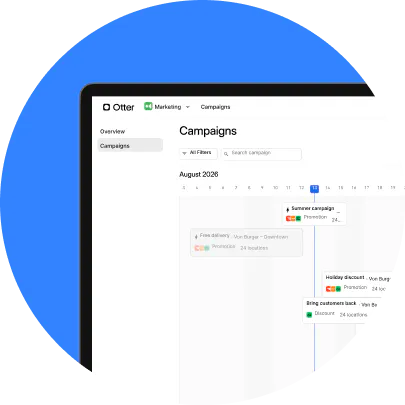
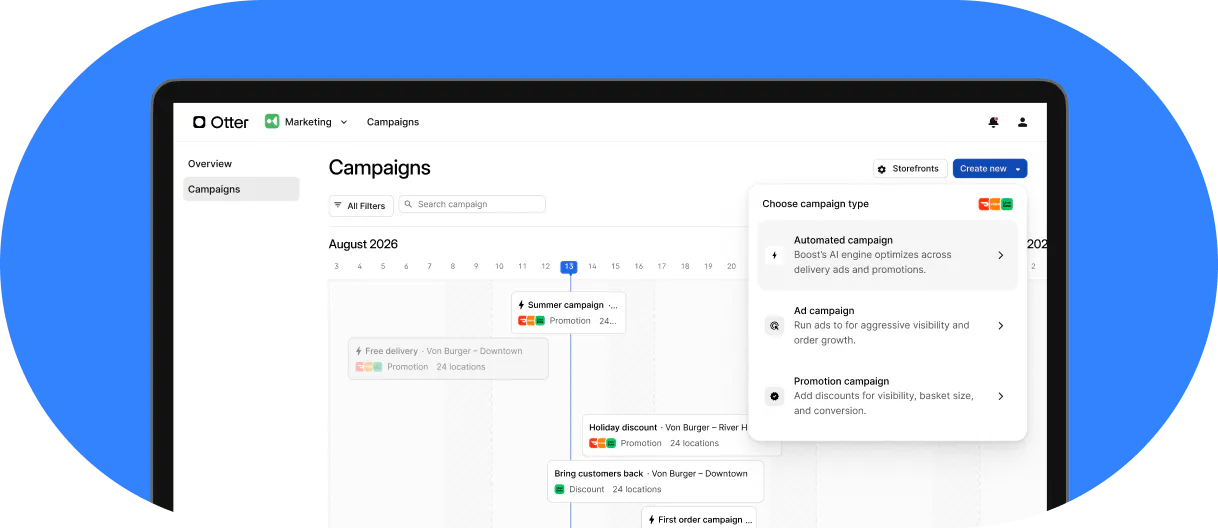
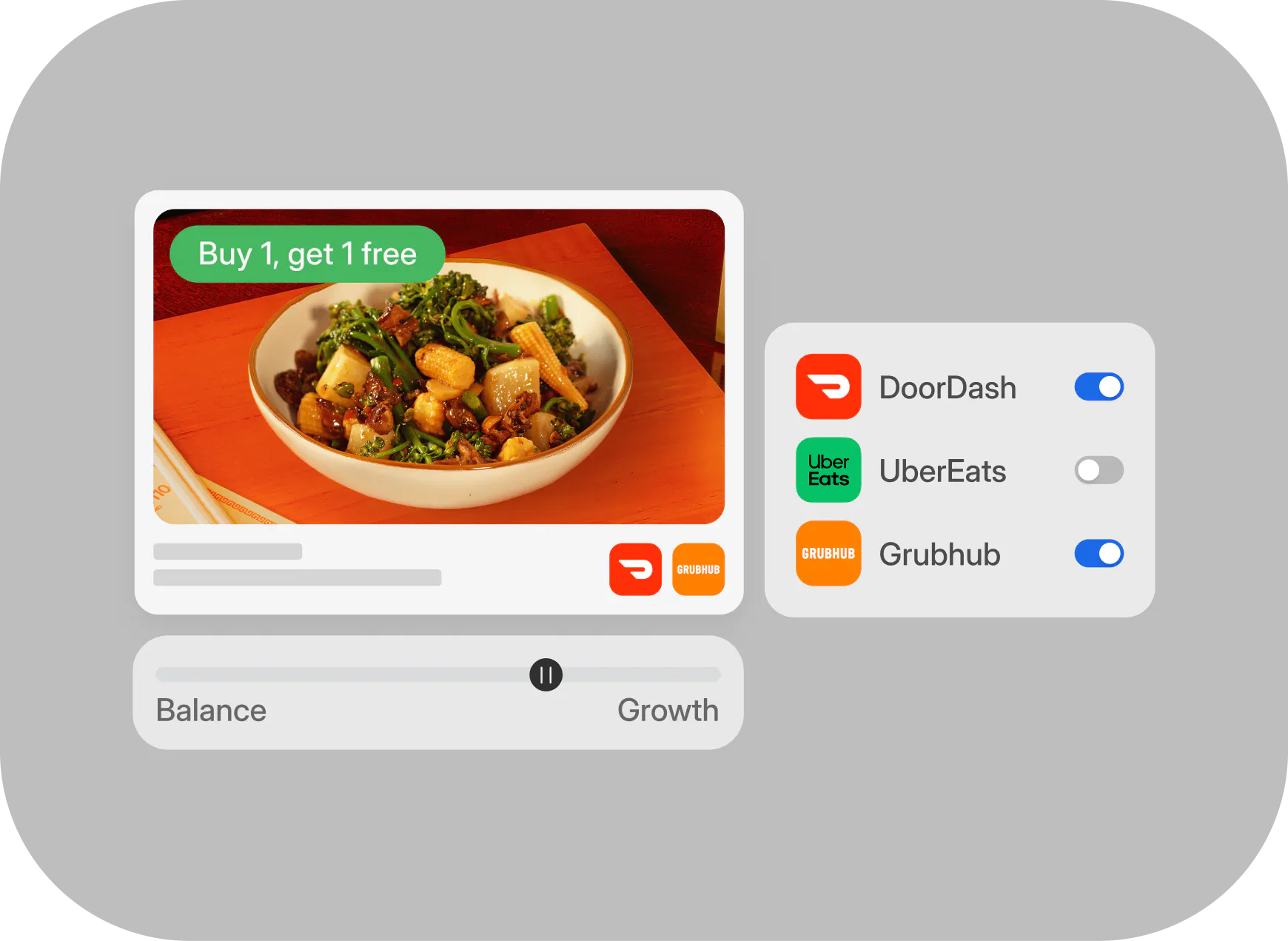
- Set up and manage delivery app promotions across DoorDash, Uber Eats, and Grubhub from one dashboard
- ROI increases of up to 10-20% from automated delivery app promotions
- Cross-channel analytics that let you compare performance across delivery apps, direct ordering, and dine-in in one view
- Promotion timing and targeting informed by actual order data, not calendar intervals
Operators who want to add loyalty depth can pair Otter Marketing with Otter Loyalty, which builds guest retention programs on the same data foundation. For review management and online reputation across delivery platforms, Otter Ratings and Reviews adds visibility into guest feedback without a separate tool login.
That operational visibility changes how operators manage their business day-to-day. Christina Hong of Seoulmates describes it this way:
“Another thing I love about Otter is the analytics side of it. On the back end, it is so easy to see the breakdown every single day, as well as the monthly sales, yearly sales. I’m able to compare this week to next week, see what days do better, what items are doing better. It just makes managing as a business owner so much better.” - Christina Hong, Seoulmates, Beverly Grove, LA
That level of insight starts with choosing the right POS system for delivery restaurants.
Who it fits best: Independent and multi-unit operators with meaningful delivery volume who want promotions informed by real sales data. If 40-plus percent of your revenue runs through delivery apps, this is where measurable ROI shows up fastest.
Honest scope: Otter Marketing is optimized for delivery app promotion management and cross-channel analytics. If you’re simultaneously building a first-party email list, pair it with a dedicated email tool for that layer.
The Question Every Platform Dodges: Who Actually Owns Your Customer Data?
Every competitor page on this topic touts “customer data” as a feature benefit. None of them explain what happens to that data when you cancel.
Three questions to ask any vendor before signing:
- Can I export my complete customer list in a standard format right now?
- What happens to my guest data if I cancel?
- Are guests who signed up through your platform mine to re-market to independently?
Red flags in contract language:
- “Platform-generated customer” definitions that exclude guests from your ownership
- Re-marketing restrictions on guests acquired through the tool
- Automatic data deletion at cancellation
The practical test: During your trial period, attempt a full data export in the first two weeks. How long it takes and what format you get tells you more about data ownership than any sales conversation. Whether your first-party guest list lives inside a WordPress site, your POS loyalty program, or a restaurant CRM, the test is always the same: can you take it with you? That portability is the difference between a customer retention asset and a vendor lock-in liability. Cancel, and you may be starting your guest relationship strategy from zero.
Why Marketing Without Ops Data Behind It Underperforms
Most restaurant marketing platforms are a separate layer from your operations. They don’t know what guests actually ordered, when, at what margin, or through which channel.
The consequence in campaign terms: win-back emails go to guests who ordered yesterday. Promo discounts go to your most loyal regulars who don’t need the incentive. Suppression logic doesn’t exist because the platform has no visibility into your actual order history.
What ops integration and POS-connected marketing actually enable:
- Trigger a win-back campaign after a genuine ordering lapse, not a calendar interval
- Suppress promos for guests who converted last week
- Identify that a regular who orders every Tuesday has gone dark and fire a recovery campaign automatically
Why independent operators feel this hardest: You don’t have a marketing team to babysit campaign logic. A real ops integration replaces the human oversight that enterprise teams can afford. Every wasted promo dollar sent to the wrong guest at the wrong time is margin you didn’t need to give away. Without ops integration, the marketing KPIs you track (open rates, click-throughs, campaign reach) measure activity, not outcomes. Your digital marketing budget is working harder than it needs to.
How to Match the Platform to Where Your Restaurant Is Right Now
- Stage 1: No list, no data yet. Prioritize tools that build first-party guest data first. Email capture at checkout, loyalty sign-up on your website, post-order SMS marketing opt-in. SMS marketing and email combined give you the customer retention infrastructure to build on. Don’t automate what you haven’t collected yet.
- Stage 2: Have a list, need to activate it. Email marketing tools or a basic restaurant CRM make sense here. Focus on triggered campaigns and behavioral segmentation before spending on acquisition. Content marketing through social media posts can support awareness, but conversion happens when the data is there to back it.
- Stage 3: Delivery-heavy and want to grow revenue now. Delivery app promotion automation with cross-channel analytics delivers the fastest measurable ROI at this stage. Otter Marketing fits here.
- Stage 4: Dine-in focused, wanting loyalty depth. POS-native loyalty platforms make sense. Look for platforms that include digital gift cards as part of their guest engagement toolkit. Prioritize portability of guest data from day one.
The one question that closes every vendor evaluation: “Show me exactly where my guest data lives and how I export it if I cancel.” How they answer tells you whether this platform was built for you or for their own retention metrics.
Your Revenue Mix Determines Which Platform Delivers ROI
The right restaurant marketing platform isn’t the one with the longest feature list. It’s the one built for your operator type, your revenue mix, and your actual bandwidth. If you’re delivery-heavy and want measurable results without building complex campaign logic from scratch, start with delivery app promotion automation.
That’s where the ROI shows up first.
Otter Marketing connects your delivery app data, automates promotions across channels, and gives you the cross-channel analytics to see what’s actually driving orders and margin.
If you want to see what that looks like in practice, book a demo with Otter and we’ll walk you through what automated promotion management does for operators at your volume.
Frequently asked questions about restaurant marketing platforms
What is a restaurant marketing platform?
A restaurant marketing platform is software that helps operators attract new guests and bring existing ones back through tools like email marketing, SMS campaigns, loyalty programs, social media management, and delivery app promotions. The most effective ones connect to your operational data (POS transactions, delivery app order history) so campaigns trigger on real guest behavior rather than arbitrary calendar schedules.
What’s the difference between restaurant marketing software and a general tool like Mailchimp?
General email tools are powerful for list management and broadcast sends, but they carry no restaurant-specific triggers. They can’t fire a win-back campaign because a weekly regular hasn’t ordered in three weeks, because they have no visibility into your POS or delivery app data. Restaurant-specific platforms connect marketing actions to operational events. That ops integration is what separates intelligent automation from scheduled guesswork.
Do I own my customer data if I use a third-party loyalty or marketing platform?
It depends entirely on the platform and the specific contract terms. Some tools let you export your full guest list at any time in a portable format; others restrict access to data generated inside their system. Before signing, ask: “Can I download my complete customer list right now?” and “What happens to my data if I cancel?” Then actually test the export during your trial period. Don’t take a sales rep’s word for it.
What restaurant marketing tools are best for independent owners who don’t have time to manage campaigns?
Independents with limited bandwidth benefit most from platforms with strong automation built in: win-back campaigns, birthday offers, and post-visit follow-ups that run without daily intervention. Platforms connected to your delivery app order data can run and adjust promotions automatically — an approach used by AI marketing companies in the restaurant space. Otter Marketing automates delivery app promotions across channels, with ROI increases of up to 10-20%, without requiring you to build each campaign manually.
How is restaurant marketing automation different from regular marketing automation?
Restaurant marketing automation uses operational triggers (a guest’s last order date, order frequency, average ticket, specific items purchased) rather than generic time-based rules. A campaign fires because a specific guest has genuinely lapsed, not because it’s been 30 days since your last email send. The smarter the operational data feeding the automation, the less margin you give away on promotions sent to the wrong people at the wrong time.
Is restaurant CRM software worth it for a single-location independent?
A true restaurant CRM tracks visit history, spend by guest, preferences, and communication history, and it delivers ROI once you have enough behavioral data to act on. For most single-location independents, the practical priority is building a first-party guest list before investing in CRM infrastructure. A CRM with no data behind it is overhead. A CRM connected to your POS transaction history is a customer retention and revenue tool.
Can restaurant marketing software reduce my dependence on DoorDash and Uber Eats?
Some platforms are specifically designed to shift volume from third-party apps to your own direct channel. Owner.com is the clearest example. Others, like Otter Marketing, help you maximize the revenue you’re already generating on delivery apps through automated promotions and cross-channel analytics. The right approach depends on your goal: exiting third-party platforms over time, or optimizing your performance on them while you build direct channels in parallel.
What should I look for in a restaurant marketing platform if I’m just getting started?
Start with three questions. Does this platform collect first-party guest data I actually own and can export? Does it offer automation that runs without daily attention from me? Does it connect to where my orders actually come from (my restaurant POS system, online ordering system, or delivery apps)? Avoid platforms built for enterprise chains if you're running one to three locations. You'll pay for complexity you'll never use and spend training time on features your staff won't touch.

Book a demo to see how Otter’s all-in-one platform can help your restaurant thrive.