Table of contents
- Executive Summary
- The Problem: Where Errors & Fraud Happen
- Scale of the Problem
- Downstream Impact on Restaurants
- What “Good” Looks Like: Best Practices
- The Dispute Process Today: How Delivery Platforms Make Decisions/Dispute Resolutions
- Why the Dispute System Is Challenging for Restaurants
- Real-World Constraints
- Introducing a Better Approach: Verification Layer Technology
- Otter Success Metrics
- Conclusion: Building a Full Stack
- Appendix
Executive Summary
Food delivery platforms like DoorDash, Uber Eats and Grubhub represent a significant revenue stream for most restaurants.
Yet 3.5% of all delivery orders are flagged for errors or disputes.
This represents a staggering volume of revenue at risk. Most restaurants lack the tools to win back that money.
Instances of customer fraud or actual in-store errors reported (including everything from food prep mistakes to missed items and more) can eat up 5–7% of delivery revenue annually– a significant number.
Mistakes happen.
The challenge is reducing them by catching potential mishaps before they occur, disputing fraud, and getting the best evidence for those disputes when they inevitably come along.
Here, we’ll unpack all things Delivery-Error-Related. We’ll:
- show you where errors occur in the food prep and packing process
- clarify the impact these instances have on a business
- uncover leverage points for prevention, and
- give you insight into how the dispute process works.
We’ll also explore verification technologies that help you achieve these objectives using minimal resources (time, people, money), and at scale.
This is your go-to, solution-oriented guide to mastering and overcoming Delivery Order Errors and Fraud.
The Problem: Where Errors & Fraud Happen
Delivery Order Errors
Operational delivery order errors fall into several familiar buckets.
- Wrong items / incorrect order contents.
- Missing items, especially side dishes or main dishes.
- Late or delayed delivery.
- Cold or poor-temperature food.
- Menu synchronization / pricing / availability mismatches across platforms.
- Manual re-entry or tablet-based order mistakes.
- Duplicate or double order entry.
- Wrong portion or size.
- Orders not received / missed notifications.
- Incorrect substitutions or modifier errors.
Wrong items, missing items, lateness, and temperature issues sit at the top for delivery platforms. Wrong items, when a different product arrives than the customer expected, are a common operational error. Missing items are up there as well - when a customer claims an ordered item failed to arrive. Some sources say that as many as 70% of customer complaints on delivery apps are about missing items.¹
Together, wrong and missing items are the easiest claims for a customer to make and the hardest for you to disprove.
Less common but still impactful operational errors include wrong portions, significantly delayed orders, order mix-ups and duplicate order entries credited back to the customer. All of these errors, regardless of how often they occur, eat into your bottom-line.²
Quality complaints remain widespread - up to 28% of all orders complaints in this category feature cold food³, while sloppy packaging and items that don't match the menu photo get submitted for refunds. Half the time, these issues aren't even your fault⁴. A careless driver or one stuck in traffic can impact the temperature and presentation of an order, yet, the one-star review still lands on your listing.
66% of consumers blame the restaurant for delivery errors⁵, even when the platform or the driver dropped the ball. Your name is on the bag. Your rating takes the hit. Your payout absorbs the refund.
Customer Fraud
Not every dispute is an honest mistake. A growing share are outright scams. In recent years, fast food fraud increased by nearly 50%.⁶
False missing-item claims are common: a customer got everything but claims an item missing to score a partial refund. Zero risk for them, full cost for you. "Never received" claims on entire orders come next: even if the driver clearly dropped it at the door, the platform refunds them.
Refund fishing is getting creative, too, where customers exaggerate minor quality issues into full refunds. These aren’t just angry customers. Repeat offenders and organized rings⁷ systematically target restaurants week after week across multiple platforms and locations. At your expense, these customers get cash and free food with little oversight or accountability.
How widespread? Refund abuse accounts for nearly half of all consumer fraud on delivery.
48% of all refunds requested are fraud or abuse—not honest errors.
The remaining 52% are legitimate disputes, but platforms treat all claims equally when deciding who pays chargebacks.⁹
There's no single point of failure. Money leaks out at every stage: wrong item at order entry, missed item at the packing station, wrong bag at handoff, degraded quality in transit, false claim at the final dropoff.
Where errors and fraud enter the order lifecycle
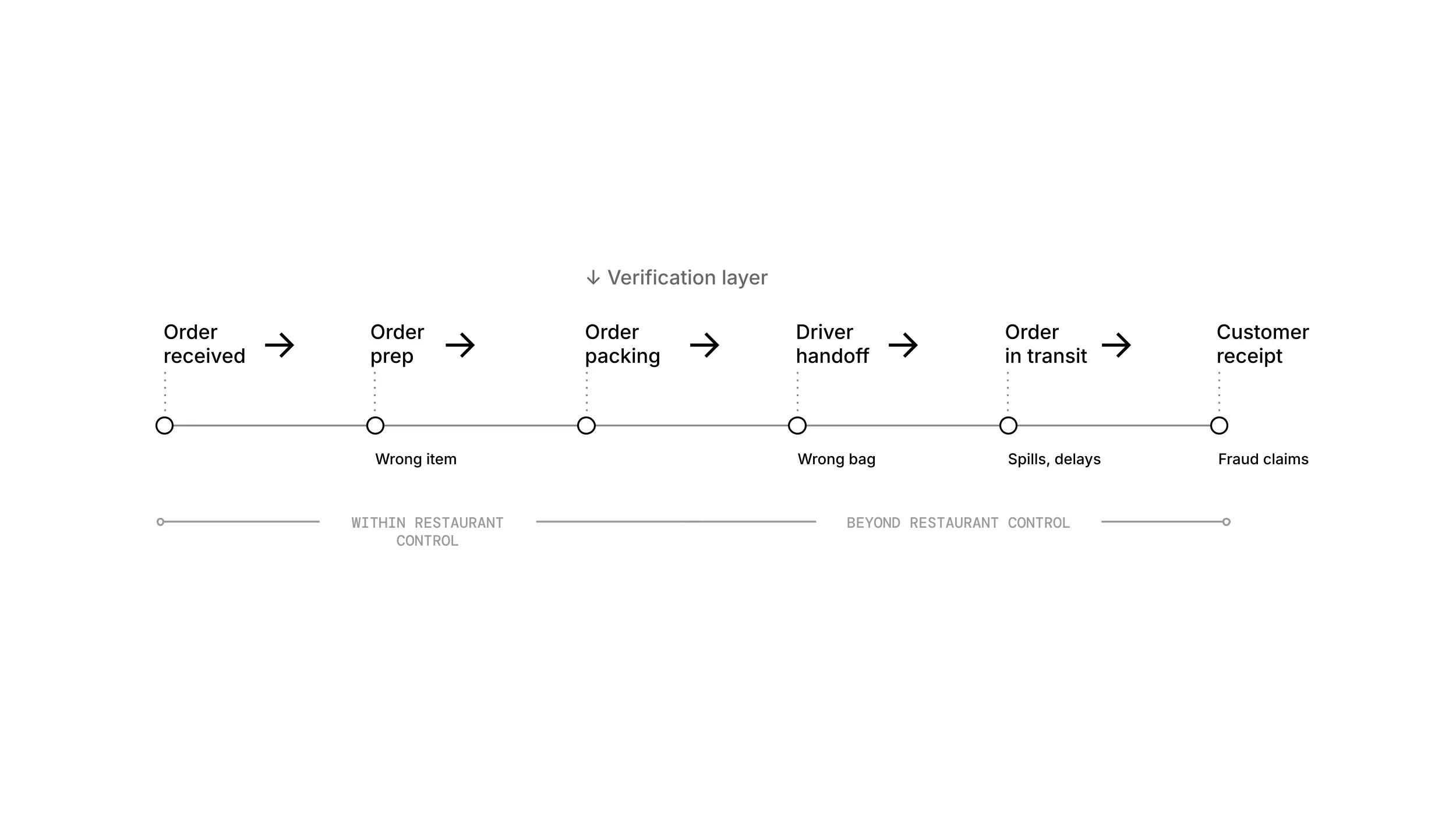
Revenue disappears from every one of these touch points. Without visibility and evidence at each step (photos, timestamps, verification), restaurants can’t defend themselves, and the money keeps leaking away.
We’ll discuss how innovations like Verification Layer technology can stop these issues before they even happen, and how some technologies can even holistically manage the dispute process after the fact.
Scale of the Problem
Delivery errors and fraud are a big problem for restaurants, and it’s getting bigger each year. In the U.S. alone, restaurants will lose a total of $1.8B in 2026 in delivery app refund and fraud-related losses (up 31%, year-over-year). Even worse, this problem hits all the metrics that matter for your business.
60% of all delivery food refund requests are fraudulent.²
3.5% of all orders are flagged for errors.³
2.5–3% of total revenue gets caught up in disputes⁴
48% of all consumer fraud is refund abuse⁵
Most restaurants do not dispute order errors — leaving revenue on the table.
Put differently: 2.5–3% of all your delivery revenue is leaking out through disputes — and that represents roughly 20% of already-thin delivery profits.¹
The math is simple. If you're doing $100K/month through delivery platforms, that's $2,500–$3,000/month disappearing into chargebacks. For a 10-location operator, that's potentially $300K–$360K per year walking out the door.
The problem is growing and– after calculating the effort needed to address the issue over numerous platforms and locations– many restaurants are choosing not to use their resources to push back… leaving a growing amount of revenue behind.
For a $100K/mo operator, the math is simple — and brutal
Most operators run across DoorDash, Uber Eats and Grubhub simultaneously — the leak compounds across every platform.
OPERATOR PROFILE | DELIVERY GMV | MONTHLY LEAK (2.5–3%) | ANNUAL LEAK |
Single location | $100K/mo | $2,500–$3,000 | $30K–$36K |
10 location chain | $1M/mo | $25K–$30K | $300K–$360K |
50 location operator | $5M/mo | $125K–$150K | $1.5M–$1.8M |
Downstream Impact on Restaurants
The immediate hit to your business is obvious: chargebacks eat directly into revenue.
A single location with a steady delivery volume can lose $500/month or more to disputed orders on just one delivery platform. That's $6,000/year per store and per platform, and most multi-location operators are running across DoorDash, Uber Eats, and Grubhub simultaneously.
Some restaurants do fight back. They log into each platform's merchant portal, review the claim, gather whatever evidence they can, and submit a dispute. But that process is riddled with costs and inconsistent results depending on their available evidence.
Beyond the dollar amount, every reported error that needs to be reviewed or disputed costs staff time. Someone on the team has to log in, review the claim, gather any evidence available, and decide whether it's even worth fighting. For most restaurants, the answer is "no," given the heavy lift of disputing the claim, which is exactly why the money keeps disappearing. Otter estimates staff lose an average of 10 hours per month reviewing these claims. On a per order basis, it's just a few dollars. But when you add all of them up, it's worth the hundreds of dollars per month. If– that is– your staff can handle it.
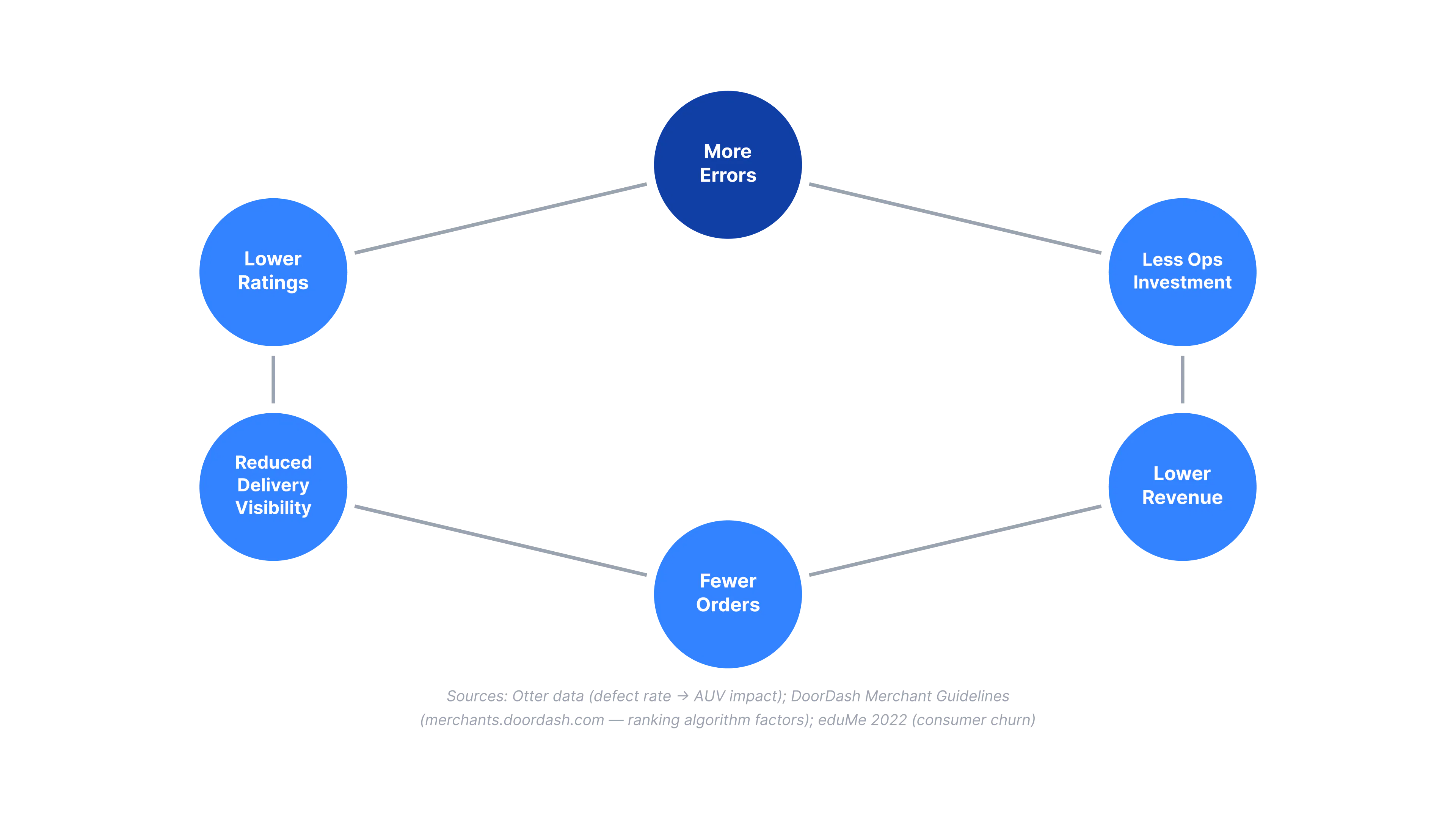
In the long run, the compounding effects of delivery disputes are worse than the chargebacks themselves. Delivery errors and fraud cause a vicious cycle. Over time, this cycle can result in a massive revenue loss.
For an in-depth look at how restaurants handle revenue loss and reconciliation in the context of POS systems, check out Otter’s report on Decoding Delivery Fees and Reconciliation.
Otter estimates show that restaurants with the best accuracy rates earn an average of $262K in delivery Average Unit Volume. The worst accuracy rates? $138K in delivery AUV. That's 89% more revenue for restaurants that get their orders and delivery right.
How Error Rates Impact Key Business Metrics
Bottom decile | Top decile |
13% Defect rate | 2.4% Defect rate |
26% 28-day retention | 33% 28-day retention |
3.9★ Avg. order rating | 4.6★ Avg. order rating |
$138K Delivery AUV | $261K Delivery AUV |
Otter’s data across 9,341 locations shows restaurants with strong dispute discipline and verification see a massive uplift in delivery revenue. Those without it see declining AUV over time.²
(1) Retention falls.
Legitimate delivery errors erode trust and cause frustration for customers on the receiving end of those mistakes. Most customers who experience an error never re-order from the business.
Otter's data across 9,341 locations shows a stark gap: restaurants in the top decile for order accuracy see 33% customer retention (28th day) and 4.6-star average ratings. Those in the bottom decile? 26% retention and 3.9 stars. This is further supported by research from TouchBistro¹ showing that every 1% increase in order error rate translates to a 0.3% decrease in customer re-order rate.
(2) Platform visibility decreases.
Delivery platforms reward accuracy and customer satisfaction with better placement in search results. High error rates push you down the rankings, which means fewer organic orders.
(3) Ratings drop. Customers who experience errors (real or perceived) leave bad reviews. Those reviews - in addition to fewer repeat customers - tank your platform ranking [See: Otter Report on Delivery Platform Marketing]. Lower ranking means fewer eyeballs, fewer orders, and lower revenue over time. Breaking this vicious cycle is very challenging - and often expensive - for operators of all sizes.
The vicious cycle of delivery errors
What “Good” Looks Like: Best Practices
Best practices involve a three-layered defense: operational controls, evidence collection, and dispute process implementation.
- Operational controls are the first preventative solution.
- Make sure the POS integrates cleanly with each delivery platform so order details match.
- Build a team visual confirmation step: get eyes on every item before it goes in the bag.
- Establish a handoff protocol: driver confirms the order.
- Add a final QA check before anything leaves the kitchen.
- Evidence collection is what gives you leverage.
- Timestamped photos of completed orders (especially high-value or complex ones) are the single most useful asset in a dispute.
- A video of the driver handoff helps as well.
- Syncing your POS timestamps with the delivery platform's clock makes your evidence harder to dismiss.
- Dispute process implementation is where most restaurants fall short.
- Monitor chargebacks in real time.
- Respond to every single one… even the small ones.
- Build a database of repeat offenders.
- Understand how each platform's adjudication process works so you can anticipate what evidence they'll weigh most heavily.
Scaling Challenges
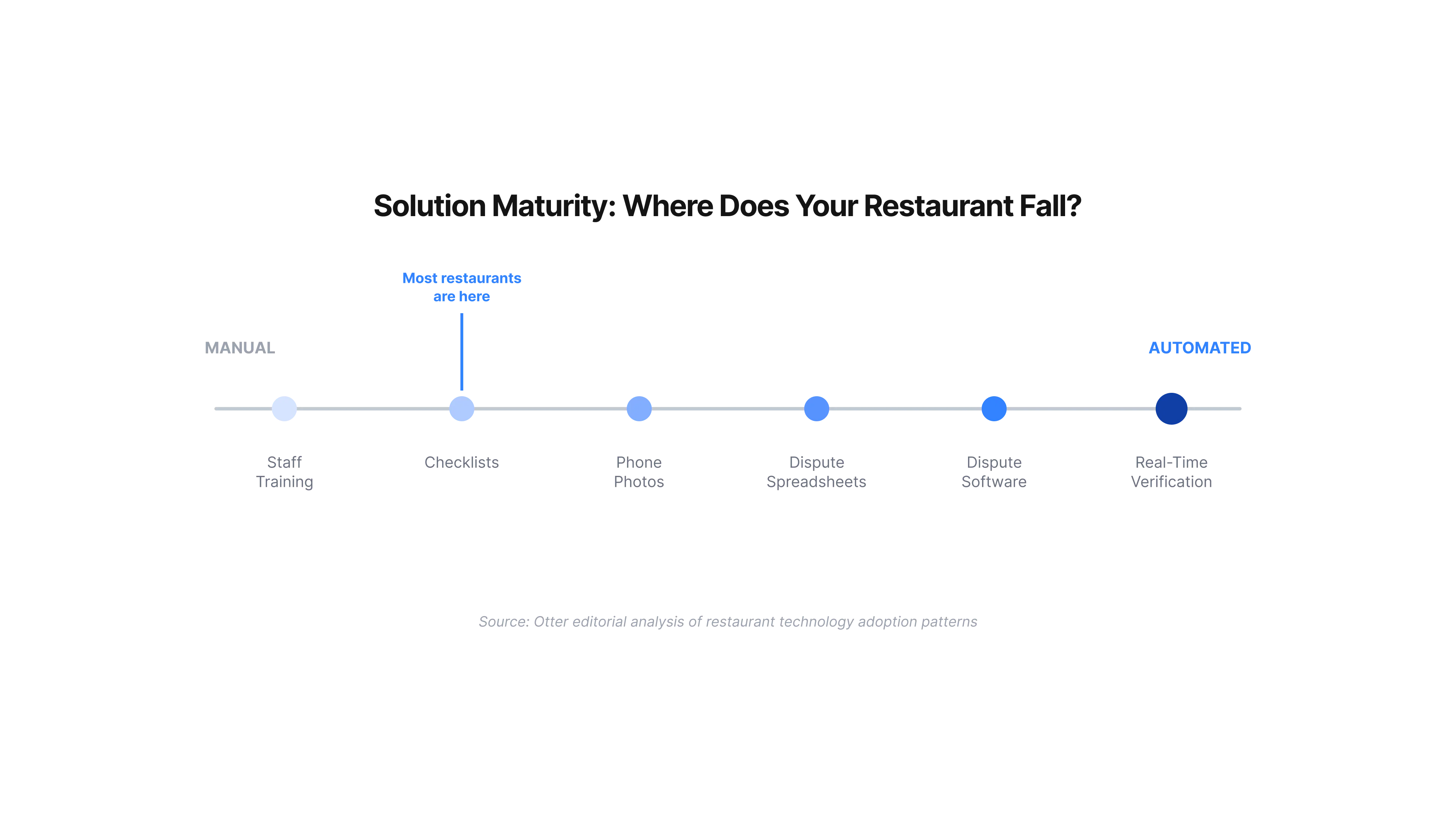
The problem with these best practices is that none of these scale manually. When you're doing hundreds of delivery orders a day across multiple platforms, you can't photograph every bag, log into three different merchant portals, and write individual dispute responses. The manual lift is too high. So most operators write it off and move on.
That's where Dispute Management Systems come in. These platforms tie all three layers together (controls, evidence, and discipline) into a single automated workflow. Instead of relying on staff to manually capture evidence, file disputes, and track outcomes across portals, a DMS handles it systematically: flagging orders, storing proof, submitting disputes, and surfacing patterns across locations and platforms.
It's the difference between knowing what to do and actually being able to do it at scale.
The Dispute Process Today: How Delivery Platforms Make Decisions/Dispute Resolutions
When a customer reports a problem (ie. missing item, wrong order, food that arrived cold) the platform decides what happens next. Their system looks at a handful of inputs:
- The customer's history
- The driver's track record
- The restaurant's reputation
- Order size
- Any evidence available.
Then it makes a call, usually within hours.
There’s a catch: the system is built to favor the customer.
Not because platforms are out to get you, but because it's better for their business. Refunding a customer is instant. It keeps them happy and keeps them ordering.
Actually investigating a dispute? That takes time and money. So the default answer is: give the customer their money back and move on.
The numbers paint an important picture. Across all industries, only 12% of merchants on apps actually recover the chargebacks filed against them. But here's the kicker: merchants who do fight back win 54% of the time.¹
The money is recoverable. Most restaurants just aren't in a position to go after it.
It helps to understand what platforms are actually optimizing for:
- Keeping customers, not restaurants. A loyal eater drives more lifetime revenue than any single restaurant partner.
- Speed, not accuracy. Resolving a complaint in hours keeps the customer happy, even if the complaint is fraudulent.
- Low cost. Real fraud detection is expensive. Blanket refunds are cheap.
Why the Dispute System Is Challenging for Restaurants
Because of their business models, platforms prioritize refunding unhappy customers rather than working with restaurants to resolve disputes. That puts the onus of resolving disputes on you, which means time, effort, and resources to push disputes through the system.
The process to fight back is not always an easy one, and it’s easy to miss customer order disputes once submitted. Oftentimes, there are no notifications to the restaurant when a customer reports an error. Restaurants need to regularly check for issues, going deep into the platform.
Fighting chargebacks takes time most restaurants don't have. Each dispute means someone on the team logs into a merchant portal, pulls together whatever evidence exists, writes a response, and submits it.
Now multiply that by multiple platforms (and sometimes for multiple locations). Now multiply that by dozens or hundreds of disputes a month. It's a time-eater, about 10 hours per month per location,… and if there is no system for capturing evidence in real time, there's often nothing to submit.
The frustrating part? Restaurants that actually fight back tend to win. But that stat only matters if you have the bandwidth to submit disputes in the first place. For most operators, the math is simpler: write it off, move on, lose the money.
~54% win rate for merchants that dispute.
For those who do nothing, it's 0%. Every dollar defended is a dollar reclaimed.²
Regulators are starting to pay attention. In 2024, LA County sued Grubhub for "deceptively and unilaterally" charging restaurants when customers asked for refunds, without even checking who was at fault.
It's not that restaurants can't win disputes– it's that the process makes it not worth the effort. Which is exactly why restaurants need systems that do this work for them, automatically.
Real-World Constraints
You and your restaurants can know exactly what to do– capture evidence, dispute every chargeback, track patterns– and still struggle with executing at scale. That's the reality for most restaurants and restaurant chains.
It’s not always worth the time and effort without automation. A 500-location chain processing 100,000 delivery orders a week can't photograph and dispute every order manually. Even a 10-location operator is looking at hundreds of potential disputes per month across multiple platforms. Most restaurants want to address each error. They just don’t have the bandwidth.
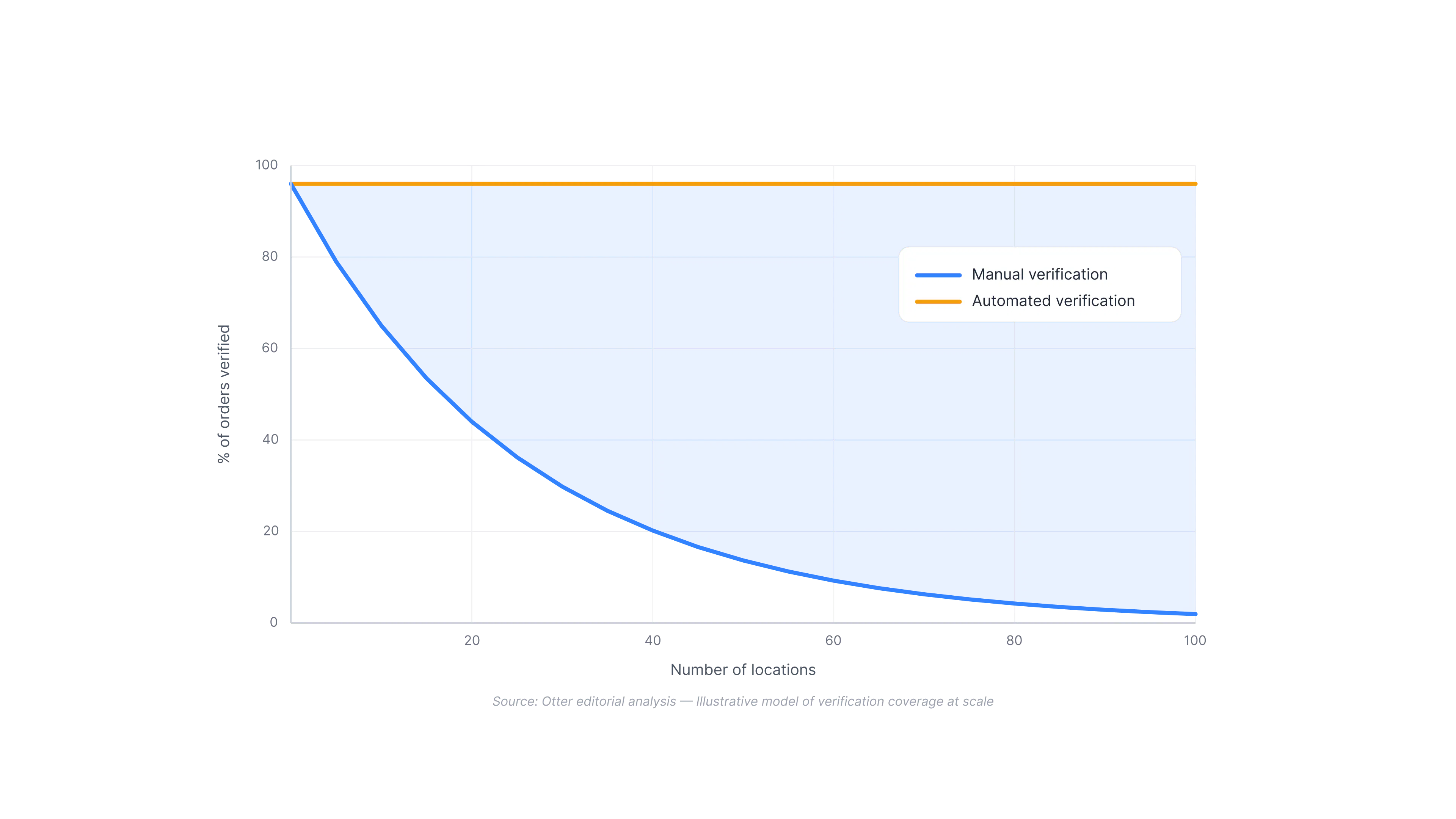
There’s almost no time to act. A completed order normally sits at the packing station for a short amount of time before it's out the door. That's your only shot to capture evidence. Miss it and the proof is gone. On the dispute side, some platforms give you as little as 48 hours to respond: wait too long and you lose by default.
Every platform works differently. DoorDash, Uber Eats, and Grubhub each have their own portal, their own dispute process, and their own evidence requirements. What works on one doesn't necessarily carry over to another. Managing this across platforms is messy and manual, adding to an already big lift.
Doing nothing costs more than it looks. It's tempting to write chargebacks off as a cost of doing business. But the downstream effects pile up: lower revenue per location, lost customers, worse platform rankings and fewer organic orders. What feels like a $500/month problem becomes a drag on your entire delivery business.
All of which leads to an obvious conclusion: restaurants need independent verification systems that handle this automatically, from capturing evidence, filing disputes, to tracking outcomes without adding work to a team that's already stretched thin.
Introducing a Better Approach: Verification Layer Technology
So what does a better approach look like for multi-location operators?
It starts with catching problems before they become chargebacks. Instead of scrambling to respond to errors or complaints, the right system catches problems before the order leaves the kitchen and builds your evidence automatically in case a dispute comes later.
That's what a "verification layer" does. It's technology that sits inside your existing POS or delivery workflow and handles the heavy lifting:
- Alerts staff of errors in realtime before items leave for delivery, preventing errors as they start to happen
- Captures evidence automatically, grabbing photos, timestamps, and verification records at the packing and delivery stations
- Flags high-risk orders before they go out, whether it’s a repeat offender flagged for possible fraud, or large orders and complicated requests
- Connects to dispute workflows so when a chargeback does come in, evidence is automatically submitted on your behalf
- Spots trends like habitual fraud indicators and error patterns across locations
- Tracks outcomes across platforms in order to learn from every dispute, not just reacting to the next one
- Plug & Play. Simply plug in, mount and connect to Wi-Fi. No other integrations or setup needed.
- Multi-location visibility. Operators running 10, 50, or 500 locations need to benchmark and compare across their entire portfolio.
The goal isn't to turn your location operators into dispute analysts. It's to take the burden off your team entirely. The system watches, captures, and files all while your team keeps doing what they do best.
The best part: a best-in-class verification layer doesn't add time to the order prep process. It works in the background, with standardized processes already integrated into the workflows your teams follow. No extra steps, no new habits to build, no training overhead.
Otter Success Metrics
Otter Verify is a verification solution sitting at the intersection of order accuracy, evidence capture, and dispute automation. It’s made to save revenue, time, and headaches for restaurants, chains and franchises.
How Otter can help
Otter has developed a new solution that addresses the root causes of Delivery Errors and Customer Fraud.
Multinational chains are partnering with Otter. They are seeing 4x fewer errors dropping from an 8% error rate to 2%.¹ And when disputes do come up, they see a 90% win rate, compared to 50% previously.²
For a restaurant doing $100K/month through delivery platforms, that translates to real money. Without Otter, you're looking at roughly $4,000 in chargebacks and maybe $2,000 recovered — a net loss of $2,000/month. With Otter, chargebacks drop to $1,000, recovery hits $900, and your net loss shrinks to $100. That's a 95% reduction in chargeback impact.
Without Otter Verify | With Otter Verify |
4% chargeback rate | 1% chargeback rate |
-$2K/mo net chargeback loss | -$100/mo |
95% reduction in chargeback impact & $1,900/mo saved per location³.
Scale that across locations and the numbers get serious fast.
Restaurants with strong verification and dispute discipline see
up to 89% more delivery revenue than those without.⁴
Why Otter Verify is different
Otter Verify is a part of Otter’s ecosystem of all-in-one delivery solution, from POS and order management to marketing automation and reporting. Beyond automated dispute management and order verification, Otter Verify seamlessly plugs into the rest of your delivery stack, offering you the seamless integration to manually manage your delivery business only when needed; Otter does everything else. No workflow changes, no lengthy onboarding, no disruption to daily operations.
Unlike CCTVs and weighing scales, Otter Verify is the only verification solution that offers real-time order verification, resulting in a large reduction of order errors and increase in dispute win rates. It also doesn’t disrupt your current operations, fits seamlessly into your staff’s workflow, and does not require any expensive integrations.
Otter Verify is the only option built to prevent errors and recover revenue automatically.
Regardless of your error rate and dispute processes, if you’re on delivery platforms, you’re likely losing money from chargebacks. In short, Otter Verify pays for itself, automatically uncovering errors and recovering revenue all on your behalf.
Otter Verify Fixes Gaps Other Solutions Can’t
Verification System | Otter Verify | CCTVs | Weighing Scales |
Real-time order verification | ✓ | X | ✓ |
Low upfront investment | ✓ | X | X |
No integration required | ✓ | ✓ | X |
Minimal staff workflow change | ✓ | ✓ | ✓ |
High impact on missing and incorrect rate | ✓ | X | X |
High impact on win back rate with evidence based disputing | ✓ | X | X |
Conclusion: Building a Full Stack
Delivery errors and fraud aren't going away. As long as restaurant operators and franchise owners rely on third-party platforms for a growing share of their revenue, chargebacks, false claims, and operational mistakes will be part of the equation. The question isn't whether these problems exist: it's whether you have the systems in place to catch them, fight them, and learn from them.
The restaurants that are winning on delivery aren't doing anything magical. They're doing three things consistently: keeping their order accuracy tight, capturing evidence at the packing station, and contesting every chargeback with proof. The difference is that they're not doing it manually. They're using technology to automatically handle the heavy lifting.
Otter’s solution helps operators build the system to catch, fight, and learn from errors and fraud.
Verification works because it’s a seamlessly integrated solution, offering order aggregation, analytics, and dispute management, all in one. That's what turns a standalone tool into a full-stack defense.
The hidden cost of delivery errors and fraud isn't hidden anymore. And for restaurants ready to take back control of their delivery channel, neither is the solution.
Appendix
Source List
- Incognia 2025 Frontline Report (Gig Economy Edition) Incognia, 2025
- Restaurant Business Online – Delivery Chargebacks Article Restaurant Business Online, April 2024
- eduMe Survey – Half of Americans Reliant on Food Delivery eduMe, 2022
- DoorDash Merchant Guidelines – Most Loved/Missing/Incorrect Orders DoorDash for Merchants, DoorDash
- Sift FIBR Food & Delivery Report (Q1 2023) Sift, Q1 2023
- Delaget – Dealing with Third-Party Delivery Chargebacks Delaget (now PAR Technology), December 2024
- Freddy's Case Study – Food On Demand Food On Demand, May 2024
- Freddy's Case Study – Franchise Times Franchise Times, 2024
- DoorDash Merchant Refund Policy DoorDash for Merchants, DoorDash
- Restaurants Online Ordering & Delivery: Pain & Solution US Tech Automations, 2026
- Restaurants Say They're Bearing the Brunt of Delivery Chargebacks Restaurant Business Online, April 2024
- When Delivery Costs Restaurants More Than It Pays Beer & Food Attraction, 2024
- U.S. Online Food Delivery Market Outlook Grand View Research
- Chargeback Statistics 2026 Chargeback.io, 2026
- Delivery App Refund Abuse Is Rising Craver, 2024
- Merchant Risk Council – Refund/Policy Abuse Report Merchant Risk Council, 2024
The Problem: Where Errors & Fraud Happen
¹Linkedin Post
²Restaurant Order Management Pain Points: One System for All 2026
³Restaurant or Delivery App Companies: Which Suffer Most When Problems Occur
⁴Consumers Flag Food Damage, High Charges On Apps: LocalCircles
⁵Almost Half of Americans are Now Reliant on Food Delivery Services
⁶Food & Delivery Fraud: Benchmarking Risk and Tracking Trends
⁷Fighting Fast Food Fraud
⁸Research Flags Top Fraud Challenges Faced by Food Delivery Companies
⁹Incognia Frontline Report
Scale of the Problem
¹Restaurants say they're bearing the brunt of delivery chargebacks
²Source: ClearCOGS
³Source: Otter POS data — 9,341 locations
⁴Source: Restaurant Business Online, 2024
⁵Source: Incognia 2025 Frontline Report
Downstream Impact on Restaurants
¹Restaurants say they're bearing the brunt of delivery chargebacks
²Source: Otter POS data (9,341 locations)
Why the Dispute System Is Challenging for Restaurants
¹LA County Sues Grubhub Alleging Unfair and Deceptive Business Practices
²Source: Chargeback.io (2026)
The Dispute Process Today: How Delivery Platforms Make Decisions/Dispute Resolutions
¹Chargeback Statistics 2026: 25+ Facts on Fraud, Costs & Trends
Otter Success Metrics
¹Case of a chicken restaurant using Otter Verify
²Otter POS Data (9,341 locations)
³Otter POS Data (9,341 locations)
⁴Based on data for 9,341 locations across 5 major national chains on delivery platforms
Glossary
Chargeback: A refund initiated by a customer (or platform on their behalf) disputing a charge
Dispute discipline: The practice of systematically responding to all chargebacks with evidence
Verification layer: Technology that captures evidence and flags orders for scrutiny before disputes occur
AUV: Average Unit Volume – total delivery revenue per location