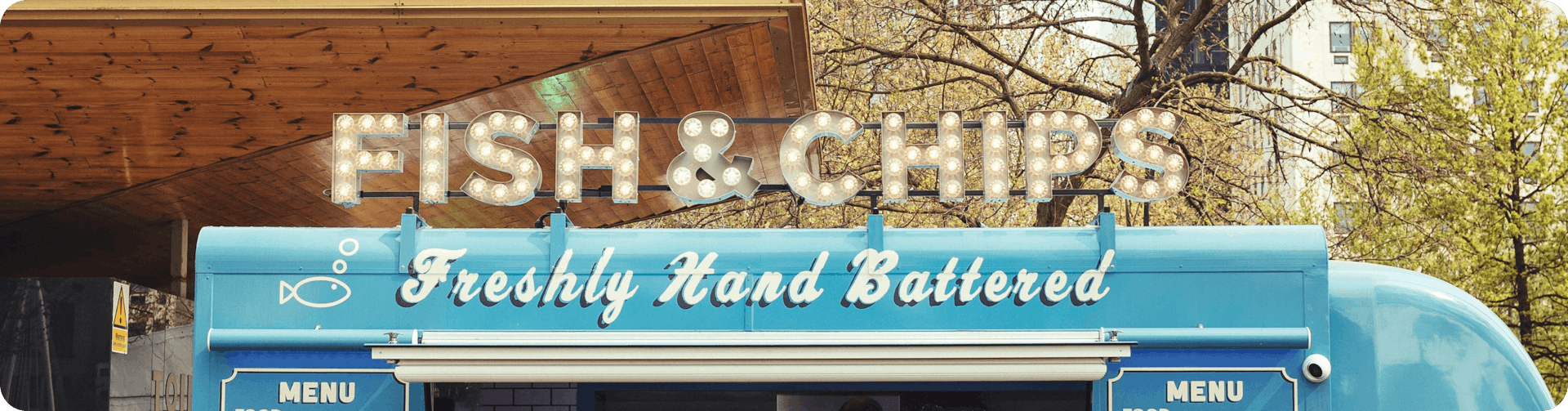
A restaurant can coast for years on being the same building on the same corner. A food truck can't. If a customer loved what you served last week and you're two blocks over today, they may never find you again, and that single difference is why so much generic small-business marketing advice falls flat once you put it on wheels.
This guide skips the industry-forecast numbers (Otter already covers those in its food truck trends rundown) and focuses on what actually gets people in line: what to post and when, who to partner with, how much of your revenue should realistically go toward marketing, and how to tell if any of it is working.
Key insights
• Posting your location clearly and consistently is the single highest-leverage thing a food truck can do online, more important than polished photography or clever captions.
• A digital loyalty program solves the mobile business's core marketing problem: earning repeat recognition from customers who can't just “walk by again.”
• A reasonable starting marketing budget is 5-10% of revenue for a truck that's sustaining itself, and 11-20% if it's actively trying to grow, per general small-business benchmarks (these aren't food-truck-specific, so treat them as a starting point).
• Geo-targeted ads let a truck market to whoever is physically near it today, a problem a fixed restaurant's marketing never has to solve.
Know who you're actually marketing to
Food truck customers tend to fall into a few recurring groups, and which ones matter most to you should shape where you post and who you partner with:
• Lunch-hour regulars near a fixed weekday spot (office parks, hospitals, industrial areas)
• Event and festival crowds who find you once and may never see you again unless you make it easy to follow you
• Late-night crowds near bars and venues, often driven by word of mouth more than any single post
• Campus and business-park regulars who reward a predictable schedule
• Neighborhood regulars near a rotation stop you keep for months or years
Most trucks serve more than one of these, but trying to speak to all of them in every post usually means speaking clearly to none of them. Pick the one or two that make up most of your revenue and let the rest of your marketing follow their habits.
9 food truck marketing tactics that fill your line
1. Post your location like it's the most important information you own
For a fixed restaurant, a social media post about “we're open today” is marketing. For a food truck, telling people exactly where and when you'll be is operational information customers need to find you at all, which is also why it works so well as marketing. Post the day's location and hours everywhere you're active (Instagram Stories, a pinned post, a Facebook update) at the same time each morning so regulars know when to check. Otter's guide to social media marketing for restaurants has more on building a consistent posting rhythm.
2. Turn a digital loyalty program into your repeat-business engine
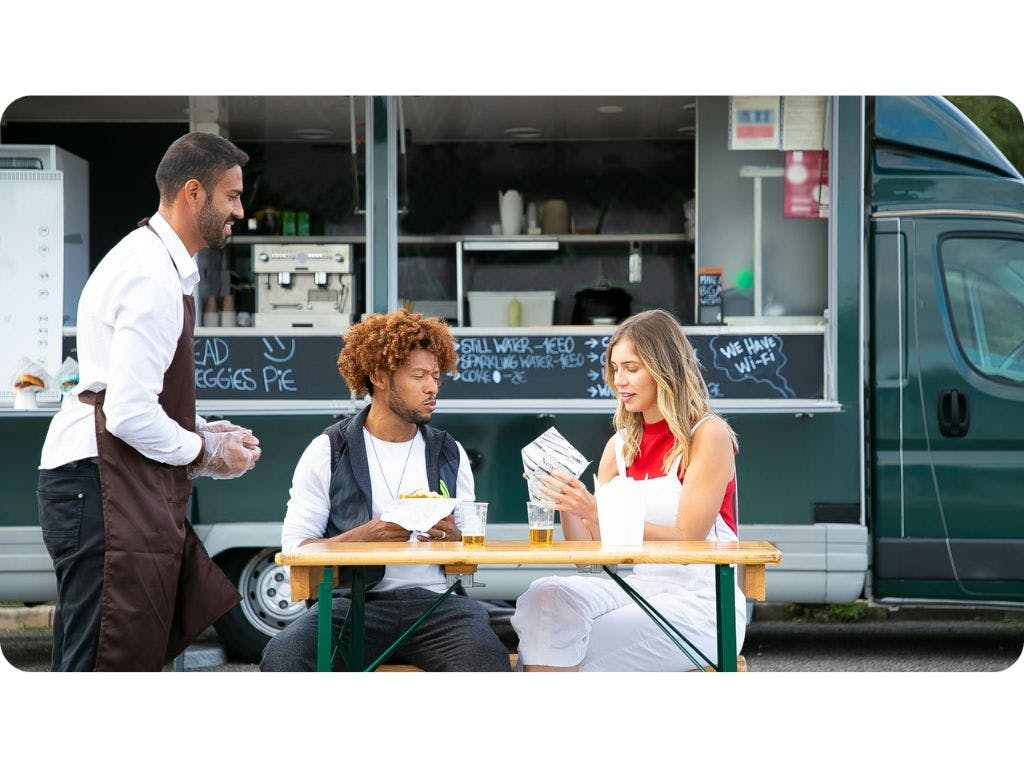
Because a truck can't rely on being visibly, physically present every day, giving customers a reason to actively seek you out matters more than it does for a restaurant with a fixed address. A digital loyalty program removes the biggest friction point of the old paper punch card: customers lose paper cards, but they don't lose an account tied to their phone number or an app they already use to order.
“Otter Loyalty, I think it's super cool because our guests, it's really easy for them to redeem their rewards. When they order online, they log in and on the right-hand side it shows them all the rewards. All they do is click on it.”
Attribution: Nicoletta Kuti, co-owner, Telly's Charburgers, Santa Clarita, CA
3. Partner with festivals, breweries, and other local businesses
Food truck rallies, brewery residencies, and office-park lunch programs put you in front of an audience that's already gathered and already hungry, without you having to build that audience yourself. These partnerships also tend to be recurring, which turns a one-time event into a predictable weekly or monthly stop that regulars build into their routine.
4. Make your food impossible to scroll past
Bright, high-contrast food photography (shot in daylight, not under a truck's interior lighting) consistently outperforms staged studio shots for food trucks specifically, since it looks like something a real person could walk up and order right now. Encouraging customers to tag you when they post their own photos costs nothing and reaches people your own account never will. Otter's rundown on using influencer marketing at your restaurant covers how to turn a handful of local food accounts into a repeatable source of visibility.
5. Run geo-targeted ads for the radius you're actually serving today
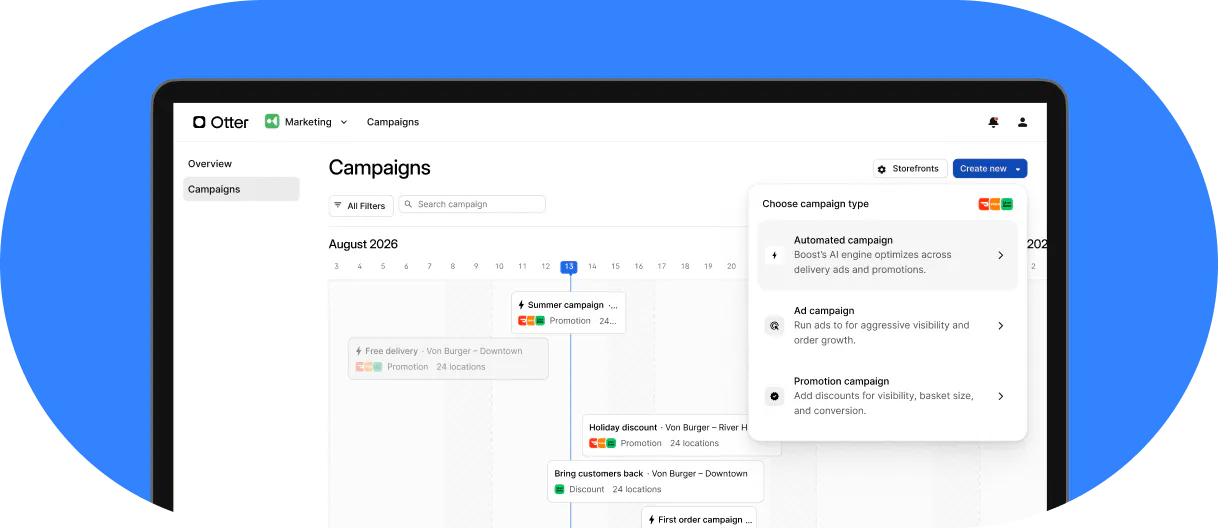
A fixed restaurant sets up local ads once and mostly leaves them alone. A truck's “local” changes daily, which makes geo-targeted ads (a boosted post or a small ad budget aimed at a radius around today's location) one of the few paid tactics built for exactly this problem. Otter's Marketing tool automates ad placement and spend across delivery apps specifically, which covers one slice of that paid-visibility work without a separate agency contract for that channel alone.
6. Create urgency with limited-time items and themed pop-ups
A weekly special or a themed pop-up (a holiday menu, a collaboration with another truck) gives people a reason to show up this week specifically, instead of “whenever.” It also gives you something new to post about without having to reinvent your core menu. Otter's list of the most profitable food truck items is a useful starting point for picking a limited-time item that's actually worth the marketing push.
7. Give yourself a home base online, even if your kitchen moves
Social media accounts can be suspended, algorithms change what gets seen, and a third-party delivery app's page is designed to promote its own listings, not just yours. A simple website with your schedule, menu, and a direct way to order gives you one place you fully control. Pairing it with commission-free online ordering means a customer who finds you through a social post or a friend's recommendation can order directly from you instead of a third-party app that takes a cut of the sale.
8. Ask customers what's working, and change what isn't
Reviews and direct feedback (a comment, a DM, a conversation at the window) tell you which items and which locations are actually driving repeat visits versus which ones just get one try. Responding publicly to feedback, especially critical feedback, is itself a form of marketing: it signals to everyone watching that a real person is behind the truck and is listening.
9. Let your ordering platform do part of the marketing work for you
Automated upsell prompts at checkout (“add a drink?”, “add a side?”) and simple order-history-based promotions do quiet, ongoing marketing work without a new campaign every week. Combined with a point of sale system that captures order data across every channel, this turns everyday transactions into the raw material for the next tactic: knowing what's actually working.
What to budget for food truck marketing
There's no food-truck-specific marketing-budget standard, but a reasonable general-business benchmark comes from the U.S. Small Business Administration, cited by HawkSEM: businesses making under $5 million a year typically spend around 5-10% of revenue on marketing to sustain themselves, and 11-20% if they're actively pushing to grow. For a new truck still building a following, leaning toward the higher end of that range for the first year, then pulling back once you have a base of regulars, is a reasonable approach.
In practice, most of that budget for a truck goes toward a mix that costs very little in cash and mostly costs time: consistent posting, photography, and community partnerships, with a smaller slice reserved for boosted posts or geo-targeted ads around high-traffic events.
How to know your food truck marketing is actually working
Track a small number of numbers consistently rather than everything available: which locations or events produce the most orders, which social posts precede a visible bump in foot traffic, and how often loyalty members come back versus first-time customers. Analytics that combines sales data across every channel (in-person, delivery apps, and direct online orders) makes it possible to see which marketing effort actually moved a number, instead of guessing based on which post got the most likes.
The best food truck marketing looks nothing like restaurant marketing
The tactics that work here all trace back to the same fact a fixed restaurant doesn't have to deal with: your location is the variable, not the constant. Once that's the lens, the choices get simpler, tell people where you'll be before anything else, give them a reason to come back that doesn't depend on running into you again by chance, and spend your marketing dollars where your customers actually are today, not where they were last month. Book a demo with Otter to see how loyalty, ordering, and marketing tools built for restaurants also hold up for a business that moves.
Frequently asked questions about food truck marketing
What is the main mode of marketing for food trucks?
Social media, especially location and schedule updates, is the primary marketing channel for most food trucks, since it's free, immediate, and doubles as the operational information customers need to find the truck at all.
What are the four Ps of marketing a food truck?
The four Ps, product, price, place, and promotion, apply to a food truck the same way they apply to any business, with one twist: “place” is a moving variable rather than a fixed address, which is why location communication carries more marketing weight for a truck than it does for a restaurant.
What are the most common food truck marketing mistakes?
The most common mistakes are inconsistent location posting (customers give up checking if the schedule is unpredictable), relying entirely on one social platform, and treating marketing as a one-time launch push instead of an ongoing weekly habit.
Should I hire a marketing agency for my food truck?
It depends on bandwidth and budget. Many food truck owners handle day-to-day social media and local partnerships themselves and only bring in outside help for paid advertising or search optimization. Otter's Marketing tool automates ad spend and placement across delivery apps specifically, which covers one piece of paid marketing without requiring a separate agency contract for that channel.
How can Otter help with food truck marketing?
Otter combines a loyalty program, automated delivery-app advertising, a website builder, and cross-channel analytics, so a food truck can run its ordering, its repeat-customer outreach, and its ad spend from one system instead of stitching several separate tools together.
Does Otter's marketing work with delivery apps and online ordering?
Yes. Otter's Marketing tool manages ad spend and placement directly on delivery apps, and it works alongside Otter's own commission-free online ordering, so a truck can run paid visibility on third-party apps and direct ordering from one connected system.

Pack your line with Otter