Table of contents
- What makes a ghost kitchen business plan different from a standard restaurant plan
- Executive summary: defining your concept, model, and kitchen setup
- Market analysis: validating demand before you sign anything
- Operations plan: kitchen space, workflow, and tech stack
- Financial projections: how to model revenue after delivery commissions
- Multi-concept strategy: planning for multiple virtual brands from one kitchen
- Marketing plan: building a delivery-first brand with no physical storefront
- Delivery commissions decide whether your ghost kitchen plan survives contact with reality
- Frequently asked questions about ghost kitchen business plans
You're about to open a spreadsheet, search "restaurant business plan template," and start filling in blanks designed for a dining room you don't have. That's the problem. A traditional restaurant plan assumes foot traffic, a high-visibility lease, and front-of-house staff who upsell desserts. A ghost kitchen has none of those levers, and a plan built on those assumptions will mislead everyone who reads it, including you.
As of 2024, the U.S. ghost kitchen market is valued at $1.5 billion and projected to grow at a 14.0% compound annual rate through 2034, according to Emergen Research. That growth is real, and it's part of a broader shift in food delivery as more food entrepreneurs skip the dining room entirely. But the operators who lose money in this model aren't the ones who get low order volume. They're the ones who get decent order volume, look at their bank account, and realize the margin math was never right to begin with.
If you're still deciding whether the ghost kitchen business model fits your concept at all, Otter's guide to what a ghost kitchen is covers the basics, including how ghost kitchens, cloud kitchens, and virtual kitchens differ, before you get into planning.
Key insights
- Ghost kitchen financial projections built on gross revenue are built on fiction. Net revenue after a 15-30% platform commission is the only number that tells you whether your business actually works, and whether your profit margin holds up
- The lowest-risk ghost kitchen entry is not a dark kitchen lease. It is adding a virtual restaurant brand to an existing licensed kitchen during off-peak hours using staff and ingredients you are already paying for
- Running multiple virtual brands from one kitchen requires separate brand P&Ls in your business plan. Blending their revenue into one line hides underperformers until the margins are already gone
- Tablet sprawl is an operations plan failure, not a minor tech inconvenience. Your plan should name exactly how orders land, who sees them, and how fulfillment errors are prevented
What makes a ghost kitchen business plan different from a standard restaurant plan
Your revenue is 100% platform-dependent from day one. That means your plan needs to model delivery-specific variables from the first page: which delivery platforms you'll launch on, what commission rate each charges, your projected average ticket, and your expected order volume by daypart.
There's no walk-in customer, no upsell opportunity, no window that builds brand awareness with passing traffic. Every customer acquisition dollar has to be modeled explicitly, because there is no passive acquisition channel.
Lenders and kitchen landlords have seen enough of these plans to know when the assumptions are generic. They want delivery-specific numbers pulled from real delivery apps and real order volume, not a revenue projection that could apply to any restaurant.
One honest framing before you write a word: ghost kitchens are generally a growth strategy for existing operators, not a low-risk startup vehicle. If you already have a licensed kitchen, staff, and purchasing relationships, the math can work. If you're starting from zero, your plan needs to be honest about that risk profile and your startup capital, because your reviewers will be.
Executive summary: defining your concept, model, and kitchen setup
Keep the executive summary (some templates call this section a company overview) to one page. It should answer four questions: what is the concept, who is the customer, where will you cook, and how will orders reach customers.
Concept definition: Specify cuisine type, price point, target delivery platforms at launch, and the geographic delivery zone you're targeting. "Delivery-first concept" is not a concept. Name the cuisine, the format, the number of SKUs at launch, and the ZIP codes you're targeting.
Model type is the most consequential decision in your plan:
- Shared commissary kitchen: lower startup costs, flexible terms, but scheduling conflicts and shared health inspection risk
- Dedicated dark kitchen lease: higher overhead costs, more control, longer breakeven timeline, and a dedicated physical space to manage
- Existing kitchen adding a virtual restaurant in off-peak hours: lowest capital risk, best entry if you already have a licensed commercial kitchen, staff, and established ingredient purchasing
If you're adding a virtual brand to an existing kitchen, document why. You're already paying for the space, the staff, and the ingredients, avoiding the high rent of a second lease entirely. The incremental cost is low, and that's a real competitive advantage worth stating explicitly.
Each model carries a different cost structure, permitting complexity, and breakeven timeline. Naming your model in the executive summary lets every downstream section build logically on it.
Market analysis: validating demand before you sign anything
Before you commit to a kitchen space, open the delivery apps active in your target ZIP code and search your cuisine category. If 40 burger concepts are already live in a 3-mile radius, that's a real data point your plan needs to address, not ignore.
Use Google Trends to confirm whether search and delivery demand for your cuisine type is growing or declining in your specific market. National trends don't tell you what's happening in your delivery radius.
Define your delivery zone with real numbers:
- Most orders originate within 2-3 miles of the kitchen
- Estimate the number of households and average household income in that zone
- Identify underserved time windows or cuisines. If breakfast delivery is thin in your area and your kitchen can run a morning shift, document that gap as a market opportunity
Round out the market analysis with three more data points:
- Competitive audit: Document how many ghost kitchen or delivery-only concepts are competing in your radius, their star ratings, price tier, and review velocity (new reviews per week is a reasonable proxy for order volume)
- Target customer profile: Household income, likely order frequency, and device preference. This directly informs your pricing and marketing strategy
- Category fit: Some cuisine categories convert better for delivery than others. Wings, ramen, and pizza consistently outperform categories that don't travel well. If your concept selection is still flexible, research this before signing anything
Operations plan: kitchen space, workflow, and tech stack
Kitchen type and workflow
Document the kitchen type clearly, whether that's a commissary kitchen, a dedicated dark kitchen, or an existing restaurant's commercial kitchen. Each option carries different permitting requirements, health code implications, and scheduling constraints. State which you're using and why.
Workflow is non-negotiable in your plan. Describe the exact order flow from receipt to driver pickup:
- Where does an order land?
- Who sees it first?
- Who preps it, who bags it, and how does a driver retrieve it?
If you can't answer those questions in your plan, you're not ready to operate.
Solve order management before it breaks your operation
Order management is where most ghost kitchens break down operationally. Multiple third-party delivery apps, multiple tablets, manual re-entry of orders into prep systems: this creates fulfillment errors and slowed ticket times at exactly the moment you can least afford them. Your plan must state how you will solve this, not leave it as "POS system TBD."
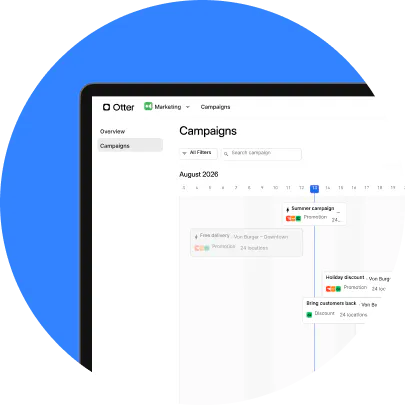
Otter's POS consolidates order management from DoorDash, Uber Eats, Grubhub, and your own direct ordering channel into a single screen, eliminating manual re-entry and reducing fulfillment errors. When writing your tech stack section, that level of specificity (named system, named function) is what lenders and kitchen landlords want to see.
Staffing and permitting
Staffing assumptions: Document how many people per shift, their roles, and how those numbers change as order volume scales. This feeds directly into your labor cost line in financial projections.
Permitting and licensing checklist:
- Business license
- Food handler certifications for all staff
- Shared kitchen usage agreement (if applicable)
- Health department approval for the kitchen space
List what you have secured and what is still pending. If you're using a shared commissary, confirm in writing that the facility's existing permits cover your specific operation.
Packaging and quality control
Document packaging decisions and cost-per-order as a named line item. Packaging is a quality control checkpoint, not an afterthought. It affects both food quality at delivery and your margin per order.
Financial projections: how to model revenue after delivery commissions
This is where most ghost kitchen business plans fail. They model gross revenue, not net revenue after platform fees, and every downstream assumption inherits that error.
Calculate net revenue per order
Third-party delivery commissions run 15-30% per order under standard terms. Your projections must use net revenue per order as the base unit.
Document this formula explicitly in your plan:
(Average ticket) x (1 - blended commission rate) = Net revenue per order
Net revenue per order x projected monthly orders = Monthly net revenue
Find your break-even order volume
Monthly fixed costs (kitchen lease, labor, insurance, licensing, tech) / Net revenue per order = Break-even order volume
State that number. Your reviewers need to know what "success" looks like operationally, not just financially.
Set a realistic food cost target
Ghost kitchens should target food costs between 28-35% of net revenue, not gross revenue. There's no front-of-house volume to offset a high food cost percentage.
Sourcing and distributor discounts can improve your food cost over time, though those savings typically take around 90 days to materialize. Otter's Inventory Savings connects to the food distributors you already order from through existing distributor partnerships and returns cash back automatically on qualifying purchases, which is worth naming in your plan as a lever that improves margin without changing how you buy.
Track platform mix with real data
Platform mix: Document what percentage of orders you project from each delivery channel. If you plan to build a direct ordering channel (which carries lower commissions), model that revenue stream separately from app-sourced orders.
Otter's restaurant analytics surfaces per-platform order data, average ticket, and order volume over time. If you're already using Otter, you can pull real performance data to populate projections rather than estimating, which strengthens any plan presented to a lender or partner. Otter's guide to using Otter Analytics to make data-driven restaurant decisions walks through where to find that data.
Model three volume scenarios
Scenario modeling: Build three cases:
- Low volume (survival mode): What's the minimum order count to keep the lights on?
- Mid volume (break-even): What's the exact order count where fixed costs are covered?
- High volume (profitability): What does the P&L look like at 2x break-even?
Budget your startup costs
Startup capital needs vary by model, but include these as named line items:
- Shared commissary lease: $0-$2,000/month
- Equipment: variable if space is shared
- Licenses: $200-$2,000+ depending on state
- POS and online ordering technology
- Initial packaging purchase
- Launch marketing budget
Build in a 90-day cash runway
Include a 90-day cash runway line for cash flow. Ghost kitchens typically take 2-3 months to reach consistent order volume. A plan that doesn't account for that runway signals inexperience to anyone reviewing it.
Multi-concept strategy: planning for multiple virtual brands from one kitchen
Running two or three virtual restaurant brands from one kitchen is a distinct business model, and one of the more common ways operators scale a ghost kitchen business plan once the first brand is proven. If that's your intent, it deserves its own section.
- Separate brand P&Ls: Each virtual brand needs its own revenue line, commission assumption, and food cost percentage. Blending them into a single revenue number hides underperformers until the damage is done
- Shared labor allocation: Document how prep labor is split across brands, whether menus share core ingredients, and how the schedule handles two brands spiking simultaneously
- Menu engineering for multi-brand: Design each concept's menu so that core ingredients serve multiple brands. Shared proteins, sauces, or produce reduce both waste and prep station complexity
- Staggered launch strategy: Launch brand one first, reach consistent order volume, then layer brand two. This keeps operations manageable and gives you real per-brand data before you commit to scaling
Two paths exist for adding a second concept. You can build your own virtual brand from scratch, which is what the sections above assume. Or you can franchise an established one: Otter's Virtual Brands product lets operators run a proven, top-performing delivery-only brand out of their existing kitchen, without designing a menu or building brand awareness from zero. Either way, name which path you're taking in your plan, since the labor allocation and menu engineering work differently between them.
Christina Hong, owner of Seoulmates in Los Angeles, runs her Korean fusion restaurant alongside a virtual kitchen brand, Boffin Bird, out of the same space. As she put it: "Another cool thing about Otter is it helps me run multiple brands. We have our main storefront, Seoulmates, and our virtual kitchen, Boffin Bird, both on the same system. When people order on the kiosk, they can order from both menus, and both menus are also available on all the third-party apps. It makes the ordering system for both restaurants, through the same system, very easy."
Marketing plan: building a delivery-first brand with no physical storefront
How do customers find you when there's no sign on a building and no passing foot traffic? Your marketing plan needs to answer that question directly.
Optimize your platform listings
Platform optimization is your storefront. Food photography quality, item description copy, keyword-rich store name, and your response rate to reviews all directly affect your ranking within delivery app search results. This is your primary acquisition channel.
Build ratings velocity early
Ratings velocity matters in the launch window. Document a plan to generate your first 50-100 reviews quickly through launch discounts or first-order promotions. Low review counts suppress your app ranking before you've had a chance to compete.
Build direct ordering channels
Building branded, direct ordering channels reduces long-term platform dependency and lowers your effective commission rate on repeat customers. Otter's Online Ordering gives you a branded ordering page you control directly. Many operators pair a direct channel with loyalty programs, like Otter Loyalty, that reward repeat orders and give customers a reason to order with you directly instead of defaulting back to a delivery app. Include this in the plan even if volume starts small.
Use social media and paid promotion
Food photography and short-form video on Instagram and TikTok can build awareness within your delivery radius. Paid promotion within delivery apps (DoorDash Ads, Uber Eats Ads) is a real acquisition lever. Budget for it and model the customer acquisition cost against expected lifetime order value.
Set up email and SMS remarketing
If you capture customer contact information through a direct ordering channel, a basic remarketing sequence drives repeat purchase at near-zero marginal cost.
Budget for marketing
Marketing budget line: Ghost kitchen launch marketing typically runs 5-10% of projected gross revenue. Include this as a named line item in your marketing strategy so it's never treated as discretionary.
Delivery commissions decide whether your ghost kitchen plan survives contact with reality
The operators who lose money on ghost kitchens aren't the ones who get low order volume. They're the ones who get solid order volume and discover the margin math was never right to begin with.
Modeling financial projections on gross revenue instead of net revenue is the single most common and most expensive error in ghost kitchen planning. Every decision downstream (pricing, food cost target, staffing, marketing spend) inherits that mistake.
A plan built on net revenue forces realistic assumptions into every other section. Menu prices go up. Food cost targets get tighter. Labor assumptions get leaner. Marketing budgets get justified by actual profit margin contribution, not gross revenue.
Treat the business plan as a living document. Update order volume data, per-platform performance, and food cost actuals each quarter. That's how you catch underperformance early enough to act on it. Building direct ordering channels from the start, even when volume is small, creates the infrastructure to reduce third-party delivery app dependency as you scale and improves the long-run margin profile your plan projects.
A well-modeled ghost kitchen business plan isn't just a document for raising capital or signing a lease. It's the operational compass you'll use to decide when to add a second virtual restaurant brand, when to renegotiate a kitchen agreement, and when to exit a platform that's consuming more margin than it returns.
Ready to build the operations behind your ghost kitchen plan? Book a demo with Otter to see how order management, analytics, and multi-brand tools come together in one system
Frequently asked questions about ghost kitchen business plans
What sections does a ghost kitchen business plan need?
A ghost kitchen business plan needs an executive summary, a concept and model overview, a market analysis validating delivery demand in your target zone, an operations plan covering kitchen type and tech stack, financial projections that model net revenue after delivery commissions, a marketing plan for building a delivery-first brand, and (if applicable) a multi-concept section for running multiple virtual brands from one kitchen.
How do delivery app commissions affect my financial projections?
Third-party delivery services run 15-30% commission per order under standard terms. Build your projections on net revenue per order, not gross, and show the exact order volume needed to cover fixed and operational costs at those net margins.
How much does it cost to start a ghost kitchen?
Startup costs depend on the model you choose. A shared commissary kitchen can cost $0-$2,000 per month with minimal equipment cost if equipment is shared. Adding a virtual restaurant to an existing licensed kitchen during off-peak hours is the lowest-cost entry available. Budget separately for licenses ($200-$2,000+ depending on state), POS and online ordering technology, packaging, inventory, and a launch marketing spend of 5-10% of projected gross revenue.
Can an existing restaurant add a virtual brand without leasing a separate kitchen?
Yes, and this is the model most operators who succeed with ghost kitchens use. Adding a virtual brand during off-peak hours uses staff, equipment, and ingredients you're already paying for, which dramatically reduces overhead costs. Your business plan should document the shared labor allocation, a separate brand P&L, and how the virtual brand's menu overlaps with your existing ingredient list.
What is the difference between a ghost kitchen and a virtual brand?
A ghost kitchen (also called a dark kitchen or cloud kitchen) is a physical facility: a licensed commercial kitchen that operates without a dine-in area. A virtual brand, sometimes called a virtual kitchen or virtual restaurant, is a delivery-only concept that operates out of a ghost kitchen, a shared commissary kitchen, or an existing restaurant's kitchen during off-peak hours. One ghost kitchen can run multiple virtual brands simultaneously, each with its own name, menu, and delivery app storefront.
How long does it take a ghost kitchen to become profitable?
Most ghost kitchens take 2-3 months to reach consistent order volume. Your business plan should include a 90-day cash runway and a scenario model showing the order count required for break-even. Operators who launch with existing customer bases or strong social followings in their delivery radius typically reach profitability faster than those starting from zero brand recognition.

Get a demo built for ghost kitchens