Table of contents
- Why restaurants can't ignore food delivery apps
- The reach and revenue advantages of food delivery apps
- Operational advantages once the order comes in
- The customer relationship advantages: reviews, loyalty, and feedback
- Ghost kitchens: the delivery-only version of this advantage
- Where the advantages meet their limits: commission fees and profit margins
- Managing every delivery app without losing your mind
- The advantage isn't the app, it's who manages what it sends you
- Frequently asked questions about food delivery app advantages
Food delivery apps changed the restaurant industry faster than almost any other technology in the last decade. 17% of Americans order delivery at least once a week and that figure climbs sharply among younger, higher-income city dwellers. Platforms like DoorDash, Uber Eats, and Grubhub together move tens of billions of dollars in orders every quarter. For restaurants, that demand is an opportunity: on-demand food delivery apps put a restaurant in front of customers who would otherwise never walk through the door.
But the advantages of food delivery apps come with real costs, mainly commission fees that can eat into thin restaurant margins. The honest answer to "are food delivery apps worth it" is that the advantages are real and substantial, as long as a restaurant also manages what those apps send back.
Key insights
- Food delivery apps expand a restaurant's online presence and brand visibility to customers who discover the business through the app itself, not a search for its name
- Millennials and Gen Z drive most delivery volume, and both groups expect real-time order tracking, mobile ordering, and digital wallets as the default way to pay
- Commission fees from DoorDash, Uber Eats, and Grubhub typically run 15 to 30% per order, which is the single biggest disadvantage of relying on third-party delivery apps alone
- The restaurants that come out ahead pair delivery apps with their own commission-free online ordering platform and a system that keeps every app's orders in one place instead of on separate tablets
Why restaurants can't ignore food delivery apps
A restaurant industry that used to compete on location and word of mouth now competes on app store rankings, reviews and ratings, and search visibility inside DoorDash, Uber Eats, and Grubhub. That shift has been good for accessibility. A customer who never would have found a small restaurant's own website can find it through an app they already have installed, browse online menus with photos, and order in three taps.
That reach is the core advantage of food delivery service for restaurants: it turns takeout into an on-demand channel available to anyone with a phone, not just people who already know the restaurant exists.
The reach and revenue advantages of food delivery apps
Expanded online presence and accessibility
Every restaurant listed on a delivery app gets a searchable profile that functions as a second storefront. Customers browsing nearby restaurants for the first time discover businesses they would never have searched for by name, which directly builds brand visibility in a crowded restaurant industry.
A built-in audience of millennials and younger diners
Millennials and Gen Z order delivery more often than any other age group, and both generations expect the same on-demand convenience from restaurants that they get from every other app on their phone. Meeting them where they already are, rather than trying to convert them to a restaurant's own app first, is one of the clearest advantages of online food delivery.
Increased revenue without added dining room capacity
A delivery order doesn't need a table, a server, or a parking space. For restaurants near their dine-in capacity during peak hours, food delivery apps add incremental, on-demand revenue from the same kitchen without the cost of expanding the dining room.
Operational advantages once the order comes in
Real-time order tracking and route optimization
Customers and restaurants both benefit from the logistics layer delivery apps operate behind the scenes. Real-time order tracking keeps customers informed from kitchen to doorstep, while each platform's own route optimization gets drivers to the right address efficiently, without the restaurant needing to manage a delivery fleet or plan routes itself.
Contactless delivery and flexible payment
Contactless delivery became the default during the pandemic and never went away, because it's simply more convenient. On the payment side, delivery apps accept credit/debit cards and digital wallets by default, and some markets still see meaningful cash on delivery volume. Restaurants don't have to build or maintain any of that payment infrastructure themselves.
Fewer front-of-house bottlenecks
Every delivery order that comes through an app is an order a host or server didn't have to take over the phone. That frees up front-of-house staff for the guests actually in the building, which is a real, if under-discussed, operational efficiency gain, and it shows up directly in customer satisfaction scores for the guests who are dining in. For a closer look at how kiosks, QR codes, and delivery orders all fit together on the floor, Otter's rundown of restaurant ordering options breaks down each channel.
The customer relationship advantages: reviews, loyalty, and feedback
Reviews and ratings that build trust before the first order
A new customer deciding between two similar restaurants on a delivery app almost always checks reviews and ratings first. A strong ratings profile functions as free marketing, and consistent customer feedback gives a restaurant an early warning system for menu items or packaging that need attention.
Loyalty programs and incentives that bring customers back
Delivery apps run their own loyalty programs and loyalty rewards, and many restaurants layer their own incentives on top: a free side on a customer's fifth order, a discount code for a slow Tuesday, a point system tied to spend. Done well, these programs turn a one-time delivery customer into real customer retention and long-term customer loyalty, not just a single transaction.
Ghost kitchens: the delivery-only version of this advantage
Cloud kitchens and ghost kitchens take the reach advantage of food delivery apps a step further. Because a ghost kitchen exists purely to fulfill delivery orders, it can operate outside a restaurant's usual five-mile radius, test a new concept without the cost of a second dining room, and reach an entirely new customer base through the same delivery apps a brick-and-mortar restaurant already uses. If a restaurant is weighing whether a delivery-only concept makes sense, Otter's guide to ghost kitchens walks through the different models and what each one costs to run.
Where the advantages meet their limits: commission fees and profit margins
No conversation about the advantages of food delivery service is complete without the disadvantages, and the biggest one is cost. DoorDash, Uber Eats, and Grubhub all take a cut of every order, and that commission is the main reason food delivery apps can feel like they're taking more than they're giving.
Platform | Typical commission per order | Known for |
|---|---|---|
DoorDash | 15% to 30% | Largest US market share |
Uber Eats | 15% to 27% | Strong urban density and route optimization |
Grubhub | 5% to 20%, plus advertising fees | Longest-running US marketplace |
Zomato | Varies by market | Leading on-demand platform outside the US |
Once packaging, payment processing, and promotional placement are factored in, the effective cost of a third-party delivery order often lands well above the advertised commission rate. That's a real hit to profit margins, especially for independent restaurants without the volume to absorb it.
The advantages and disadvantages of food delivery balance out differently depending on how a restaurant responds. Restaurants that rely on third-party delivery apps as their only online food ordering system feel the commission fees the hardest. Restaurants that add a commission-free online ordering platform alongside the apps keep the reach of DoorDash, Uber Eats, and Grubhub while routing repeat customers to a channel that doesn't take a cut.
Managing every delivery app without losing your mind
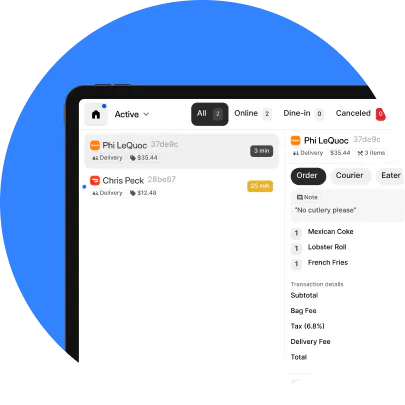
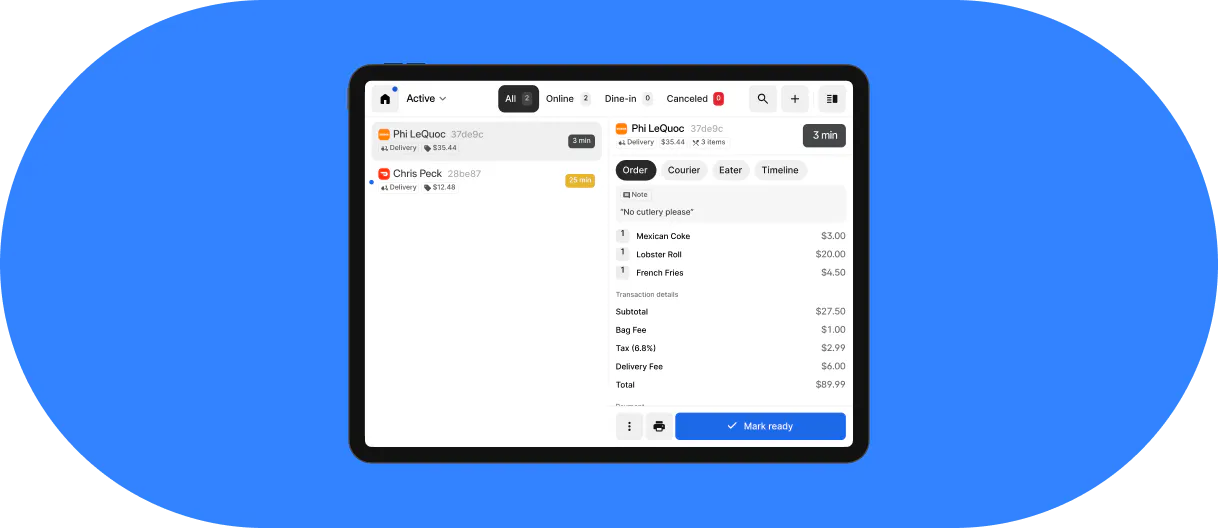
The operational advantage most articles about food delivery apps skip is what happens after the order lands. A restaurant running DoorDash, Uber Eats, Grubhub, and its own online menus all at once is juggling several tablets, several menus to keep in sync, and several places to watch for a missed order.
Jose Pacheco, owner of Birria Los Socios in Rancho Cucamonga, California, ran into exactly that problem before switching to Otter's Order Manager: "Otter was a tablet I used to connect all my online ordering, so that made it easier to get all those apps into just one. I love the fact that you could use just one tablet and one printer, and you didn't have to come back to all the tablets. When you get an order, it all comes out from just one tablet."
That kind of consolidation is where the competitive advantage really shows up: a restaurant gets the customer reach of every major delivery app without the point of sale system chaos of managing them one by one, since every order, whether it comes from a delivery app or the restaurant's own POS system, lands in the same place.
The advantage isn't the app, it's who manages what it sends you
Food delivery apps are not going away, and for most restaurants they shouldn't. The reach, the accessibility, and the incremental revenue are real. The restaurants that struggle with delivery apps are usually struggling with the operations behind them, not the apps themselves: too many tablets, too many menus, and no easy way to turn a delivery customer into a loyal one.
Get the operations right with a system built to handle every app in one place, and the advantages of food delivery apps stop competing with your margins and start compounding with them.
Frequently asked questions about food delivery app advantages
What are the main advantages of food delivery apps for restaurants?
The biggest advantages are expanded reach and brand visibility, incremental revenue without added dining room capacity, and access to built-in customer loyalty tools like reviews and ratings, loyalty programs, and customer feedback that most restaurants couldn't build on their own.
What are the disadvantages of food delivery apps?
The main disadvantage is commission fees, typically 15 to 30% per order depending on the platform, which directly affects profit margins. Restaurants also give up some control over the customer relationship, since the delivery app owns the checkout experience and much of the customer data.
Do food delivery apps actually increase revenue for restaurants?
Yes, in most cases. Delivery orders use existing kitchen capacity without requiring more dining room space or staff, which makes them a source of incremental revenue. The net benefit depends on how well a restaurant manages commission costs against that added volume.
What's the difference between DoorDash, Uber Eats, and Grubhub for restaurants?
All three operate as third-party delivery services with similar commission structures, roughly 15 to 30% per order. DoorDash currently holds the largest share of the US market, Uber Eats has strong density in urban areas, and Grubhub is the longest-running of the three. Zomato plays a similar role in markets outside the US.
Are ghost kitchens a good way to use food delivery apps?
Ghost kitchens, also called cloud kitchens, let a restaurant fulfill delivery orders from a space built for delivery only, without the cost of a dining room. They work well for testing new concepts or reaching customers outside a restaurant's usual delivery radius, but they depend entirely on delivery apps and online presence to bring in orders.
How can restaurants reduce the impact of commission fees?
The most effective approach is pairing third-party delivery apps with a commission-free online ordering platform for direct orders, and consolidating every app into one order management system so staff aren't juggling multiple tablets and menus. Loyalty programs that reward direct orders also help shift repeat customers away from the highest-commission channel.
Do customers still use cash on delivery?
Less often than a few years ago, but it hasn't disappeared. Most delivery app orders are paid by credit/debit cards or digital wallets at checkout, though cash on delivery still shows up in some markets and for some customer segments.
See how Otter manages every delivery app