Table of contents
- What is a virtual restaurant brand?
- Virtual brands vs. ghost kitchens: What is the difference?
- Is your restaurant ready to launch a virtual brand?
- Should you create your own concept or license an existing brand?
- How to start a virtual restaurant brand
- What does launching and running a virtual brand cost?
- How to measure your virtual brand’s performance
- Build a virtual brand your kitchen can support
- Frequently asked questions about virtual restaurant brands
In the National Restaurant Association’s 2026 State of the Restaurant Industry findings, 61% of adults said restaurants remain essential to their lifestyles. That demand gives you a reason to explore new ways to serve guests, but a second online brand still needs to earn its place in your kitchen.
A virtual restaurant brand lets you sell a distinct food concept without opening another dining room. You can build your own concept or fulfill orders for an established brand, using space and resources you already have. The opportunity depends on local demand, delivery quality, and what remains after the extra costs, not simply how many listings you create.
Key insights
- A virtual restaurant brand is a food concept sold through online ordering channels, with its own name and menu but no dedicated dining room
- Creating your own concept and licensing an established brand are different paths, with different responsibilities for menus, marketing, fees, and ongoing support
- Shared equipment and ingredients can reduce the need for a new buildout, but you still need to budget for packaging, labor, platform fees, marketing, and any brand fees
- Test one concept before adding more, and track its contribution, delivery quality, and effect on your main restaurant
What is a virtual restaurant brand?
A virtual restaurant brand is a distinct food concept that customers order online and that your kitchen prepares for delivery or pickup, without a dedicated dining room for that brand. It has its own name, menu, and customer-facing identity.
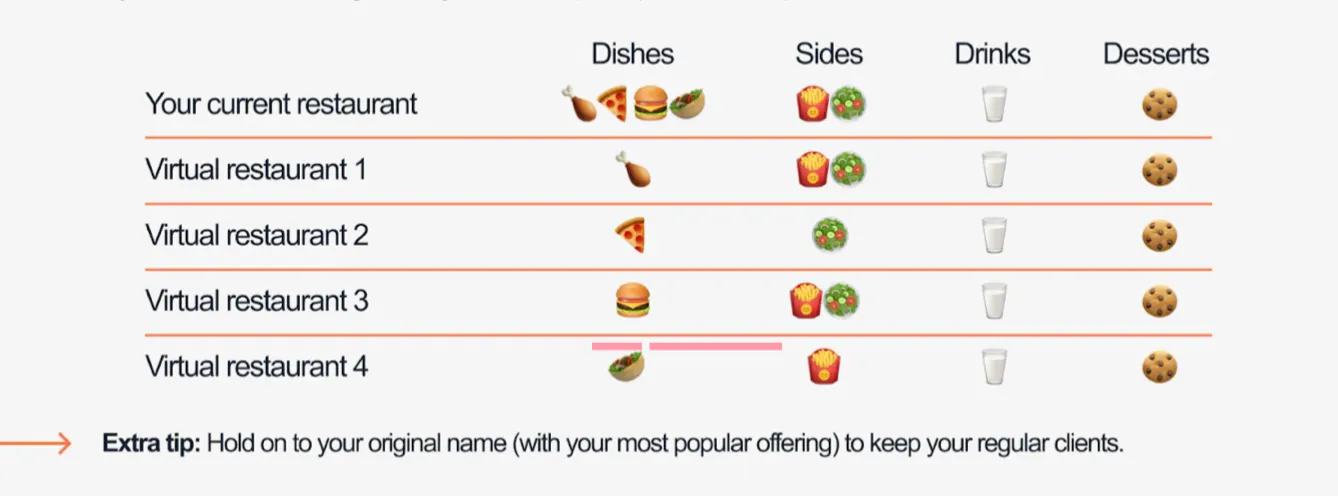
For example, you might run a neighborhood restaurant and create a separate online concept focused on rice bowls. Guests choose the bowl brand through its own listing or ordering page, while your team prepares the food in your existing kitchen.
You do not need a separate building for every brand. You do need a clear concept, a kitchen that can handle the work, and a reliable way to take, prepare, and hand off orders.
Virtual brand and virtual restaurant are often used to describe similar models. The important question is what you are selling, where it is prepared, and who handles the work.
Virtual brands vs. ghost kitchens: What is the difference?
A virtual brand describes the concept customers order from. A ghost kitchen describes a delivery-focused kitchen operation. You can run a virtual brand from your current restaurant or from a kitchen built for off-premises orders.
Terms such as cloud kitchen and dark kitchen are used differently across providers. Check the actual setup rather than making decisions based on the label.
Model | What it describes | What it means for your plan |
|---|---|---|
Virtual restaurant brand | A distinct online food concept | You need a brand, menu, ordering channels, and a fulfillment process |
Ghost or dark kitchen | A kitchen focused on off-premises orders | You need suitable space, staffing, equipment, and delivery handoff |
Shared commercial kitchen | Space used by multiple food businesses | You need to confirm access, storage, scheduling, and included services |
Existing restaurant with a virtual brand | A second concept prepared alongside your main menu | You need to protect service quality across both concepts |
Otter’s guide to what a ghost kitchen is explains the kitchen models in more detail. Your virtual brand plan should focus on the concept and its economics, whichever facility you use.
Is your restaurant ready to launch a virtual brand?
Your kitchen needs usable capacity during the hours you plan to sell. An empty counter does not necessarily mean you have spare cooking, packing, or staff capacity.
Check these areas before you develop a full menu:
- Cooking capacity: Can your equipment handle both menus when orders arrive together?
- Staffing: Who will prepare, check, and pack the extra orders?
- Storage: Do you have room for ingredients and packaging without crowding your existing stock?
- Handoff: Can staff separate bags by brand and give couriers the correct order?
- Demand: Is there a local customer need your concept can serve?
- Financial room: Can you fund the launch and a test period without relying on immediate profit?
You may have more room to test a breakfast concept before your main service than a second dinner menu during your busiest hours. Choose the daypart around your actual workload.
A second brand can also compete with your main menu for attention and orders. Track both businesses so you can distinguish additional demand from sales that have moved between listings.
Should you create your own concept or license an existing brand?
Build your own virtual brand when you want to develop the concept and control its identity. Consider an established brand when you want an existing menu and operating framework, and are comfortable with the agreement’s costs and requirements.
Neither path removes the work of producing good food and managing service. Compare what you receive with what you are responsible for.
Decision | Create your own brand | License or franchise an established brand |
|---|---|---|
Concept and identity | You develop the name, positioning, and menu | You operate under an existing concept and agreement |
Menu control | You decide how to develop and change it | Changes may need approval or follow brand standards |
Marketing | You build awareness and fund promotion | Support depends on the agreement |
Training and sourcing | You create recipes, procedures, and supplier plans | You may receive specifications, training, or approved supplier requirements |
Costs | You fund development and operations | You may also pay setup, licensing, royalty, or other contractual fees |
Exit | You decide how to pause or retire the concept | Notice periods and other obligations depend on the contract |
Otter Virtual Brands provides a path to fulfill orders for an established online-only brand from your current kitchen. The product page describes a franchise model with brands managed and marketed by Future Foods, including concepts such as Brekkie Bagels and Birria Hands.
That program is separate from using order-management software to run concepts you already own. Before joining, confirm current availability, fees, equipment needs, menu requirements, marketing responsibilities, and contract terms for your location.
How to start a virtual restaurant brand
Use the same basic sequence whether you are developing your own concept or assessing an established one. For a licensed brand, some menu and branding decisions will already be defined.
1. Validate demand and choose a concept
Review delivery options in your service area. Look for a customer need you can meet well, rather than adding another listing because a cuisine appears popular.
Compare local pricing, delivery times, menu choices, and customer feedback. Use your own sales records to identify dishes or ingredients that already perform well.
For example, a bowl concept may fit a kitchen that already prepares rice, vegetables, and proteins. A new cuisine that requires different equipment and prep skills may be a larger project.
Tip: Describe the target guest, meal occasion, and reason to choose your concept in one sentence. If you cannot explain the difference, keep working on the idea.
2. Check requirements before committing
Confirm the rules for your location and the ordering platforms you plan to use. Ask the relevant local authority whether your proposed brand and kitchen arrangement require changes to permits, registrations, or approvals.
Check platform onboarding requirements, menu-distinctiveness rules, listing information, and performance standards. If you are licensing a concept, review the brand agreement too.
Do not assume your existing restaurant setup automatically covers every new arrangement.
Tip: Keep a written launch checklist showing each requirement, who must confirm it, and whether it has been completed.
3. Choose a clear name and identity
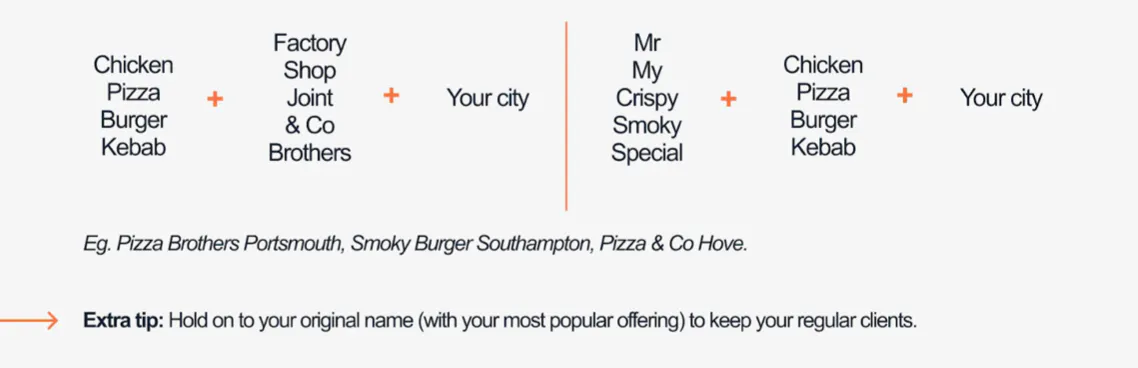
For your own brand, choose a name that helps guests understand the food without copying another business. Check for conflicting names and confirm that your proposed identity is suitable for the channels you will use.
Build a simple visual identity that works on a small screen and on packaging. Keep the listing, menu, and food photos consistent with what you actually serve.
If you are licensing a brand, follow the identity and customer-facing information required by the agreement.
Tip: View the name and logo at the size they will appear in an ordering app. Guests should be able to read them quickly.
4. Build a focused menu and test delivery quality
Start with a menu your team can execute consistently. Reuse ingredients and preparation steps where they fit the concept, while keeping the offering meaningfully distinct.
Organize items into clear categories. Use accurate photos and descriptions that explain portions, main ingredients, and available choices. There is no single category count or description length that works for every concept.
Use modifiers for choices your kitchen can reliably fulfill. Make required choices clear, price extras correctly, and avoid long option lists that create confusion. Offer sides, drinks, or desserts where they make sense for the meal.
Pack each item and test it after a realistic delivery trip. Check temperature, texture, spills, portion size, and whether components need separate containers.
Tip: Ask someone who did not cook the food to open the bag and assess it. Test the experience your guest receives, not just the dish at the pass.
5. Price the menu and prepare a cost plan
Calculate what remains from an order after food, packaging, channel fees, discounts, and incremental labor. Include any brand fees and other costs that apply to your model.
Separate launch expenses from recurring charges. Estimate the volume you need to cover those costs, and test what happens if orders arrive more slowly than expected.
Otter’s guide to writing a ghost kitchen business plan can help you organize demand, operations, and financial assumptions for a delivery-focused concept.
Tip: Model a full-price order and a promoted order separately. A discount can increase sales while reducing what each order contributes.
6. Set up menus, orders, and kitchen handoff
Assign responsibility for updating menus, marking items unavailable, checking tickets, and handing off orders. Confirm that each ticket shows the correct brand, items, modifiers, and service mode.
Otter Menu Management helps you manage menus across connected delivery channels. Confirm which integrations support your setup and test how changes appear on each listing.
Otter Order Manager consolidates orders from connected channels into a shared workflow. It can support concepts you own as well as your broader delivery operation; using it is different from joining the Virtual Brands program.
Christina Hong, owner of Seoulmates in Los Angeles, California, describes the operational value: “Another cool thing about Otter is it helps me run multiple brands.”
That is the goal for your setup: keep the brands recognizable while giving your team a clear way to manage the work.
Tip: Place test orders with similar items under both brands. Follow each ticket through preparation, packing, and pickup to catch naming or routing errors.
7. Launch a limited pilot
Start with a manageable menu, service area, and operating schedule. Give your team time to learn the workflow before increasing the number of channels or concepts.
Use accurate listings and packaging that help guests recognize the brand. Test promotions against a budget, and review results after discounts and advertising costs.
Listen to feedback about the food and delivery experience. A repeated complaint about temperature or a missing modifier needs an operational fix.
Tip: Define the pilot’s review date and success measures before launch. Decide what results would justify continuing, changing the menu, or pausing.
What does launching and running a virtual brand cost?
Your cost depends on what you already have, what the new concept requires, and whether you own or license the brand. Avoid opening a new dining room if you do not need one, but budget for the work that still has to happen.
Cost area | Launch expenses to check | Ongoing expenses to check |
|---|---|---|
Brand development | Name, logo, photography, and listing setup | New creative work and menu updates |
Menu and ingredients | Recipe tests and opening inventory | Food purchases, waste, and supplier changes |
Packaging | Samples, labels, and initial stock | Containers, bags, seals, and branded materials |
Labor and training | Recipe training and workflow tests | Extra prep, packing, cleaning, and management time |
Equipment and space | Any additional tools, storage, or installation | Maintenance, utilities, or extra space costs |
Ordering and promotion | Channel setup and launch advertising | Platform fees, processing, software, ads, and discounts |
Established-brand participation | Any required setup or initial fee | Applicable royalties, licensing fees, and contractual charges |
Local requirements | Any required applications or setup changes | Renewals or ongoing compliance expenses |
A shared ingredient is still a food cost. An employee already on the schedule still has a workload limit. If the new brand adds shifts, overtime, waste, or slower service, include that effect in your plan.
Get written quotes and use the actual terms of your channel and brand agreements. There is no reliable universal startup price for every virtual restaurant.
An illustrative per-order calculation
Suppose an order produces $25 in food sales, excluding taxes and tips. Assume these example costs:
- Food: $7.50
- Packaging: $1
- Platform fee: $6.25, based on an assumed 25% rate
- Incremental labor: $3
- Restaurant-funded promotion: $1
That leaves $6.25 in contribution per order, before any additional brand fees, software charges, refunds, or allocated overhead. These figures are illustrative, not Otter pricing, a platform quote, or an industry benchmark.
Contribution is what the order leaves to help cover other costs. It is not net profit. If your real costs or sales mix differ, your result will too.
Calculate contribution by brand and channel so you can see which orders support the business.
How to measure your virtual brand’s performance
Review the new concept and your main restaurant together. An increase in combined sales is useful only if service and profitability remain healthy.
Sales and contribution
Track orders, average order value, and contribution after the costs that apply to each channel. Separate full-price orders from discounted orders.
Use a brand-level profit and loss view for recurring expenses and overhead. Avoid judging the concept by gross sales alone.
Preparation and delivery quality
Monitor preparation times, late handoffs, unavailable items, cancellations, and refunds. Read reviews for repeated issues with packaging, accuracy, temperature, or portions.
Compare the new workflow with your main service. If the extra concept slows existing tickets, change the menu, hours, or capacity before expanding.
Customer demand and repeat orders
Review which dishes sell, when orders arrive, and whether guests return where your channels provide that information. Separate performance by ordering channel so one strong listing does not hide a weak one.
Do not assume every virtual-brand order is a new customer. Compare total kitchen sales and main-brand performance with your pre-launch baseline, allowing for seasonality and other changes.
Decisions after the pilot
Continue when the contribution and workload fit your plan. Adjust the concept if demand exists but the menu, packaging, pricing, or schedule needs work.
Pause when ongoing costs or service problems outweigh the benefit. A pilot is useful because it gives you a way to learn before committing more resources.
Build a virtual brand your kitchen can support
A virtual restaurant brand can help you test a new concept and serve a different meal occasion without adding a dining room. Its value depends on whether guests want the food, your team can deliver it consistently, and the orders contribute enough to support the business.
Choose the ownership model first. Then check requirements, test the food and workflow, and compare the complete costs. Expand after the results support the decision.

Book a demo with Otter
It’s time to enhance your operations with Otter’s all-in-one restaurant platform. Book time with our sales team to learn more.
Frequently asked questions about virtual restaurant brands
What is a virtual restaurant brand?
A virtual restaurant brand is a distinct food concept sold through online ordering channels without its own dedicated dining room. Your kitchen prepares the food for delivery or pickup under that brand’s name. It can operate alongside your main restaurant or from a delivery-focused kitchen.
Is a virtual brand the same as a ghost kitchen?
A virtual brand is the concept customers order from, while a ghost kitchen describes the delivery-focused kitchen operation. You can run a virtual brand from an existing restaurant or a dedicated kitchen. Terminology varies, so confirm the physical setup and operating responsibilities.
Can I run multiple virtual brands from one kitchen?
Yes, if your space, equipment, staff, and order workflow can handle the combined demand. Shared ingredients and preparation steps can help, but they do not remove capacity limits. Test one additional concept before adding more.
Do virtual brands only sell through delivery apps?
No, you may also use a direct online ordering channel, and pickup may be available depending on your setup. The defining feature is the separate concept without a dedicated dining room, not exclusive use of a particular app. Check the requirements of each channel and any brand agreement.
How much does it cost to start a virtual restaurant?
The total depends on your kitchen, menu, branding, staffing, channels, and ownership model. You may avoid a new dining-room buildout while still paying for packaging, photography, training, marketing, and additional equipment. A licensed or franchised concept may also involve contractual fees.
Can a virtual brand take sales from my main restaurant?
It can, particularly when the concepts serve similar guests and meal occasions. Track combined sales, contribution, and main-brand performance to assess whether the new concept adds value. A separate listing does not guarantee a new customer.
Do I need a separate license or business registration?
The answer depends on your location, legal structure, kitchen arrangement, and proposed activity. Ask the relevant local authority what your new concept requires. Confirm platform and brand-program requirements separately.
What food works best for a virtual restaurant brand?
Choose food that your team can prepare consistently and that holds up through packing and transport. Familiar ingredients and shared prep can make the operation easier to manage. Test the delivered meal before deciding it belongs on the menu.
Can I sell my existing dishes under a new brand?
Some ingredients or dishes may fit a second concept, but simply duplicating a menu under another name may not meet a platform’s requirements. Check current menu and listing rules before launch. Give guests a clear reason to choose the new concept.
How do I start a virtual brand with Otter?
Otter’s Virtual Brands program provides a path to fulfill orders for an established online-only brand from your kitchen. Ask about available concepts, eligibility, fees, operating requirements, and contract terms. If you already own the concepts, discuss the menu and order-management tools needed for your setup instead.

Book a demo to see how Otter’s all-in-one platform can help your restaurant thrive.