Table of contents
- What defines a restaurant category
- Types of restaurants by service style and price
- Newer restaurant models built around delivery and pickup
- Midscale restaurant examples in the U.S.
- How to choose the right restaurant type for your business
- Matching technology to your restaurant type
- Choose the category you can execute, not the one you admire
- Frequently asked questions about types of restaurants
The United States has more than 1 million restaurant and foodservice outlets heading into a year the National Restaurant Association projects will bring $1.55 trillion in sales. Almost none of them run the same way.
The word "restaurant" covers a diner that opens at 5 a.m., a tasting-menu room with a sommelier, and a kitchen with no dining room at all that exists only inside three delivery apps. Those are not variations on one business. They differ in check size, staffing, kitchen complexity, real estate, and where the orders come from, and each of those differences changes what you need to run the place. This guide walks through the main types of restaurants, what defines each category, and what each one actually demands from an operator.
Key insights
- Restaurant categories are defined less by cuisine than by service model, average check, and the mix of on-premises versus off-premises orders.
- The traditional ladder runs from quick service through fast casual, midscale, casual dining, upscale casual, and fine dining, with check size and labor cost rising at each step.
- Newer categories including ghost kitchens, virtual brands, food halls, and food trucks exist mainly because delivery and pickup changed what a restaurant needs to be.
- The category you choose determines your technology requirements more than your cuisine does: a counter-service concept and a table-service concept need genuinely different systems.
What defines a restaurant category
Cuisine is the least useful way to sort restaurants. Two taco shops can belong to completely different categories if one runs a counter with a kiosk and the other seats guests and runs a bar.
Five things actually separate the categories:
- Service model. Does a guest order at a counter, at a table with a server, on a screen, or on a phone before they arrive?
- Average check. What one guest typically spends, which drives everything from menu design to how many covers you need.
- Kitchen complexity. A limited menu executed fast is a different operation from a scratch kitchen with multiple prep stations.
- Order mix. How much of your volume is dine-in versus takeout, delivery, and catering.
- Labor model. Whether you need trained servers, a counter crew, or a small kitchen team and no front of house at all.
Here is how the main categories compare on those dimensions:
Category | Typical check | Service model | Where orders come from |
|---|---|---|---|
Quick service | Lowest | Counter, drive-thru, kiosk | Mostly off-premises and counter |
Fast casual | Low to moderate | Counter or kiosk, food made to order | Split between counter and digital |
Midscale and family dining | Moderate | Table service, sometimes counter or hybrid | Mostly dine-in, growing takeout |
Casual dining | Moderate | Full table service, often with a bar | Mostly dine-in |
Upscale casual | Higher | Full table service | Almost entirely dine-in |
Fine dining | Highest | Full table service, often coursed | Dine-in only |
Buffet | Low to moderate | Self-serve, seated | Dine-in |
Cafe, coffee shop, bakery | Low | Counter | Counter plus mobile order ahead |
Ghost kitchen | Varies | No dining room | Delivery and pickup only |
Virtual brand | Varies | No dedicated space | Delivery apps only |
Food hall stall | Low to moderate | Counter in a shared space | Counter plus delivery |
Food truck | Low to moderate | Window service | Window plus pre-orders |
Types of restaurants by service style and price
Quick service restaurants (QSR)
Quick service is built on speed and repeatability. Menus are tight, food is largely pre-prepped, and the operating model depends on moving a high volume of low-check orders through a counter, a drive-thru, a kiosk, or a delivery app. Labor is a counter crew rather than trained servers, and the winning operators are the ones who shave seconds off the same handful of tasks.
The category leans harder on technology than any other, because the order arrives from four or five places at once. A restaurant point of sale built for counter speed and self-service kiosks that let guests order without occupying a staff member both do real work here. Otter's rundown of quick service restaurant examples covers the brands that define the category.
Fast casual restaurants
Fast casual sits one rung up: counter ordering, but food assembled to order from fresher ingredients, better interiors, and a higher check than quick service. Think build-your-own bowls, better burgers, and specialty concepts where the guest still walks to a counter but expects more than a warming tray.
Operationally it is the most delivery-friendly of the traditional categories. Food travels well, the menu is modular, and commission-free direct online ordering tends to pay off faster here than in any table-service format, because guests are already used to ordering these concepts ahead.
"The hospitality is still there and we're proud of it. The customer can place their order on the kiosk, but after that transition, from placing the order to checking out the vibes, having customer service from front of house, that's where we really connect with our customers."
Scott, owner of Bred Hot Chicken, Costa Mesa and San Juan Capistrano, California
Midscale and family dining restaurants
Midscale restaurants sit between fast food and upscale dining: moderate prices, familiar American comfort food, booth seating, and a relaxed room designed for families and everyday diners rather than occasions. This is the diner and family-restaurant category, and it is defined as much by predictability as by price. Guests come because they know exactly what they are getting.
Service models vary more here than the category's reputation suggests. Traditional midscale runs full table service, but a growing share of operators run counter ordering with food brought to the table, or lean on digital ordering for takeout. The hybrid versions carry meaningfully lower labor complexity than full table service while keeping the sit-down experience.
Midscale concepts also depend on repeat visits more than almost any other category, which is why Otter Loyalty and the wider set of restaurant loyalty programs do disproportionate work in this segment. A guest who comes twice a month is the whole business model.
Casual dining restaurants
Casual dining is full table service at moderate prices, usually with a bar, a broader menu, and a longer average stay than midscale. The casual dining definition most operators use in practice: servers, alcohol, a real kitchen, and a check that sits comfortably above family dining without approaching fine dining.
The operating demands change here. You need trained servers, floor management, tab handling, and a kitchen that can execute a wide menu at speed during a compressed dinner rush. Labor is the dominant cost and table turnover is the dominant metric.
Upscale casual restaurants
Upscale casual keeps the relaxed atmosphere of casual dining but raises the check through better ingredients, a chef-driven menu, a developed drinks program, and a more designed room. Guests dress up slightly. Reservations start to matter. The category depends on affluent catchment areas and a reliable occasion calendar in a way midscale does not.
Fine dining restaurants
Fine dining is the highest-check, highest-touch category: coursed menus, extensive wine service, a large front-of-house team, and often a tasting format. Kitchen complexity is at its maximum and covers per night are at their minimum. Success rests on reputation, consistency at a very high standard, and a location that can sustain premium pricing.
It is also the category least served by delivery-oriented technology, for obvious reasons. Fine dining needs deep reservation, coursing, and table management tools more than it needs channel consolidation.
Buffet and all-you-can-eat restaurants
Buffets trade service labor for food cost. Guests serve themselves, so front-of-house staffing is light, but food waste management and continuous replenishment become the operational challenge. The category performs well with large groups, families, and value-driven markets, and it lives or dies on covers per hour.
Cafes, coffee shops, and bakeries
Cafes run counter service with a low check and very high transaction volume, which makes speed at the register and mobile order-ahead the two things that matter most. Many also carry a retail component (beans, packaged goods, whole cakes) that a pure restaurant does not, so inventory and menu setup get more complicated than the small footprint suggests.
Newer restaurant models built around delivery and pickup
The categories above existed before delivery apps. These four largely did not, and they exist because a restaurant no longer needs a dining room to have customers.
Ghost kitchens
A ghost kitchen is a production kitchen with no dining room and no walk-in traffic. All revenue arrives through delivery and pickup. That removes rent pressure, front-of-house labor, and buildout cost, and replaces them with a total dependence on channel performance: if your listing ranks poorly or an app disconnects, you have no walk-in business to fall back on. Otter's guide to what a ghost kitchen is covers the model in detail.
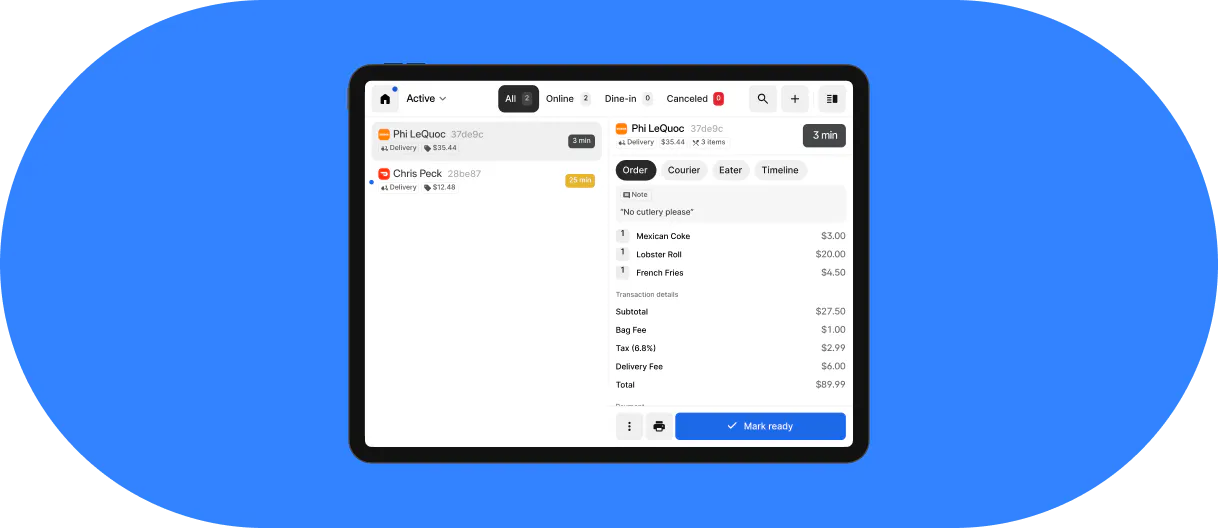
The technology requirement is unavoidable rather than optional. Orders from several delivery platforms have to land in one queue, which is the specific job Otter Order Manager does.
Virtual brands
A virtual brand is a delivery-only concept run out of a kitchen that already exists, usually alongside the operator's main storefront. A burger shop that also sells wings under a different name on the apps is running a virtual brand. It monetizes spare kitchen capacity and reaches a different search term in the apps without new rent.
The hard part is menu operations, not cooking. Two or three brands across four platforms is a dozen menus to keep in sync, which is why Otter Menu Management matters more here than in any other category: one price change should propagate everywhere rather than being made eleven times. Otter's explainer on virtual restaurant brands covers how operators structure them.
Food halls and food courts
A food hall stall is a small counter concept in a shared space, sharing seating, foot traffic, and sometimes back-of-house infrastructure with its neighbors. Startup cost is far below a standalone restaurant and the landlord supplies the crowd, but the footprint is tiny, the menu has to be tight, and there is nowhere to hide during a rush.
"Otter was a tablet I used to connect all my online ordering, so that made it easier to get all those apps into just one. I love the fact that you could use just one tablet and one printer, and you didn't have to come back to all the tablets. When you get an order, it all comes out from just one tablet."
Jose Pacheco, owner of Birria Los Socios, Haven City Market, Rancho Cucamonga, California
Counter space is the scarcest resource in a food hall, which is the practical argument for consolidating channels onto one device. Otter's guide to food hall POS systems covers what changes when you operate inside someone else's building.
Food trucks and mobile concepts
Food trucks trade fixed rent for mobility and a much smaller kitchen. The trade-offs are real: limited menu, limited storage, weather exposure, permit complexity, and revenue that depends on picking the right location on the right day. The upside is the lowest entry cost of any category and the freedom to follow demand. Otter's breakdown of food truck POS systems covers the hardware and connectivity constraints that come with working out of a vehicle.
Midscale restaurant examples in the U.S.
The midscale category is easiest to understand through the chains that defined it. These brands are the reference points most operators mean when they describe a concept as family dining:
- Denny's (founded 1953). The around-the-clock diner, serving breakfast platters and comfort classics to families, travelers, and late-night crowds. Its defining trait is availability: 24-hour operations and fast table turnover produce steady revenue in markets where an upscale concept could not survive.
- IHOP (founded 1958). Built its position on pancakes and all-day breakfast, with approachable pricing and a family-friendly room that makes it a default for value-conscious diners.
- Cracker Barrel (founded 1969). Southern comfort food paired with a country-store retail floor, running full table service with scratch-made biscuits and a distinctly nostalgic atmosphere.
- Bob Evans (founded 1946). A Midwest and Southern favorite with farm-fresh positioning, focused on breakfast and homestyle comfort food.
- Golden Corral (founded 1973). The buffet benchmark, built on carving stations and unlimited variety for large groups and families.
- Perkins (founded 1958). Breakfast plus a bakery program, known for pie and all-day comfort food in a laid-back room.
What these chains share is not menu but discipline. A guest walking into any location gets the same dish, the same room layout, and the same service pattern, and that predictability is what drives the repeat visits the category depends on.
How to choose the right restaurant type for your business
Who you are serving
Start with the guest, because the guest determines the category. Families looking for an affordable sit-down meal, office workers who need lunch in twenty minutes, and couples marking an anniversary are three different businesses. Your audience sets your menu, your service style, your hours, and your room.
Location and traffic
Highway stops, strip malls, and smaller cities support broad-appeal midscale and quick service concepts with long hours. Dense urban areas favor fast casual and cafes. Upscale casual and fine dining need affluent catchment areas and enough occasion traffic to fill a room at a high check. Food halls and ghost kitchens invert the question entirely, since one buys the landlord's foot traffic and the other needs none at all.
Startup capital
Capital requirements rise roughly with check size. Food trucks and food hall stalls sit at the bottom, quick service above them, midscale higher again because of larger rooms and more equipment, and upscale and fine dining highest of all once premium finishes and a wine program enter the picture. Ghost kitchens are the outlier: relatively low buildout, but you are buying marketing rather than real estate. For the numbers behind a franchised route into any of these, see Otter's breakdown of what it costs to open a franchise restaurant.
Staffing and service model
Full table service means trained servers, higher labor cost, and more management overhead. Counter service and hybrid models cut that complexity substantially while still allowing a seated experience. This is the single decision that most changes your weekly labor line, and it is worth modeling honestly before you sign a lease.
Matching technology to your restaurant type
The most common mistake in this category of decision is buying a system designed for a different type of restaurant. A fine dining room needs coursing and floor plans. A ghost kitchen needs none of that and needs channel consolidation instead. Paying for the wrong half is how operators end up with expensive software they use a fraction of.
If you run | What the system has to do well |
|---|---|
Quick service or fast casual | Counter speed, kiosk ordering, digital and delivery orders in one queue |
Midscale or family dining | Table or hybrid service, repeat-visit tracking, takeout alongside dine-in |
Casual, upscale casual, or fine dining | Floor plans, seat-level ordering, coursing, tab and bar handling |
Ghost kitchen or virtual brand | Multi-platform order consolidation and menu sync across every app |
Food hall or food truck | Small footprint, few devices, reliable operation with poor connectivity |
Cafe or bakery | Fast repeat transactions, mobile order ahead, retail items alongside food |
Whichever category you land in, the reporting question is the same: which items sell, in which channel, at which hours. Otter Analytics answers that by channel rather than lumping every order together, which matters as soon as more than one order source exists.
Choose the category you can execute, not the one you admire
Most restaurant concepts fail on execution rather than idea. Fine dining is the most admired category and the hardest to run. Ghost kitchens look like the cheapest way in and are ruthless if your app listings underperform. Midscale looks unglamorous and quietly produces some of the most durable businesses in the industry.
The honest way through it is to work backwards from what you can actually staff, fund, and sustain. Pick the category that fits your capital, your catchment area, and the team you can realistically hire and train, then buy the systems that category needs rather than the ones the demo made look impressive.

Book a demo with Otter
It’s time to enhance your operations with Otter’s all-in-one restaurant platform. Book time with our sales team to learn more.
Frequently asked questions about types of restaurants
What are the main types of restaurants?
The main types of restaurants, ordered roughly by check size, are quick service, fast casual, midscale and family dining, casual dining, upscale casual, and fine dining, plus buffets and cafes and bakeries. Alongside those sit four newer models built around off-premises orders: ghost kitchens, virtual brands, food hall stalls, and food trucks. Categories are defined by service model, average check, and order mix rather than by cuisine.
What is a midscale restaurant?
A midscale restaurant sits between fast food and upscale dining: moderate prices, familiar American comfort food, booth seating, and a relaxed room built for families and everyday diners rather than special occasions. Denny's, IHOP, and Cracker Barrel are the reference brands. Service is traditionally full table service, though many operators now run counter or hybrid formats to reduce labor complexity.
What does casual dining mean?
Casual dining means full table service at moderate prices, usually including a bar and a broad menu, with a longer average stay than family dining and a check below upscale casual. In practice, operators use it to describe a restaurant with servers, alcohol service, and a real scratch or semi-scratch kitchen, where table turnover and server labor are the two numbers that decide profitability.
What is the difference between fast casual and quick service?
Quick service runs a tight, largely pre-prepped menu optimized for the fastest possible transaction, at the lowest check in the industry. Fast casual keeps counter ordering but makes food to order from fresher ingredients, invests more in the room, and charges a higher check. The operational difference is kitchen work: fast casual assembles, quick service dispenses.
What are the three types of dining?
The three-way split most people mean is quick service, casual dining, and fine dining, arranged by service level and price. It is a useful shorthand but it hides most of the interesting middle: fast casual, midscale and family dining, and upscale casual all sit between those three points, and the delivery-only models sit outside the framework entirely.
Which type of restaurant is most profitable?
No category is reliably most profitable, because margin depends far more on execution, location, and cost control than on format. Quick service and fast casual generally run lower food and labor costs per transaction but need high volume. Fine dining earns the highest margin per cover but fills the fewest covers. Ghost kitchens carry the lowest fixed costs and the highest channel risk. The right question is which category you can run well in your specific market.
Which type of restaurant is cheapest to open?
Food trucks and food hall stalls are typically the lowest-cost entry points, since one avoids fixed rent and the other takes a small footprint inside an existing building with shared seating and foot traffic. Ghost kitchens are also comparatively cheap to build out, though the savings shift into marketing spend, because there is no walk-in traffic to fall back on if delivery-app visibility drops.

Pick the POS that fits your restaurant type